
Buyer Decision
By Vincent Xi, Editorial Author. Author profile: https://slipperforge.com/authors/vincent-xi/. This guide uses documented sourcing, RFQ, product-specification, and public standard contexts; it does not claim factory visits, client results, awards, certifications, private testing, or SlipperForge production capacity.
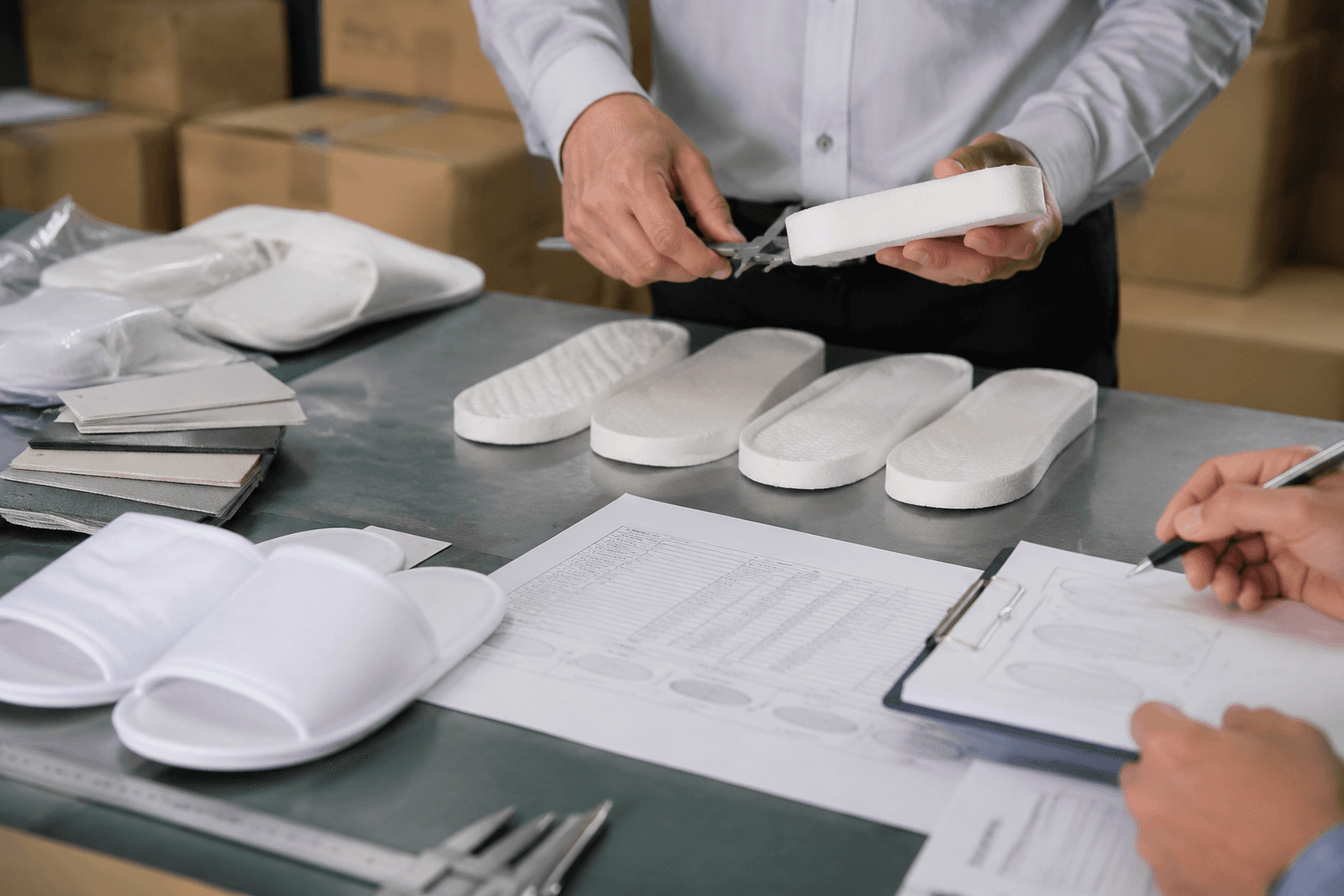
The buyer decision is simple to state but easy to quote badly: what finished EVA sole thickness for disposable hotel slippers fits the actual room use, price target, packing method, and inspection plan? A useful RFQ does not ask for a comfortable hotel slipper. It states the finished outsole thickness in millimeters, the measurement points, the tolerance, the upper material, the outsole texture, the packaging, and the documents the supplier must provide.
Methodology: this article combines RFQ fields commonly needed for disposable hotel slipper procurement with public source contexts including ISO 2859-1:1999 for acceptance-sampling terminology, ASTM D3575 for flexible cellular olefin foam test vocabulary, EU REACH Annex XVII for restricted-substance document context, and California Proposition 65 for destination-market warning and chemical-document context. Commercial quantities, lead times, tolerances, and carton volumes are marked as July 2026 example assumptions or example calculations to verify in the current supplier quote.
- Use finished EVA outsole thickness, not raw sheet thickness, as the quoted value.
- Tie the thickness choice to the use area: dry guest room, bathroom-adjacent area, spa locker, serviced apartment, retail pack, or recovery shipment.
- Make suppliers quote the same size, upper fabric, outsole texture, construction method, packing method, carton quantity, and document list.
- Require written exceptions when a requested tolerance, texture, thickness range, MOQ, or packing format is not available.
Thickness as a Commercial Choice
EVA sole thickness for disposable hotel slippers changes more than comfort. It affects EVA foam usage, pair weight, packed height, carton count, freight exposure, sample approval, and complaint risk. A lower unit price can be poor value if the slipper arrives thin, curled, over-compressed, or inconsistent with the hotel tier.
For a dry bedside amenity, the buyer may accept a thinner outsole if storage space, landed cost, and carton efficiency are the main constraints. For spa-adjacent or upgraded rooms, the buyer usually needs a more substantial hand feel, a cleaner edge profile, stronger shape recovery after packing, and closer review of outsole texture.
The practical choice is not the thickest possible sole. It is the thinnest finished outsole that still fits the room position, floor exposure, packing format, target landed cost, MOQ, and inspection standard.
- Dry-room program: prioritize compact packing, predictable cost, clean upper attachment, and acceptable hand feel.
- Bathroom-adjacent program: add outsole texture review, bonding checks, and destination-market document review.
- Spa or locker program: check thicker outsole feel, damp-floor risk, shape recovery, and edge finish.
- Retail or private-label program: check presentation after unpacking, barcode or insert-card fit, and cosmetic consistency.
- Air-freight recovery order: avoid extra outsole bulk unless the room-use requirement justifies the volumetric cost.
Thickness Ranges to Quote
Budget dry-room reference: 3 mm to 4 mm finished EVA outsole thickness is a July 2026 example RFQ assumption for one disposable hotel slipper SKU used in dry guest-room amenity programs, to verify with the supplier. Scope: finished outsole after production and normal packing, measured at buyer-defined heel and forefoot points. Source context: RFQ planning assumption, not a public standard or capacity claim.
Mid-range reference: 5 mm to 6 mm finished EVA outsole thickness is a July 2026 example RFQ assumption for one open-toe or closed-toe disposable hotel slipper SKU where the buyer wants better hand feel without moving into a bulky premium pack, to verify with the supplier. Scope: selected upper material, selected outsole texture, and individual packing as quoted. Source context: RFQ planning assumption.
Upgraded reference: 7 mm to 8 mm finished EVA outsole thickness is a July 2026 example RFQ assumption for suite slippers, spa-adjacent slippers, serviced apartments, or private-label hospitality packs, to verify with the supplier through samples and carton data. Scope: finished outsole, not loose EVA sheet thickness. Source context: RFQ planning assumption.
A quote that says only 5 mm EVA sole is incomplete. Ask whether the number covers EVA foam only, EVA plus textile backing, a laminated outsole stack, or the finished outsole after construction. Heel, forefoot, toe edge, and side edge can measure differently after die cutting, stitching, bonding, lamination, and packing.
- Budget RFQ line: finished EVA outsole thickness 3 mm to 4 mm, July 2026 example RFQ assumption for dry guest-room use, measured at heel and forefoot after production and normal packing, tolerance to be confirmed.
- Mid-range RFQ line: finished EVA outsole thickness 5 mm to 6 mm, July 2026 example RFQ assumption for upgraded dry-room use, textured bottom surface, upper material and color specified, individual packing specified.
- Upgraded RFQ line: finished EVA outsole thickness 7 mm to 8 mm, July 2026 example RFQ assumption for suite, spa-adjacent, or private-label use, outsole texture sample required, carton packing confirmed before order approval.
- Ask whether the outsole is single-layer EVA, laminated EVA, EVA plus sponge, EVA with textile backing, or EVA with an added texture layer.
- Request a sample pair from the exact thickness, upper fabric, outsole color, outsole texture, logo process, and packaging combination quoted for bulk production.
Upper Materials and Sole Construction
Importers often compare EVA thickness while leaving the upper vague. That creates weak quotes because a non-woven upper, terry upper, waffle upper, velvet upper, and coral fleece upper do not have the same hand feel, packed height, logo options, or perceived room tier.
Construction also matters. Stitched-edge slippers, bonded-upper slippers, piped-edge slippers, laminated outsole slippers, and paper-band retail packs can all use EVA, but they do not fail in the same way during inspection. The RFQ should connect EVA outsole thickness with the upper material, edge finish, toe opening, outsole texture, and individual packing method.
For low-competition search intent such as EVA sole thickness for disposable hotel slippers with terry upper or disposable hotel slipper MOQ with custom logo, the useful answer is the same: define the exact component stack before asking for price.
- Non-woven upper: usually quoted for basic dry-room amenities; verify edge finish, bonding, and packed shape recovery.
- Terry or waffle upper: often used when the buyer wants a more textile-like feel; verify fabric weight, color consistency, logo method, and carton compression.
- Velvet or coral fleece upper: can support an upgraded presentation; verify lint, odor, shade matching, toe-opening shape, and package recovery.
- Printed upper: confirm print method, artwork size, color limit, plate or setup charge, ink document availability, and MOQ impact.
- Embroidered or woven-label logo: confirm stitch density, label placement, upper distortion, sample timing, and whether MOQ changes by logo version.
RFQ Fields That Stop Price Confusion
Non-comparable quotes usually start with missing fields. One supplier may quote a thinner stock outsole, another may quote a different upper, and a third may include packaging that the first two excluded. The unit prices look comparable, but the products are not.
Put the sole details inside the specification table. A useful tolerance line could read: finished EVA outsole thickness tolerance +/-0.5 mm at heel and forefoot, stated as a July 2026 example QA assumption for one disposable hotel slipper inspection plan, to verify with the supplier. Unit: millimeters. Scope: finished outsole after production and normal packing. Source context: QA planning assumption because EVA compression, cutting method, lamination, stitching, bonding, and measurement tools affect results.
If the supplier cannot hold the requested range, get the exception before sampling. A written reply such as available tolerance +/-0.8 mm or measured before lamination is more valuable than a low quote that fails inspection later.
- Product type: open-toe or closed-toe disposable hotel slipper, room tier, and intended use area.
- Size: outsole length and width in millimeters or centimeters, target fit market, and one-size or multi-size requirement.
- Outsole thickness: nominal finished EVA thickness in millimeters, heel and forefoot measurement points, tolerance, and finished-product measurement basis.
- Outsole material: EVA color, single-layer or laminated structure, bottom texture, density or hardness reference if the supplier can document it, and any recycled-content claim with evidence.
- Upper material: non-woven, terry, waffle, velvet, coral fleece, or selected alternative, with color and logo process.
- Construction: stitched edge, bonded upper, piping, trim, toe shape, edge smoothness, and acceptable cosmetic variation.
- Packaging: individual polybag, paper band, bulk pack, insert card, barcode, carton marks, export carton quantity, and buyer-required warnings or labels.
- MOQ: minimum quantity by SKU, size, color, EVA color, upper material, logo version, packaging version, and carton-mark version.
RFQ Text to Send
Use direct wording and force exceptions into the quote. The supplier should not have to guess whether EVA sole thickness means raw sheet, finished outsole, or laminated stack.
If the supplier proposes another thickness, upper fabric, logo process, or packing method, ask for it as a separate line item with its own unit price, MOQ, carton data, sample time, production time, and document list.
- Please quote disposable hotel slippers with finished EVA outsole thickness of [3 mm to 4 mm / 5 mm to 6 mm / 7 mm to 8 mm], stated as July 2026 example RFQ ranges to verify, measured at heel and forefoot after production and normal packing.
- Please state thickness tolerance in millimeters and confirm whether measurement is for finished outsole, pre-cut EVA sheet, laminated outsole stack, or EVA plus textile backing.
- Please quote upper material as [non-woven / terry / waffle / velvet / coral fleece], color [buyer color], logo method [none / embroidery / print / woven label], and outsole texture [supplier to describe and photograph].
- Please confirm construction method: stitched edge, bonded upper, piping, laminated EVA, single-layer EVA, or other supplier-defined construction.
- Please confirm MOQ by SKU, color, size, logo version, EVA color, outsole texture, and packaging version. If custom EVA color or printed upper changes MOQ, show the minimum separately.
- Please provide sample cost, counter-sample time in calendar days, production lead time in calendar days after approved sample and deposit, and quote validity date.
- Please provide pairs per carton, carton length x width x height in centimeters, gross weight, net weight, carton marks, and loading estimate for the quoted quantity.
- Please list available documents for the EVA outsole, textile upper, print or ink where relevant, and packaging materials. Documents must match the actual material, color, order date, and destination-market requirement.
MOQ and Sample Approval
Disposable hotel slippers MOQ follows the way the supplier must set up materials and packing. EVA color, upper material, die-cutting setup, logo process, print plate, embroidery setup, packaging print, carton marks, and size split can each change the minimum.
Stock construction planning: 3,000 pairs per SKU is a July 2026 example RFQ assumption for stock EVA color, stock upper material, one packaging method, and no custom upper print, to verify with the supplier. Unit: pairs. Scope: one SKU definition agreed by buyer and supplier. Source context: RFQ planning assumption.
Customized construction planning: 5,000 to 10,000 pairs per SKU is a July 2026 example RFQ assumption for custom upper printing, private-label insert cards, special EVA color, buyer-specific carton marks, or separate packaging versions, to verify with the supplier. Unit: pairs. Scope: one SKU definition agreed by buyer and supplier. Source context: RFQ planning assumption.
Timing reference: 5 to 7 calendar days for a counter sample and 25 to 35 calendar days for mass production are July 2026 example RFQ assumptions to verify with the supplier. Scope: counter sample after artwork, size, upper material, outsole thickness, outsole texture, and packaging direction are confirmed; mass production after approved sample and deposit for an order within the example 3,000 to 10,000 pairs per SKU planning range.
- Ask whether MOQ is counted per SKU, EVA color, upper color, size, logo, outsole texture, packaging version, or purchase order.
- Request a physical sample in the quoted thickness instead of accepting a similar reference slipper.
- Approve sole thickness, upper touch, outsole texture, pair weight, logo position, packaging fit, carton label, and carton quantity together.
- Freeze artwork before sample approval when the order includes printed uppers, woven labels, paper bands, insert cards, barcodes, or custom cartons.
- Keep the approved sample and packaging proof for repeat orders so the next production run does not drift into a thinner outsole or different carton pack.
Carton and Freight Check
EVA sole thickness can move cost from the unit price into freight. A thicker outsole may reduce pairs per carton, increase carton height, or force stronger compression. Those changes matter when slippers ship with bathrobes, towels, or other hotel amenities.
Carton example: 100 pairs per export carton in a carton measuring 60 cm x 40 cm x 50 cm equals 0.12 m3 per carton. This is a July 2026 example calculation to verify with actual supplier carton dimensions. Scope: carton length multiplied by width multiplied by height, divided by 1,000,000 cm3 per m3.
Order example: 10,000 pairs packed at 100 pairs per carton equals 100 cartons and 12 m3 gross carton volume before pallets, loading loss, or mixed-SKU consolidation. This is a July 2026 example calculation to verify in the current quote. Scope: 10,000 pairs divided by 100 pairs per carton, then multiplied by 0.12 m3 per carton.
Compression is a product-risk issue, not only a freight issue. Over-tight packing can bend uppers, flatten toe openings, curl outsole edges, or make retail packs look damaged after unpacking.
- Request carton length, width, height, gross weight, net weight, pairs per carton, and carton-mark draft.
- Ask whether individual polybags are flat, folded, sealed, vented, printed, or warning-labeled.
- Check whether thicker EVA causes curved uppers, crushed toe openings, compressed toe shape, or uneven stacking.
- For private-label packs, confirm whether insert cards, paper bands, hang holes, or retail barcodes reduce master-carton quantity.
- Ask for loading estimates by shipment mode when the order ships with bathrobes, towels, amenities, or mixed hotel-supply cartons.
QC Points Linked to Thickness
Inspection should not stop at visual matching. Finished outsole thickness, outsole texture, upper alignment, bonding or stitching, edge finish, carton count, and recovery after unpacking all connect to the EVA sole thickness choice.
Thin soles need checks for waviness, sharp edges, weak shape retention, and a hand feel that may not match the room tier. Thick soles need checks for uneven cutting, weak bonding, bulky folding, edge curl, and packing deformation.
ISO 2859-1:1999 may be used as a vocabulary source for acceptance sampling when buyer and supplier agree inspection level and acceptance criteria. It is not a disposable hotel slipper certification and does not replace a product-specific defect list.
- Thickness check: measure heel and forefoot on finished goods using the agreed tool, tolerance, and sampling plan.
- Pair matching check: compare left and right slipper thickness, outsole length, outsole width, and upper alignment.
- Bonding check: inspect whether the upper and EVA outsole separate when the slipper is flexed lightly by hand.
- Surface check: compare EVA pits, dents, color inconsistency, rough outsole edge, texture mismatch, and contamination against the approved sample.
- Packing check: open a production carton, count pairs, inspect shape recovery, check inner-pack method, and verify carton marks.
- Odor and cleanliness check: flag abnormal odor, stained upper material, loose thread, adhesive residue, and mixed colors or sizes.
- Document check: match test reports and material declarations to the product name, material, color, order date, and destination market.
Documents and Standards
EVA thickness does not answer chemical, labeling, or market-entry questions. Depending on the destination market and sales channel, the document set may include a material composition declaration, restricted-substance test report, phthalate screening for plastic components where relevant, azo dye report for dyed textile uppers where relevant, heavy metal screening for printed components where relevant, and packaging material declaration.
EU REACH Annex XVII and California Proposition 65 are regulatory-document contexts buyers often reference for goods entering those markets. Naming either one in an RFQ does not prove compliance. ASTM D3575 may help describe flexible cellular olefin foam test vocabulary, but it does not replace finished-product inspection or order-specific document review.
When a supplier claims compliance or certification, request the current certificate or report and check the product scope, issuing body, test date, material name, color, component coverage, and destination-market relevance. A report for another EVA color, another upper fabric, or a previous order should not be accepted without review.
- EVA outsole: request material declaration and relevant restricted-substance report tied to the quoted EVA material and color.
- Textile upper: request composition and restricted-dye or colorfastness documents when required by the buyer's market, sales channel, or hotel policy.
- Printed logo: request ink or print-process documents when the print touches skin or when packaging compliance matters.
- Packaging: request polybag warning text, recycling marks, barcode format, carton marks, and destination-specific labeling requirements.
- Claims: avoid eco, non-slip, antibacterial, recycled, or certified wording unless a current document supports the exact product, component, material, color, and order.
Quote Review
After quotations arrive, compare missing fields before comparing price. A lower unit price is not useful if the quote omits tolerance, substitutes the upper material, lowers pairs per carton, excludes packaging, or uses a different MOQ definition.
Build the comparison around unit price by quantity, finished outsole thickness, tolerance, upper material, outsole texture, size, packaging, pairs per carton, carton volume, gross weight, sample time, production time, document list, and quote validity. Clarify every blank cell before sample payment or deposit.
- Confirm quote date and validity period.
- Check that outsole thickness is finished-product thickness in millimeters, not raw EVA sheet thickness.
- Check whether the supplier quoted the requested upper or substituted a cheaper fabric.
- Check whether construction is stitched, bonded, laminated, piped, or otherwise changed from the requested sample.
- Check whether packaging is individual polybag, paper band, bulk pack, or retail pack, and whether printing is included.
- Check whether carton volume changes between thickness options.
- Check whether sample cost is refundable, credited to bulk order, or charged separately.
- Check whether production lead time starts after deposit, approved sample, artwork approval, document approval, or material arrival.
Limits to Verify Before PO
This guide gives procurement structure, not a universal technical standard for hotel slipper thickness. No single public rule makes one EVA thickness correct for every disposable hotel slipper. The right specification depends on room class, guest path, floor surface, moisture exposure, packaging, landed-cost target, and defect tolerance.
Every commercial number in this guide is a July 2026 example RFQ assumption or example calculation to verify in the supplier quote. These figures are not claims about SlipperForge production capacity, market-wide pricing, certified performance, or guaranteed lead time.
Before issuing a purchase order, verify the actual EVA sheet, finished outsole thickness, tolerance, upper material, pair weight, odor condition, outsole texture, sample appearance after packing, carton dimensions, gross weight, document scope, and destination-market requirements.
- Verify supplier quote date, SKU definition, size mix, color count, artwork version, packaging version, and shipment term.
- Verify whether the same thickness can be maintained across all sizes in the order.
- Verify whether thicker EVA changes carton loading, gross weight, volumetric exposure, and freight quote.
- Verify whether compliance documents cover the exact upper, EVA outsole, printing, and packaging used in the order.
- Verify whether any claimed standard, test, or certification document is current, relevant to the exact product, and issued for the correct material and color.
- For repeat programs, keep the approved sample, packaging proof, inspection checklist, and test-document file together.
FAQ
How should I specify EVA sole thickness for disposable hotel slippers in an RFQ? Specify finished EVA outsole thickness in millimeters, not raw EVA sheet thickness. The RFQ should state heel and forefoot measurement points, tolerance, upper material, outsole texture, construction method, packaging, MOQ basis, sample approval steps, QC checklist, and required documents.
Is 3 mm to 4 mm EVA sole thickness enough for disposable hotel slippers in guest rooms? The 3 mm to 4 mm range is a July 2026 example RFQ assumption for one dry guest-room disposable hotel slipper SKU, to verify with the supplier. It may suit a basic amenity program where low carton volume and cost control matter, but the buyer should confirm upper material, outsole texture, finished thickness tolerance, packed-sample recovery, and carton data before bulk approval.
When should a buyer choose 5 mm to 8 mm EVA outsole thickness? The 5 mm to 8 mm range is a July 2026 example RFQ assumption for upgraded guest rooms, spa-adjacent areas, serviced apartments, or private-label hospitality packs, to verify with the supplier. Buyers should check carton volume, pair weight, packaging fit, edge finish, shape recovery, and bonding because thicker EVA can increase bulk and reveal construction defects.
Does thicker EVA make disposable hotel slippers non-slip? No. Slip performance depends on outsole texture, EVA formulation, floor condition, moisture, wear, and inspection criteria. Thickness can change perceived substance, but buyers should review outsole texture, request relevant documents, and define inspection checks instead of treating thickness as a non-slip claim.
What MOQ should an importer expect for disposable hotel slippers with specified EVA thickness? As July 2026 example RFQ assumptions to verify, 3,000 pairs per SKU may be used for stock EVA color, stock upper material, and simple individual packing, while 5,000 to 10,000 pairs per SKU may be used for custom upper print, private-label inserts, special EVA color, or custom packing. The buyer must confirm whether MOQ is counted by SKU, color, size, artwork, EVA color, outsole texture, or packaging version.
What carton data should I request when comparing EVA thickness options? Request pairs per carton, carton length, width, and height in centimeters, gross weight, net weight, carton marks, packing method, and loading estimate. As a July 2026 example calculation to verify, 100 pairs in a 60 cm x 40 cm x 50 cm carton equals 0.12 m3 per carton, and 10,000 pairs at that pack rate equals 100 cartons and 12 m3 before pallets or loading loss.