
Start With the Buying Problem
A buyer searching for a closed toe vs open toe hotel slippers cost comparison is usually deciding what to approve for a room program, not learning the basic definitions. The decision must hold price, guest feel, housekeeping workflow, carton space, inspection risk, and documents together.
The first choice is whether the property values coverage or ventilation more. Closed toe hotel slippers suit colder floors, bathrobe sets, suite placement, and a more private in-room feel. Open toe hotel slippers suit spa areas, humid climates, post-shower use, and rooms where guests step in and out quickly.
The second choice is whether the quotation is clean enough to trust. If one supplier quotes a closed toe slipper with thicker EVA and embroidery while another quotes a basic open toe slipper with a thinner sole and bulk pack, the comparison is unusable.
Visible byline: Vincent Xi, Editorial Author, https://slipperforge.com/authors/vincent-xi/. This article uses the SlipperForge author profile for editorial attribution only. It does not claim factory visits, laboratory testing, certifications, awards, client results, or first-person purchasing experience.
- Buyer decision: choose the guest-use priority before negotiating small price differences.
- Quote control: keep material, EVA sole, logo, packing, and carton fields matched.
- Risk control: reject any comparison where the cheaper option also changes hidden specifications.
- Purchase output: approve the style with the best verified landed cost per usable pair.
What Changes Between Closed Toe and Open Toe
Closed toe hotel slippers change the front-foot experience. The covered vamp can feel warmer and more private, but it adds toe-shape checks, seam checks, and packed-shape risk.
Open toe hotel slippers change entry and ventilation. The foot enters faster and dries more easily after showering, but the strap must hold the foot without skewing, loosening, or letting the foot slide too far forward.
The style decision should not be treated as a quality decision by itself. A well-built open toe slipper can feel better than a poorly shaped closed toe slipper. A properly specified closed toe slipper can look more appropriate than a basic open toe slipper in a premium room.
Use the room as the test environment. Smooth tile, cold bathroom floors, spa flooring, humidity, storage time, and housekeeping handling all affect which style feels right.
- Closed toe strengths: coverage, warmth, privacy, suite presentation, bathrobe pairing.
- Closed toe risks: toe cap distortion, inner seam pressure, higher packed height, left-right shape mismatch.
- Open toe strengths: ventilation, fast entry, flatter packing potential, spa fit, warm-climate fit.
- Open toe risks: strap skew, weak attachment, off-center logo, forefoot slide, exposed stitching.
RFQ Fields That Stop False Savings
Write the RFQ as a controlled comparison. Ask the supplier to quote closed toe and open toe versions using the same upper textile, outsole material, sole thickness, outsole length, logo method, inner packing, and export carton quality.
Use measurement fields that can later appear on the inspection checklist. An adult hotel slipper may use 28.0 cm outsole length as an example dimension to verify in the supplier quote. Buyers should also request forefoot width in centimeters, sole thickness in millimeters, pair weight in grams, logo size in centimeters, carton weight in kilograms, and carton dimensions in centimeters.
Fix the logo method before asking for final price. Embroidery, woven label, heat transfer, printed logo, and debossed outsole marking do not create the same labor, setup charge, defect risk, or material compatibility.
Fix the inner packing before price approval. A bulk pack, paper band, paper sleeve, polybag, and nonwoven pouch create different unit cost, warehouse work, presentation effect, and sustainability review issues.
- Specify style: closed toe and open toe quoted side by side.
- Specify adult outsole length, with 28.0 cm used only as an example dimension to verify.
- Specify EVA sole material and sole thickness in millimeters at the measurement point.
- Specify upper textile, such as waffle fabric, terry, coral fleece, velvet, nonwoven fabric, or cotton-blend fabric where applicable.
- Specify lining, edge binding, piping, color reference, and fabric weight if available.
- Specify logo method, logo dimensions, artwork version, placement, and placement tolerance.
- Specify pair weight, inner packing, export carton material, pairs per carton, carton dimensions, gross weight, and net weight.
- Specify document list, sample lead time, bulk lead time, MOQ per SKU, and any setup charge.
Cost Questions Worth Asking
Ask what part of the cost changes because of toe construction. Closed toe may use more upper fabric and require more shaping work. Open toe may save fabric but require careful strap placement, stitching, and edge binding.
Ask what part of the cost comes from the sole. A 3 mm EVA sole, 4 mm EVA sole, and 5 mm EVA sole are different specifications. A buyer looking for savings should compare sole thickness changes separately from toe style changes.
Ask what part of the landed cost comes from packing. Open toe slippers can pack flatter, but printed sleeves, nonwoven pouches, or oversized individual bags can increase carton cube. Closed toe slippers can look more premium, but tight packing can crush the vamp and create rejection risk.
Example calculation to verify in the current supplier quote: if a closed toe upper uses 10 percent more textile area per pair and the upper textile accounts for 25 percent of the finished unit cost, the textile-area change equals 2.5 percent of finished unit cost before labor, waste, overhead, packaging, and margin.
- Ask for the assumed upper material and fabric weight.
- Ask where EVA thickness is measured and whether it is measured before compression.
- Ask whether logo setup, embroidery program, plate, mold, or artwork charges are included.
- Ask which packing format is included in the quoted unit price.
- Ask how many pairs fit per export carton under the quoted packing method.
- Ask which documents are included and which require new testing or extra cost.
MOQ and Lead Time Are Specification Issues
MOQ rises when customization adds separate components. Custom color, custom binding, embroidery, printed sleeves, special carton marks, or multiple sizes can make the closed toe versus open toe decision less important than the number of changed parts.
Planning assumption to verify as of the 2026-07-20 supplier quote: stock or lightly customized hotel slipper programs may be discussed around 1,000 to 3,000 pairs per SKU. Custom color, logo, and packaging programs may be discussed around 3,000 to 10,000 pairs per SKU. Treat these as RFQ planning ranges, not promised minimums.
Sample timing should be separated from bulk timing. Planning assumption to verify in the supplier schedule: a standard sample may take 5 to 10 business days after artwork and material confirmation, while bulk production may take 20 to 35 calendar days after approved sample and deposit. Freight, customs, and destination warehouse booking are separate schedule lines.
Approve the physical sample, not the photo. Closed toe samples need toe height, seam comfort, shape recovery, and left-right matching checks. Open toe samples need strap angle, strap centering, strap attachment, and walking feel checks.
- Confirm MOQ per style, color, logo, size, and packaging version.
- Ask whether both styles can share the same outsole and upper textile to reduce component pressure.
- Ask whether stock waffle fabric, terry fabric, EVA sheet, binding tape, or paper sleeves are available for the target delivery window.
- Keep one sealed approved sample for final inspection reference.
- Tag the sample with date, version, size, outsole length, sole thickness, material, logo version, and packing method.
- Separate sample lead time, production lead time, freight transit, customs clearance, and warehouse appointment time.
Property Fit
City business hotels should test closed toe slippers when bathroom floors are cold, guest stays are longer, or bathrobes are part of the room setup. The buyer still needs to check that the toe cap is not bulky or crushed after storage.
Beach resorts and spa properties should test open toe slippers when ventilation and post-shower use matter more than coverage. The strap must be strong enough to keep the slipper stable on smooth floors.
Economy and short-stay properties often care most about unit cost, packing density, and quick housekeeping placement. Open toe may be easier to justify, but only if the sole is not downgraded below the guest comfort target.
Multi-property groups may use both styles by room tier or season. That can improve fit but adds SKU complexity, carton-label checks, warehouse picking rules, and reorder planning.
- Suite amenity: test closed toe with robe, mat, and bathroom layout.
- Spa or poolside room: test open toe for quick entry and moisture feel.
- Cool-climate room: test closed toe for warmth and floor comfort.
- Warm-climate room: test open toe for ventilation.
- Mixed program: calculate the operational cost of extra SKUs before approval.
Inspection Language Before Production
The purchase order should define what will be inspected before goods are made. Soft textiles and EVA move under pressure, so the tolerance must state the measurement point and whether the measurement is taken before or after compression.
Example tolerance package to verify with the supplier and inspection company: outsole length tolerance of plus or minus 0.5 cm per pair, logo placement tolerance of plus or minus 0.3 cm from the approved sample position, and zero shortage in pair count per sealed export carton. These are example inspection assumptions, not universal limits.
Closed toe inspection should focus on toe symmetry, upper height, toe-box smoothness, inner seam comfort, binding cleanliness, left-right matching, and recovery after packing.
Open toe inspection should focus on strap centering, strap lift, strap stitching, forefoot coverage, edge binding, logo centering, and whether the foot slides forward during a short walking check.
For both styles, check size, sole thickness, pair weight, color, odor, stains, thread trimming, bonding, packing count, carton marks, and any metal-control requirement in the buyer's policy. If AQL sampling is used, state the inspection level and acceptable quality limits in the purchase order or inspection booking.
- Closed toe reject risk: crooked toe cap or left-right shape mismatch.
- Closed toe reject risk: bulky inner seam touching the foot.
- Closed toe reject risk: toe upper crushed after carton compression.
- Open toe reject risk: skewed strap or off-center strap logo.
- Open toe reject risk: weak strap attachment or loose binding.
- Open toe reject risk: insufficient forefoot coverage causing slide-forward feel.
- Shared reject risk: sole substitution, odor, stains, loose threads, poor bonding, wrong count, or incorrect carton mark.
Carton Cube and Landed Cost
Hotel slippers are space-sensitive goods. The buyer should request carton dimensions, pairs per carton, gross weight, net weight, and packing method before final price approval.
Example calculation to verify in supplier packing data as of the 2026-07-20 quote: a 60 cm by 40 cm by 50 cm carton has a volume of 0.12 cubic meters. If 80 pairs fit in that carton, cube is 0.0015 cubic meters per pair. If 100 pairs fit, cube is 0.0012 cubic meters per pair. Freight impact depends on shipping mode, freight rate basis, palletization, and destination handling.
Packing should match the property policy. Bulk pack or paper bands may suit a cost-controlled hotel program. Paper sleeves, nonwoven pouches, or individual bags may suit premium presentation but can increase cost and carton volume.
Carton marks should be approved before printing. Importers and distributors should confirm item code, style, size, color, quantity, carton number, gross weight, net weight, carton dimensions, country of origin where required, and destination warehouse reference where needed.
- Request carton length, width, and height in centimeters.
- Calculate carton volume in cubic meters from confirmed dimensions.
- Request gross weight and net weight in kilograms per export carton.
- Confirm pairs per carton and packing method: flat-packed, nested, bundled, sleeved, or individually packed.
- Check closed toe shape recovery after packed storage.
- Compare landed cost per usable pair, not only ex-works unit price.
Documents and Standards
Document needs depend on destination market, buyer policy, product use, material composition, packaging, and sales channel. A hotel amenity and a retail slipper may not have the same review path.
Common documents may include commercial invoice, packing list, product specification sheet, material declaration, artwork approval, certificate of origin where applicable, and test reports if required by buyer policy or destination rules.
Restricted-substance frameworks such as EU REACH may be relevant for shipments into the European Union. Naming the framework is not enough. The buyer must check whether the report covers the actual upper textile, outsole, adhesive, logo ink, label, sleeve, bag, and packaging used for the approved sample.
Private-label packaging often creates gaps. A slipper may have acceptable material documents while the printed sleeve, logo ink, woven label, or adhesive has not been reviewed. Keep document review tied to the final approved sample, not to a generic material description.
- State destination market and product use in the RFQ.
- Ask for current documents, not expired or unrelated reports.
- Separate legal requirements from buyer-policy requirements.
- Confirm fiber content and label expectations before printing packaging.
- Check report scope, issue date, lab name, covered materials, and validity period.
- Do not treat a standard name as proof of certification.
RFQ Language to Use
Use direct wording that forces a matched quote: please quote closed toe and open toe hotel slippers using the same upper textile, same outsole material, same sole thickness, same outsole length, same logo method, same inner packing, and same export carton quality. Please identify any field that cannot be matched and explain the price, MOQ, lead-time, or carton effect.
Ask for price tiers that match the likely buying volume. Example RFQ quantities to verify in the supplier quote: 3,000 pairs, 5,000 pairs, and 10,000 pairs per style. These are comparison tiers, not guaranteed MOQ levels.
Ask the supplier for one cost-down option per style without changing the guest-use purpose. The answer may show whether the real saving comes from toe construction, sole thickness, logo simplification, standard fabric color, simpler packing, or better carton loading.
- Confirm outsole length, forefoot width, sole thickness, pair weight, and measurement tolerance.
- Confirm logo method, logo size, artwork version, placement, and setup charge.
- Confirm inner packing, export carton dimensions, pairs per carton, gross weight, and net weight.
- Confirm sample cost, sample lead time, bulk lead time after approval, MOQ, and payment terms.
- List documents available before shipment and identify any report requiring new testing or added cost.
- Confirm that a sealed approved sample will be used as the inspection reference.
Decision by Buyer Type
Importers should choose by landed cost and document readiness. Open toe may reduce cube, but only confirmed carton data and inspection risk prove the saving. Closed toe may justify higher cost for premium programs if shape recovery and defect controls are acceptable.
Distributors should choose by reorder stability and warehouse clarity. Open toe can be easier to stock in high volume. Closed toe can serve higher-tier hotel accounts. The deciding factors are carton marks, picking rules, mixed-carton policy, and replenishment lead time.
Retail buyers should choose by presentation and return risk. Closed toe can feel more comfort-led in a gift set. Open toe can feel more spa-led. Test the final box, sleeve, pouch, or bundle because the customer sees the complete product, not the RFQ sheet.
Hotel procurement managers should involve housekeeping before approval. Housekeeping can judge unpacking speed, room placement, storage appearance, and whether guests may complain about damp feel, poor coverage, unstable walking, or crushed shape.
- Importer priority: landed cost, carton cube, document readiness, inspection result, and SKU plan.
- Distributor priority: reorder consistency, carton marks, account segmentation, warehouse picking, and replenishment terms.
- Retail buyer priority: packaging fit, hand feel, logo execution, shelf presentation, and return-risk reduction.
- Hotel procurement priority: guest comfort, housekeeping workflow, complaint prevention, and budget control.
- Brand founder priority: private-label differentiation without unnecessary tooling or fragile specifications.
Buying Recommendation
Request one matched closed toe sample and one matched open toe sample from the same supplier. Keep outsole length, sole thickness, upper fabric, logo method, and packing method identical wherever possible.
For budget programs, warm climates, spas, and short-stay rooms, start with open toe samples because ventilation and carton efficiency may matter more than coverage. For cooler climates, suites, long-stay rooms, and bathrobe-paired amenities, start with closed toe samples because covered-foot comfort may matter more.
Before purchase order release, collect the signed specification sheet, approved physical sample, logo artwork, packing method, carton data, carton marks, inspection checklist, required document list, MOQ, and production schedule.
The practical answer is this: closed toe supports coverage and privacy with higher shape and packing control needs; open toe supports ventilation and possible carton efficiency with higher strap and fit control needs. The supplier should prove the difference with matched samples, written tolerances, carton data, and current documents.
- Shortlist both styles under the same baseline specification.
- Run a wear check on the actual floor surface where guests will use the slippers.
- Ask housekeeping to test unpacking, placement, and storage appearance.
- Compare landed cost per usable pair after freight, inspection, document charges, and expected rejection risk.
- Approve tolerances and carton data in writing before production.
- Keep one sealed production sample for final inspection reference.
Evidence and Verification
This article uses the SlipperForge Vincent Xi author profile for byline attribution and common procurement-document practice for RFQ structure. The method is to convert a style preference into measurable fields: construction, material, EVA sole, logo, packaging, carton data, lead time, documents, inspection points, and guest-use fit.
The numerical examples are not market promises. The 60 cm by 40 cm by 50 cm carton example equals 0.12 cubic meters by length multiplied by width multiplied by height. The 80-pair and 100-pair carton scenarios show cube per pair for comparison only. The 1,000 to 3,000 pairs per SKU and 3,000 to 10,000 pairs per SKU MOQ ranges are planning assumptions to verify with the current supplier quote.
Before purchase order release, verify material stock, final MOQ, sample lead time, bulk lead time, logo setup cost, sample version, tolerance acceptance, carton dimensions, carton weight, document availability, test-report scope where required, and inspection method. If any field is missing, the closed toe versus open toe decision is not ready.
- Source context: Vincent Xi author profile for editorial attribution.
- Source context: RFQ, specification, packing list, invoice, inspection, artwork approval, and material-declaration practices used in procurement workflows.
- Method: translate style choice into measurable quote, sample, packing, document, and QC fields.
- Limitation: supplier-specific price, MOQ, lead time, carton data, and compliance status must be verified in current documents.
Editorial Image Brief
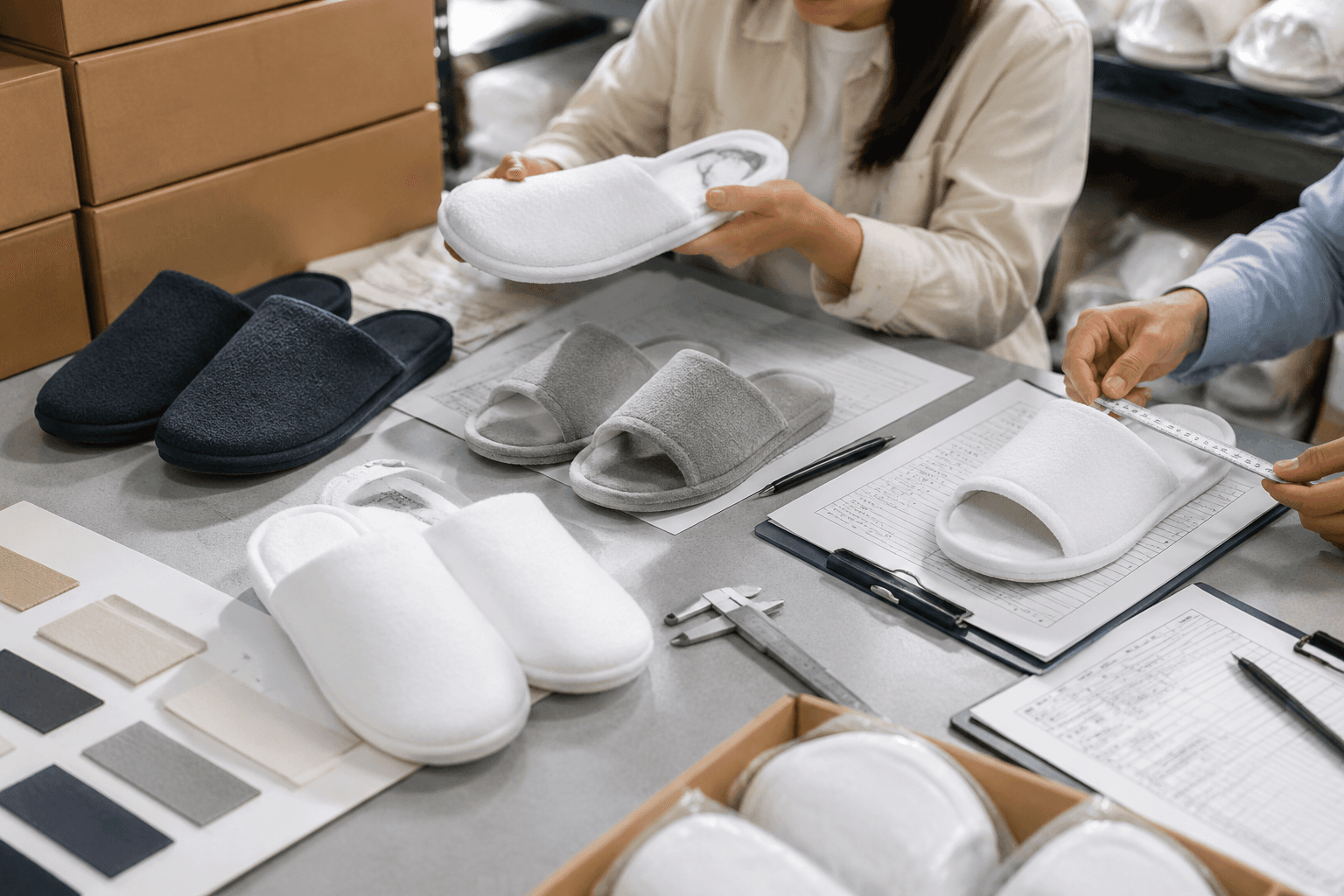
Create a realistic procurement image on a clean inspection table. Show one pair of closed toe hotel slippers on the left and one pair of open toe hotel slippers on the right. Both pairs should use the same neutral white waffle textile and similar light EVA outsole so the only obvious difference is toe construction.
Add sourcing details that a buyer would actually inspect: a centimeter ruler along the outsole, a caliper at the sole edge, a small stack of plain paper sleeves, and one plain export carton partly visible behind the slippers. The carton should have no readable brand, address, certification mark, or company name.
Keep the image bright, neutral, and product-focused. Avoid people, lifestyle staging, watermarks, fake logos, fake certificates, readable labels, and machinery.
- Product focus: matched closed toe and open toe hotel slipper pairs.
- Scene focus: RFQ and QC comparison on an inspection table.
- Measurement cues: centimeter ruler, caliper, packing sleeves, carton context.
- Style: realistic sourcing photography with accurate proportions and no branding.
FAQ
In a closed toe vs open toe hotel slippers cost comparison, which style is cheaper? Open toe hotel slippers can be cheaper when upper textile, outsole length, EVA sole thickness, logo method, packing type, and carton quality are identical because the construction may use less upper coverage and may pack flatter. This is not guaranteed. A premium open toe terry slipper with embroidery and a thicker EVA sole can cost more than a basic closed toe nonwoven slipper. Ask for matched quotes before deciding.
What MOQ should buyers expect for custom hotel slippers? As a planning assumption to verify in the current supplier quote, stock or lightly customized hotel slippers may be discussed around 1,000 to 3,000 pairs per SKU. Custom color, logo, and packaging programs may be discussed around 3,000 to 10,000 pairs per SKU. MOQ changes by material stock, logo method, packaging version, size range, and production schedule.
Are closed toe slippers better for premium hotel rooms? Closed toe slippers can be a stronger candidate for premium rooms because they give more coverage and can feel warmer and more private beside bathrobes or bathroom amenities. Buyers still need to check toe symmetry, seam comfort, EVA sole thickness, sole bonding, packed-shape recovery, and carton cube.
Are open toe slippers better for spas and resorts? Open toe slippers often fit spas, poolside rooms, humid destinations, and post-shower use because they are easy to step into and feel more ventilated. Buyers should check strap alignment, strap attachment, outsole grip feel, forefoot coverage, and whether the foot slides forward on smooth floors.
What should be approved before bulk hotel slipper production? Approve a physical pre-production sample, written specification sheet, logo artwork, packaging format, carton marks, carton dimensions, inspection checklist, MOQ, production schedule, and required document list. Keep one sealed approved sample as the final inspection reference.
How do carton dimensions affect hotel slipper landed cost? Carton dimensions affect freight, storage, and warehouse handling. As an example calculation to verify in supplier packing data, a 60 cm by 40 cm by 50 cm carton equals 0.12 cubic meters. If 80 pairs fit, cube is 0.0015 cubic meters per pair. If 100 pairs fit, cube is 0.0012 cubic meters per pair. The freight effect depends on shipping mode, rate basis, palletization, and destination handling.