
Start with the room, not the millimeter
EVA sole thickness for disposable hotel slippers should start with the room type. A carpeted budget guest room needs a different slipper from a serviced apartment with tile floors. For a bed-to-bathroom amenity, the buyer may accept a lighter EVA outsole to protect unit cost and carton density. For hard floors, colder bathroom thresholds, spa changing areas, or retail amenity packs, the same thin sole can feel too flimsy even if the upper fabric looks acceptable.
Before asking for price, classify the order as in-room disposable slippers, bathroom-adjacent slippers, spa-adjacent slippers, distributor stock, private-label hotel slippers, or retail amenity packs. That choice sets the tradeoff between cushioning, side-profile appearance, outsole texture, carton volume, and inspection strictness.
- Use open-toe disposable hotel slippers when drying speed, low cost, and compact packing matter most.
- Use closed-toe hotel slippers when warmth, coverage, and a more finished room presentation matter more.
- Do not use the same EVA outsole thickness assumption for economy guest rooms and spa-adjacent packs without sample testing.
- Ask for a side-profile sample photo only as a pre-check; final approval should rely on a physical sample.
Choose a thickness range for quoting
For carpeted economy rooms, 2.5-3.0 mm EVA outsole is an example planning range for disposable hotel slippers dated 2026-07-21 to verify in the supplier quote and finished sample. The buyer risk is a slipper that feels thin on tile, balcony surfaces, or wet bathroom transitions.
For midscale rooms, serviced apartments, and distributor programs, 3.5-4.5 mm EVA outsole is an example planning range dated 2026-07-21 to verify after fitting and carton checks. For suite, spa-adjacent, or gift-pack use, 5.0-6.0 mm EVA outsole is an example planning range dated 2026-07-21 to verify when the buyer wants a more substantial side profile and softer step feel.
Guest size can change the result. A large size with a thin EVA sole may flex too much; a small size with a thick sole may look heavy at the toe. Ask whether the quoted EVA sole thickness applies to every ordered size or only to the supplier's sample size.
- Quote at least two EVA outsole thicknesses when balancing guest feel against freight budget.
- Keep the same upper fabric, lining, sponge layer, binding, logo, size run, and packaging when comparing thickness options.
- Check whether the thicker EVA is stocked sheet material or requires special preparation.
- Ask for the outsole thickness on the finished slipper, not only the raw EVA sheet.
Put the measurement rule in the RFQ
The phrase thick EVA sole does not let two suppliers quote the same product. A usable RFQ line states target thickness, tolerance, measurement point, whether the measurement is on the finished slipper, outsole texture, and whether the same construction applies across sizes.
A practical RFQ example dated 2026-07-21 to verify in the supplier quote is: finished disposable hotel slipper EVA outsole target 3.5 mm, tolerance plus or minus 0.3 mm, measured at heel center on the finished slipper, excluding upper fabric and sponge layer. That wording gives the buyer a measurement point and gives the inspector a reference during final inspection.
If past orders showed uneven sole feel, add forefoot center and side edge checks. EVA can thin near the edge after cutting, stitching, bonding, or compression, so a heel-only measurement may miss a weak area.
- State the EVA material, target thickness in millimeters, and accepted tolerance.
- Name the measurement points: heel center, forefoot center, side edge, or other buyer-defined points.
- State whether the measurement is taken on raw EVA sheet, cut outsole, or finished slipper.
- Confirm outsole texture: plain, dotted, embossed, grid, or buyer-approved swatch.
- Write whether EVA sole thickness is the same for every size or size-specific.
Use hardness only when it changes the buying decision
Some buyers need a softer step feel; others only need a disposable amenity slipper that packs efficiently. If hardness will affect approval, ask for a Shore hardness reading and a matching physical sample. If the supplier cannot measure hardness consistently, the number may create argument without improving control.
ASTM D2240 is a standard test method for durometer hardness of rubber-like materials. In this guide, the standard is used only as measurement context dated 2026-07-21; it does not set a hotel slipper pass or fail requirement and does not certify the product.
- Use hardness requests for repeat hotel slipper programs where hand feel must stay consistent across orders.
- Tie hardness to a physical sample, not only to a number in an email.
- Ask which surface and test condition the supplier uses for the reading.
- Do not describe disposable hotel slippers as ASTM-certified based on a hardness method reference.
Separate EVA cost from other cost drivers
A lower quote may come from a thinner sponge layer, narrower binding, lighter upper fabric, simpler logo process, fewer pairs per bag, or smaller slipper size. If one supplier quotes 3.0 mm EVA and another quotes 4.0 mm EVA, the buyer still may not be comparing the same disposable hotel slipper.
Ask for a controlled alternate quote. Keep open-toe or closed-toe shape, upper fabric, lining, sponge layer, binding, logo method, size, packaging, and carton mark unchanged. Then request only the EVA outsole to change, such as 3.0 mm versus 4.0 mm as example quote alternatives dated 2026-07-21 to verify with the supplier. The price difference then speaks more clearly to the EVA sole thickness decision.
- Request a base quote and one alternate EVA outsole thickness quote in the same construction.
- Ask whether thicker EVA changes stitching, binding, bonding, or packing method.
- Ask whether sample fee, logo setup, packaging proof, inspection support, and carton marking are included.
- Compare pairs per carton for each thickness option before choosing the lower unit price.
Plan MOQ and timing before artwork approval
MOQ for wholesale disposable hotel slippers is usually affected by material stock, EVA color, sheet thickness, upper fabric, logo process, packaging, and size split. As example RFQ planning ranges dated 2026-07-21 to verify with the supplier, stock-color non-logo slippers may start around 1,000-3,000 pairs per style, logo or private-label slippers may start around 3,000-5,000 pairs per style or color, and custom EVA color or unusual sheet thickness may require 5,000-10,000 pairs per style.
Timing should be split into sample time and bulk time. As example planning ranges dated 2026-07-21 to verify in the quote, sample development may take 5-10 business days after artwork and specifications are confirmed, while bulk production may take 15-30 calendar days after deposit and sealed sample approval.
The buyer decision here is whether the schedule can tolerate physical approval. If EVA outsole thickness, bottom texture, size feel, logo position, or carton count matters, do not release bulk production from photos alone.
- Request a pre-production sample in the exact EVA outsole thickness, upper fabric, logo method, outsole texture, and packaging.
- Label the approved sample with style name, size, color, thickness, tolerance, packing method, date, and version.
- Record whether sample charges are refundable against the bulk order value.
- Confirm whether replacement samples are included if the first sample fails thickness, logo, texture, or packing review.
Recalculate cartons after the sole changes
Disposable hotel slippers often carry more freight cost sensitivity than their unit price suggests. An example packing calculation dated 2026-07-21 is 500 pairs in a 60 cm x 40 cm x 50 cm export carton. That carton equals 0.120 cubic meter, calculated from 0.60 meter x 0.40 meter x 0.50 meter, and must be verified with the supplier's final packing plan.
Using the same example dated 2026-07-21, 100,000 pairs at 500 pairs per carton equals 200 cartons and 24.0 cubic meters before pallets, loading loss, or warehouse handling allowance. If the outsole moves to a thicker EVA sheet, the supplier may reduce pairs per carton or pack more loosely to avoid compression dents and sole curl.
Do not rely on carton data from an older thin-sole order. Ask for final carton dimensions, gross weight, net weight, and packed-carton photos after the approved OPP bag, paper band, kraft sleeve, fabric pouch, or bulk packing method is confirmed.
- Confirm pairs per inner bag, pairs per master carton, carton length, width, height, gross weight, and net weight.
- State whether packing uses an OPP bag, paper band, kraft sleeve, fabric pouch, barcode label, or bulk hotel-room packing.
- Ask the supplier to check compression marks after carton stacking.
- Recalculate freight volume when EVA sole thickness, slipper size, or individual packaging changes.
Inspect the defects thickness can create
Thin EVA can show edge unevenness, rough cutting, weak bottom texture, faster compression dents, and more floor feel. Thick EVA can curl, look bulky at the toe, press against packaging, or separate from the upper if stitching, glue, or binding tension is not adjusted.
The inspection plan should connect each defect to an acceptance rule. Measure finished pairs from multiple cartons, check pair matching, review outsole texture, inspect binding tension, count packaging, and compare carton dimensions against the approved packing plan. Do not measure only the top pair in the easiest carton.
Some buyers use AQL 2.5 for major defects and AQL 4.0 for minor defects as buyer-set example inspection levels dated 2026-07-21, using ISO 2859-1:1999 or ANSI/ASQ Z1.4-2008 (R2018) sampling logic as context. These standards support the sampling structure; the buyer still chooses defect classes and acceptance levels.
- Critical defect examples to define in the PO: sharp object, contamination, unsafe odor, wrong material composition, or missing legally required label.
- Major defect examples to define in the PO: wrong EVA outsole thickness, wrong size, delamination, severe curl, missing logo, wrong packaging, or failed pair matching.
- Minor defect examples to define in the PO: slight thread ends, small print shift, light wrinkles, or carton scuffing within agreed limits.
- Measurement example dated 2026-07-21 to verify: check heel center and forefoot center on finished slippers from cartons selected during inspection.
Check documents without turning methods into claims
For EU-bound textile uppers or dyed skin-contact components, REACH Annex XVII Entry 43 sets a 30 mg/kg limit for listed aromatic amines from certain azo colorants. This data point is sourced from Regulation (EC) No 1907/2006 Annex XVII, consolidated EU legal sources available through 2024, and buyers should verify the latest applicable version before shipment.
Useful document requests may include material composition, supplier declaration, SDS for adhesives or inks where relevant, restricted-substance test reports requested by the importer, approved sample record, packing list, and inspection report. A test report is not the same thing as product certification.
Match each document to the actual EVA outsole, upper fabric, dye, print, adhesive, packaging, and batch being shipped where possible. A report for another slipper, another color, or an unrelated outsole should not be treated as proof for the current order.
- Ask for current reports tied to the same EVA, upper fabric, dye, print, adhesive, and production batch where possible.
- For US-bound programs, ask the importer which federal, state-level chemical, labeling, or warning rules apply to the exact sales channel.
- Do not describe the slipper as certified unless a current certificate covers the exact product and destination market.
- Keep compliance documents with the PO, approved sample record, inspection report, packing list, and freight file.
RFQ wording buyers can send
A good disposable hotel slipper RFQ reduces supplier guesswork. It should define the construction, the EVA outsole rule, the branding method, the packing method, the commercial terms, and the approval gate before asking for best price.
Add the business context as well. A distributor stock order may prioritize repeatable carton density and neutral styling. A hotel group rollout may prioritize consistent guest feel and reorder control. A retail amenity pack may need tighter packaging presentation and barcode handling.
- Product: disposable hotel slippers, open-toe or closed-toe, target guest size, upper fabric, lining, binding, sole material, and intended use case.
- Sole: EVA outsole target thickness in millimeters, tolerance, measurement point, finished-slipper measurement condition, hardness request if needed, texture, and color.
- Example sole line dated 2026-07-21 to verify: EVA outsole target 3.5 mm, tolerance plus or minus 0.3 mm, measured at heel center on finished slipper, dotted texture, same thickness for all sizes unless otherwise quoted.
- Branding: logo method, logo color reference, label position, artwork file type, approval proof, and buyer-requested rub or handling check where relevant.
- Packing: individual packaging type, pairs per carton, carton dimensions, carton mark, barcode requirement, pallet requirement, and floor-loaded shipment plan.
- Commercials: MOQ by style and color, sample charge, sample timing, bulk lead time, payment terms, inspection point, incoterm, and quote validity period.
- Approval: sealed sample required before bulk production, with buyer approval covering EVA sole thickness, outsole texture, upper material, logo, packaging, and carton plan.
Visual record for sample approval
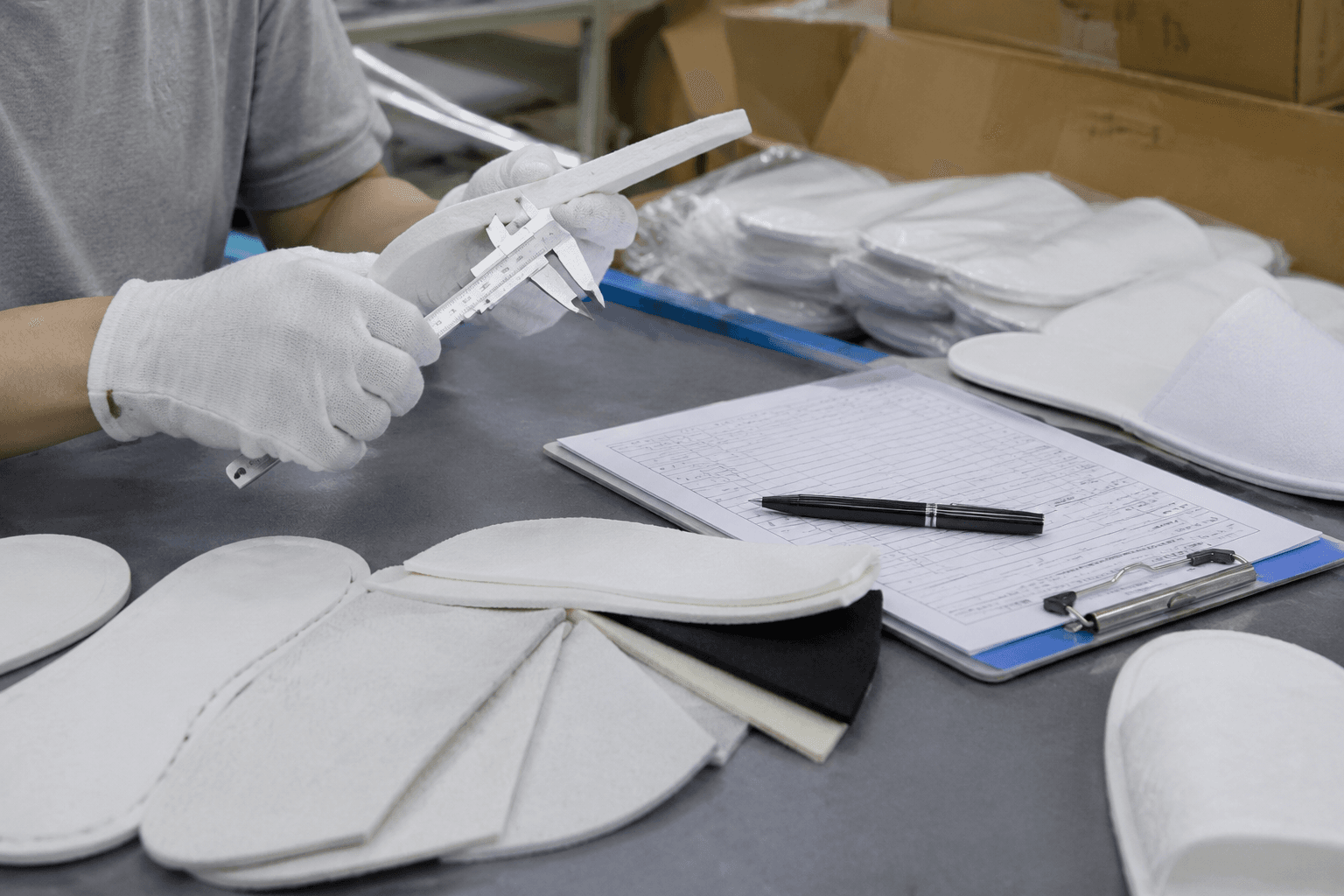
The buyer file should include a clear visual record of the approved EVA sole thickness for disposable hotel slippers. Photograph the finished sample from the side, the bottom, and the packing view so procurement, QC, and freight teams can recognize the same product later.
The most useful scene is a neutral QC bench: finished disposable hotel slippers placed side by side, outsole edge visible in profile, a caliper at the heel-center measurement point, one slipper turned over to show the EVA bottom texture, the upper fabric and binding visible, and the approved individual packaging and export carton corner nearby.
- Show the side profile clearly enough to compare EVA outsole thickness.
- Use a caliper or ruler without readable brand names or marketing text.
- Keep attention on the outsole edge, bottom texture, upper material, binding, packaging, and carton context.
- Avoid lifestyle staging when the purpose is sample approval.
- Use the same photo style for reorder files so teams can compare approved samples consistently.
Evidence method and limits
Visible byline for publication: Vincent Xi, Editorial Author, https://slipperforge.com/authors/vincent-xi/. The same Person name, jobTitle, and URL should be used in Article or BlogPosting author metadata. This guide does not rely on factory-visit claims, named client outcomes, awards, certifications, or first-person experience claims.
Methodology: the EVA thickness ranges, MOQ ranges, timing ranges, RFQ wording, carton calculations, and inspection examples are procurement planning assumptions dated 2026-07-21 to verify through live supplier quotations, physical pre-production samples, packing confirmations, purchase orders, and inspection records. Public source contexts are used only where regulations or standards provide measurement, sampling, or compliance reference points.
Limitations: legal requirements, test scope, MOQ, lead time, carton dimensions, tolerance capability, and defect classifications must be confirmed for the exact market, material, color, outsole texture, packaging, order size, and production batch. A quote, sample, or report for a different slipper should not be treated as approval evidence for the current order.
- Verify every EVA thickness tolerance on a finished sample, not only on a supplier spec sheet.
- Verify chemical and compliance documents against the material, color, print, adhesive, and batch being shipped.
- Verify carton dimensions after packaging approval because EVA sole thickness can change freight volume.
- Verify inspection settings in the purchase order before production starts.
- Verify whether a named standard is being used as a test method, sampling framework, buyer requirement, or actual certification document.
FAQ
What EVA sole thickness should a budget hotel use for disposable slippers? For a carpeted economy guest room, 2.5-3.0 mm EVA outsole is an example planning range dated 2026-07-21 to verify with the supplier quote and finished sample. If rooms include hard flooring, balcony access, higher room rates, or heavier bathroom use, ask for a second quote around 3.5-4.0 mm as an example planning range dated 2026-07-21 to verify.
Is 3 mm EVA thick enough for disposable hotel slippers? A 3.0 mm EVA outsole can be acceptable for some carpeted in-room disposable slippers, but it should be verified by physical sample. For tile floors, spa-adjacent areas, serviced apartments, or retail amenity packs, buyers often need to compare a thicker option such as 3.5-4.5 mm as an example planning range dated 2026-07-21 to verify in the supplier quote and approved sample.
Does a thicker EVA sole always make a better disposable hotel slipper? No. A thicker EVA outsole can improve cushioning and perceived value, but it can also increase unit cost, carton volume, freight cost, compression marks, and sole curl risk. Judge EVA sole thickness together with upper material, sponge layer, lining, binding, outsole texture, packaging, and the sealed approved sample.
How should EVA outsole thickness be written in a hotel slipper RFQ? Put it in the product specification section, not only in email comments. Include target millimeters, tolerance, measurement point, whether the measurement is on the finished slipper, EVA color, outsole texture, hardness request if needed, sample approval requirement, and whether the same thickness applies to all sizes.
How much thickness tolerance should buyers allow for EVA hotel slipper soles? A practical RFQ example dated 2026-07-21 to verify is target 3.5 mm EVA outsole with plus or minus 0.3 mm tolerance, measured at heel center on the finished slipper. The final tolerance should reflect EVA sheet variation, cutting, assembly method, supplier measurement capability, and inspection plan.
What MOQ should buyers expect for wholesale disposable hotel slippers? As example RFQ planning ranges dated 2026-07-21 to verify with the supplier, stock-color non-logo disposable hotel slippers may start around 1,000-3,000 pairs per style, while logo or private-label hotel slippers may start around 3,000-5,000 pairs per style or color. MOQ can change with EVA sheet thickness, upper fabric, logo process, packaging, size split, and material stock.