
Closed Toe Hotel Slippers vs Open Toe Starts With Use
Closed toe hotel slippers vs open toe hotel slippers is not only a price question. The practical choice depends on where the guest wears the slipper, how housekeeping issues it, and what the buyer needs the amenity to signal. Closed toe gives coverage and a warmer in-room feel. Open toe gives airflow, fast step-in use, and a better fit for wet-adjacent or spa settings.
For a hotel room program, closed toe hotel slippers often fit higher room categories, colder destinations, bathrobe pairings, and serviced apartments where the slipper is part of the room presentation. The buyer should inspect toe-room comfort, front seam feel, vamp recovery after packing, and whether the pair still looks neat after housekeeping handles it.
For spa, pool, and resort movement, open toe hotel slippers often reduce friction. Guests can step in quickly after showering, toes remain exposed for pedicure services, and the product feels less warm in humid climates. The buyer should check whether the band holds the foot without squeezing and whether the EVA outsole feels stable on the actual floor surface.
Author attribution: this article is written for SlipperForge by Vincent Xi, Editorial Author. Author profile: https://slipperforge.com/authors/vincent-xi/. This attribution does not claim factory visits, supplier rankings, private testing, certifications, client results, or ownership of compliance documents.
- Closed toe hotel slippers are usually the better starting point for warmth, coverage, privacy, and premium room presentation.
- Open toe hotel slippers are usually the better starting point for airflow, spa use, pedicure settings, and quick on-off use.
- The first sample review should happen against the real guest route, not only against a product photo.
Evidence Basis and Limits
Method used for this comparison: the article cross-checks common B2B hotel slipper RFQ fields, public freight dimensional-weight practices used in carton planning, and operating use cases from hotel rooms, spa areas, pool-adjacent spaces, serviced apartments, and housekeeping replenishment programs. The purpose is to help buyers write a cleaner RFQ and avoid false price comparisons.
Source context one: importer and distributor RFQs for hotel amenities commonly separate toe style, outsole thickness, upper material, logo process, pack method, carton size, and MOQ by SKU. Source context two: parcel and air-freight providers publish dimensional-weight rules that affect cartons with light, bulky products. Source context three: hotel operations create different use conditions for guest-room slippers, spa slippers, retail amenity kits, and pool-adjacent slippers.
Limits to verify: this article does not provide universal market prices, certified performance claims, or supplier-specific MOQs. Buyers should verify outsole thickness, material weight, pair weight, logo method, carton data, lead time, test reports, and destination documents against the exact approved sample and purchase order.
- Use the numbers below as RFQ planning examples unless they are tied to a supplier quote.
- Verify every MOQ, lead time, tolerance, and document against the actual supplier and shipment date.
- Do not treat toe style as a compliance category; materials, inks, adhesives, outsole, packaging, and destination market drive document needs.
How to Compare Hotel Slipper Cost Fairly
A closed toe quote is not comparable with an open toe quote if the materials differ. A buyer comparing a thin non-woven open toe slipper with a plush terry closed toe slipper is comparing two product tiers, not two toe constructions. Lock the EVA outsole material, outsole thickness, upper fabric, lining, adult length, logo size, logo method, packaging, order quantity, inspection level, and carton basis before asking for a cost split.
Example controlled RFQ basis to verify with the supplier: quote both styles for 10,000 pairs per style, one adult size, 285 millimeters overall slipper length, 4 millimeters EVA outsole thickness, 120 grams per square meter non-woven upper, white color, 35 millimeters wide one-color printed logo, individual clear polybag, and the same requested carton target. Scope and date context: example hotel-amenity quote comparison as of the buyer's RFQ date. Source context: buyer-created RFQ assumptions, not a SlipperForge product promise.
Small material changes matter at order scale. Example calculation to verify in the supplier quote: if a closed toe vamp uses 0.012 square meter more upper fabric per pair than an open toe band, and the buyer's fabric-cost assumption is USD 1.20 per square meter as of the RFQ date, the added fabric input is USD 0.0144 per pair before cutting loss, labor, overhead, packaging, margin, duty, tax, and currency effects. For a 20,000-pair order under the same assumption, that fabric input equals USD 288 before those other costs.
The logo can overturn the expected result. A simple one-color print on a wide open toe band is usually easy to quote. Embroidery on a narrow band may require a wider upper or smaller artwork. Closed toe gives more vamp space, which can suit embroidery, heat transfer, woven labels, or jacquard-style presentation, but those choices change the cost base and should be priced as presentation upgrades, not as toe-style cost alone.
- Ask for a cost bridge: upper material, lining, outsole, sponge, stitching, binding, logo process, packaging, labor, carton use, and production loss.
- Compare factory unit price and landed cost per pair separately.
- Reject a low-cost sample if the open toe band slips or the closed toe front collapses after packing.
RFQ Specification Fields Buyers Should Include
Vague product names create weak quotes. Phrases such as white hotel slipper, disposable slipper, spa slipper, closed toe slipper, or open toe slipper allow too much substitution. A supplier can quote a lighter outsole, narrower band, cheaper fabric, smaller logo, looser packaging, or missing documents while still matching the generic name.
Start with the outsole because it affects comfort, carton weight, floor feel, and quote comparability. State material, thickness in millimeters, color, tread pattern, heel thickness if different from forefoot, and intended use area such as dry guest room, bathroom-adjacent room use, spa changing room, or pool-adjacent walkway. EVA is common for disposable and semi-disposable hotel slippers, but EVA alone is not a full specification.
For closed toe hotel slippers, define vamp material, lining, sponge thickness, toe shape, front seam location, binding material, color reference, logo placement, and whether the toe must recover shape after carton compression. For open toe hotel slippers, define band width, opening height, band position, lining, sponge thickness, edge binding, and the acceptable fit reference. These fields turn comfort comments into measurable sample checks.
Example tolerance set to verify with the supplier: for the approved sample dated by the buyer, overall length tolerance plus or minus 3 millimeters per pair, logo position tolerance plus or minus 2 millimeters from the approved reference point, outsole thickness tolerance plus or minus 0.5 millimeter, and open toe band width tolerance plus or minus 2 millimeters. Source context: example inspection fields for small textile and EVA amenity products; final tolerances must match supplier capability and purchase-order terms.
- Outsole fields: material, thickness, tread, color, use area, and any heel-to-forefoot difference.
- Closed toe fields: vamp shape, front seam, lining, sponge, binding, logo placement, and compression recovery.
- Open toe fields: band width, opening height, band position, edge binding, retention, and logo placement.
Guest Experience Checks by Property Type
Airport and economy hotels usually need compact storage, simple replenishment, low replacement cost, and a slipper that looks clean on first issue. Open toe may work well if the climate is warm and the guest route is short. Closed toe may still be preferred if the room is heavily air-conditioned or the brand wants a more covered presentation.
Winter resorts, serviced apartments, and premium suites usually care more about warmth, coverage, and the way the amenity set looks beside a robe. Closed toe terry hotel slippers can fit that role, but only if the front does not flatten in the carton and the inside seam does not rub the toes. A soft-looking slipper that arrives with collapsed toes creates a poor first impression before the guest even wears it.
Spas and pool-adjacent areas need a different review. Open toe waffle hotel slippers or non-woven spa slippers often make sense because they ventilate better, work around pedicure services, and are easier to step into after showering. The band still needs enough hold to prevent sliding. Buyers should test samples on the property's relevant surfaces: bathroom tile, locker-room flooring, balcony surface, spa flooring, or dry pool-adjacent walkway.
Multi-size programs need a commercial check before they become a brand promise. One adult size simplifies housekeeping and distributor stock. Adding regular and large sizes can improve fit for some guests, but MOQ, carton labels, inventory splits, and replenishment accuracy all become harder. Ask whether MOQ applies per size before approving multiple sizes internally.
- Closed toe fits colder rooms, robe sets, long-stay rooms, and premium presentation.
- Open toe fits warm rooms, spas, pool routes, pedicure services, and fast issue programs.
- Floor-surface checks should happen before bulk approval, especially for bathroom, spa, and pool-adjacent use.
Hotel Slippers MOQ, Sampling, and Lead Time
Hotel slippers MOQ is rarely one number. It can apply by toe style, SKU, upper color, outsole color, size, logo, packaging artwork, shipment, or material lot. A distributor ordering several hotel logos needs this clarified early; otherwise the final order can be split into small runs that no longer match the quoted price.
Example MOQ planning range to verify: as of the buyer's RFQ date, buyers commonly use 3,000 to 5,000 pairs per stock-style SKU as a planning assumption for simple logo customization, and 10,000 pairs or more per SKU for custom material, custom color, outsole changes, special band dimensions, or printed packaging. Source context: B2B hotel amenity RFQ planning practice; actual MOQ must be confirmed by the supplier.
Example schedule assumption to verify: for custom hotel-slipper amenity orders as of the quote date, buyers may plan 7 to 14 calendar days for pre-production sample preparation after artwork and material confirmation, and 25 to 45 calendar days for bulk production after deposit and approved sample. Source context: RFQ schedule planning for custom amenity products; this is not a guaranteed production lead time.
Sample approval should produce a record, not just a photo thread. Keep the approved physical sample, specification sheet, pack photo, carton data, artwork file, color reference, logo dimensions, tolerance list, and available documents. Closed toe samples should be checked after compression for toe collapse and seam comfort. Open toe samples should be checked after compression for band shape, retention, edge comfort, and sliding.
- Ask whether MOQ applies per style, SKU, color, size, logo, packaging artwork, shipment, or material lot.
- Separate sample lead time from bulk lead time in the purchase schedule.
- Approve a sealed reference sample before bulk production when the order includes custom material, logo, size, color, or packaging.
QC Checks That Differ by Toe Style
General slipper inspection should cover pair matching, appearance, material, odor, stains, logo position, packaging, carton marking, quantity, and document availability. Low unit value is not a reason to skip measurable inspection fields; inconsistent slippers still affect guest perception and distributor claims.
Closed toe inspection should look at toe shape symmetry, collapsed toe caps, puckered front stitching, rough seams inside the toe area, uneven binding, glue marks, left/right mismatch, compressed sponge, outsole thickness, and logo alignment on the vamp curve. Inspect both loose samples and pairs taken from finished cartons, because compression damage may not show in a single hand sample.
Open toe inspection should look at band width, opening height, retention, band tension, edge binding, exposed stitch ends, logo distortion, and foot sliding. The buyer should set a measurable band-width tolerance or approved-sample reference instead of relying only on comments such as comfortable or loose.
Inspection framework context to verify with the inspection provider: as of the inspection booking date, buyers may reference ANSI/ASQ Z1.4 or ISO 2859-1 sampling concepts for general consumer-product inspections, with example AQL settings such as 2.5 for major defects and 4.0 for minor defects under a selected inspection level. Source context: recognized sampling frameworks used for inspection planning. This does not mean the slippers are certified to those standards, and the exact plan must be written into the purchase order or inspection booking.
- Closed toe QC: toe shape, front seam comfort, collapse after packing, binding, outsole thickness, and vamp logo alignment.
- Open toe QC: band width, opening height, retention, edge finishing, logo distortion, and sliding risk.
- Use sampling standards as inspection frameworks only; do not turn them into product certification claims.
Packaging and Freight Can Change the Winner
Packaging affects hygiene perception, housekeeping speed, retail readiness, carton density, and freight. Clear individual polybags suit many guest-room programs because the pair is easy to issue and visibly unused. Paper bands, kraft sleeves, fabric pouches, and printed wraps can improve presentation, but they add material cost, packing labor, artwork approval, and carton-volume questions.
Closed toe slippers may need more carton space because the covered front and sponge add height and resist flat packing. Open toe slippers often pack flatter when the outsole is thin and the upper is non-woven or waffle fabric, but plush spa versions can be bulky. The buyer should request actual pack and carton data for both styles instead of assuming the open toe option always ships cheaper.
Public freight-planning data point: as of 2025, many U.S. parcel dimensional-weight calculations use dimensional factors such as 139 cubic inches per pound for domestic express services, while many international air-freight calculations use factors such as 5,000 cubic centimeters per kilogram. Source context: public dimensional-weight rules published by major parcel and air-freight providers. Buyers must confirm the applicable factor with their forwarder for the route, service, contract, and shipment date.
Example carton calculation to verify: a master carton measuring 60 centimeters by 40 centimeters by 40 centimeters has a volume of 96,000 cubic centimeters. Using an example air dimensional factor of 5,000 cubic centimeters per kilogram, dimensional weight is 19.2 kilograms per carton. If actual gross weight is 12 kilograms, freight may be charged on 19.2 kilograms depending on the carrier contract. If the open toe version fits 120 pairs per carton and the closed toe version fits 100 pairs per carton in the same carton size, chargeable freight per pair changes even when unit price is close.
Example sea-freight volume calculation to verify: the same 60 centimeters by 40 centimeters by 40 centimeters carton equals 0.096 cubic meter. For 100 cartons, shipment volume is 9.6 cubic meters before pallets, loading efficiency, and forwarder rounding. Source context: buyer carton-volume calculation for landed-cost planning as of the shipment quote date.
- Request individual pack size, carton length, carton width, carton height, gross weight, net weight, and pairs per carton for each style.
- Convert freight to cost per pair before choosing the cheaper quote.
- Review packaging for hygiene perception, housekeeping handling, retail needs, and carton efficiency.
Compliance and Claim Checks
Compliance depends on destination market, materials, inks, adhesive, outsole, packaging, and whether the slipper is an in-room amenity or retail product. Closed toe and open toe are not compliance categories. The same style can pass or fail buyer requirements depending on the exact components and claim language.
For European Union programs, REACH restrictions may be relevant to chemical content in textile, plastic, dye, adhesive, print, and packaging components. For United States programs, California Proposition 65 may be raised by procurement or legal teams depending on material and exposure assessment. These references are regulatory contexts, not product certifications. Ask for current documents tied to the exact material, color, ink, outsole, adhesive, and packaging being purchased.
Slip-related claims need careful wording. Avoid anti-slip certified unless a current report supports the exact outsole, tread, sample description, test method, issue date, laboratory name, surface condition, and result. A textured EVA outsole can be described in a catalog, but procurement documents should use report-backed language only.
Packaging claims also need evidence. Recyclable paper, recycled content, compostable bag, FSC paper, plastic-free packaging, and biodegradable packaging should each be supported by the applicable declaration, certificate, or buyer-approved document for the exact packaging material. A kraft-looking sleeve is not automatically certified paper, and a translucent bag is not automatically biodegradable.
- Request current documents for the exact material, color, ink, outsole, adhesive, and packaging.
- Separate regulations, standards, supplier practice, and marketing claims in the purchase file.
- Do not publish certification claims unless a current certificate or test report supports the exact product and wording.
RFQ Wording for a Fair Comparison
Use wording that forces the comparison to stay controlled: quote closed toe and open toe options using the same outsole material and thickness, same upper material, same lining, same adult size, same logo method and size, same individual packaging, same carton quality, same inspection basis, and same order quantity. Identify cost differences caused by upper consumption, stitching, binding, packaging, carton quantity, and production loss.
Add commercial scope: destination market to be confirmed by buyer; product use is hotel guest-room amenity, spa use, pool-adjacent use, retail amenity kit, distributor stock, or another stated use. Supplier must state whether MOQ applies per toe style, SKU, color, size, logo, packaging artwork, shipment, or material lot. Supplier must also state quote validity date and peak-season production constraints.
Add sample scope: supplier to provide a pre-production sample showing the actual outsole thickness, upper material, lining, logo method, packaging, and proposed carton basis. Buyer approval requires a physical sample, specification sheet, pack photo, carton data, artwork confirmation, and available documents for material, print, outsole, adhesive, and packaging.
Add inspection scope: supplier to confirm measurable tolerances for overall length, outsole thickness, logo position, open toe band width, closed toe toe-cap shape, pair weight, packaging seal, carton marking, and pairs per carton. Major defects include wrong material, wrong logo, wrong size, unsafe sharp edge, open seam, severe stain, severe odor, wrong packaging, and wrong carton quantity. Minor defects should be limited to appearance variations within approved tolerance.
- Quote both toe styles on the same technical and commercial basis.
- State MOQ by SKU, color, size, logo, packaging artwork, shipment, and material lot where applicable.
- Provide sample lead time, bulk lead time, quote validity, carton data, pair weight, and available compliance documents.
- Define major defects, minor defects, measurable tolerances, sampling plan, and defect photo requirements.
Buyer Guidance by Channel
Importers should judge the style by landed cost and account fit. Closed toe may deserve stronger catalog coverage when customers include winter hotels, serviced apartments, business hotels, and premium guest rooms. Open toe may be the faster-moving option when the customer base includes beach resorts, spas, warm-climate hotels, pool areas, and short-stay properties.
Distributors should protect inventory simplicity. Neutral open toe stock can serve quick-turn accounts, while closed toe custom production can suit larger hotel groups with confirmed volume. Too many colors, sizes, toe styles, logo methods, and packaging formats will raise forecasting risk faster than it raises sales coverage.
Retail buyers and brand founders should look beyond hotel use. Open toe hotel-style slippers can fit spa kits, wellness boxes, travel packs, and warm-weather amenity bundles. Closed toe slippers can fit home hospitality sets, winter gift sets, bathrobe bundles, and premium accommodation kits. Retail use raises the importance of barcode accuracy, packaging durability, material labeling, claim support, and destination compliance documents.
Hotel procurement managers should bring housekeeping, spa, finance, and brand teams into sample approval. Housekeeping can judge packaging opening, carton storage, and room placement. Spa teams can judge wet-adjacent use and pedicure needs. Finance should compare landed cost per issued pair or per occupied room, not just quoted unit price.
- Importers: carry both styles only when the customer base supports both use cases.
- Distributors: separate quick-turn stock from custom hotel-group programs.
- Hotel buyers: approve after operations review, physical sample check, document review, and carton-level landed-cost calculation.
Visual Brief for Article Image
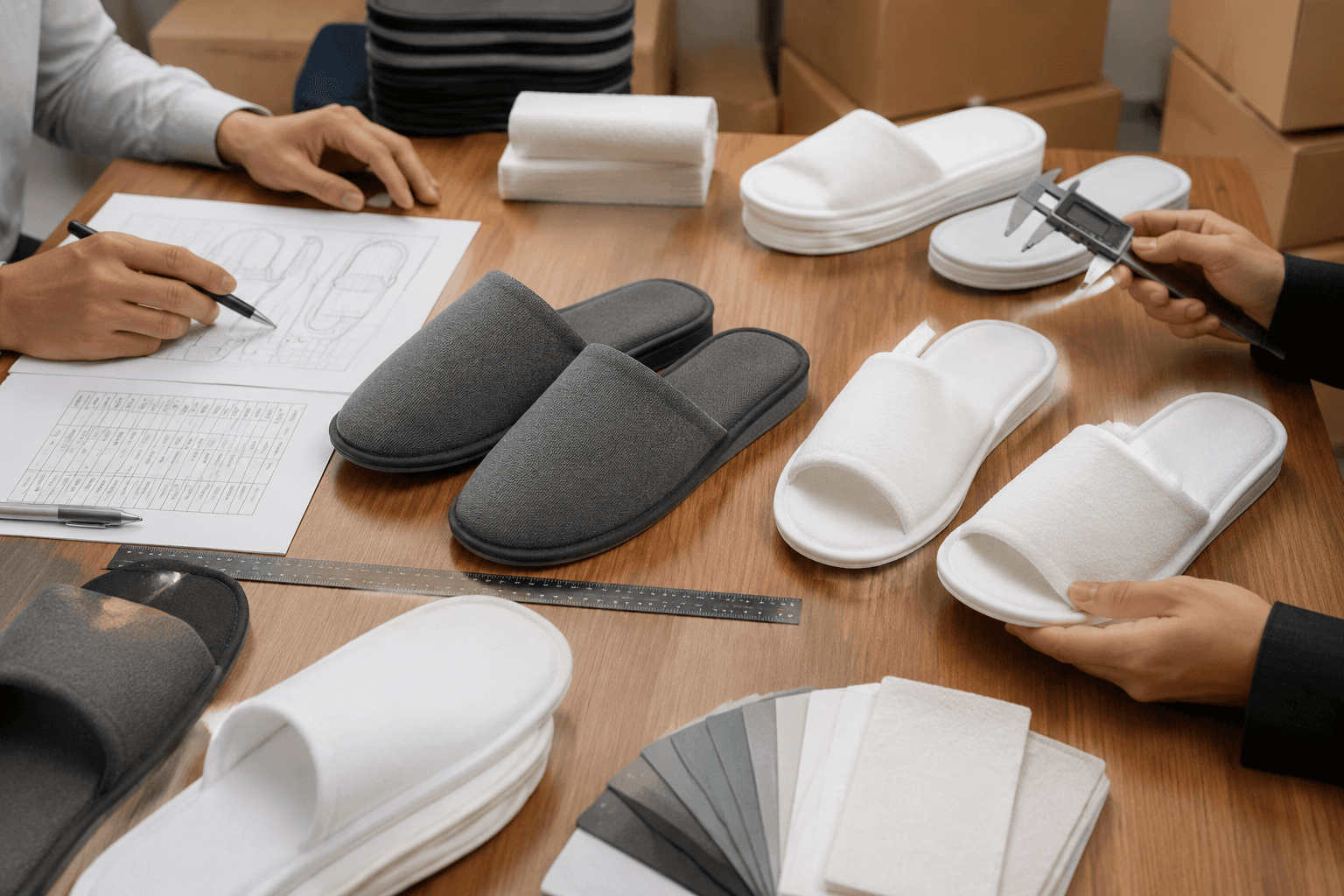
Create a realistic procurement comparison photo on a neutral hotel back-of-house worktable. Show one pair of closed toe white terry hotel slippers and one pair of open toe white waffle or non-woven hotel slippers side by side. Both pairs should show the EVA outsole edge, stitched binding, fabric texture, and simple clear individual packaging nearby.
Include a ruler, caliper, plain corrugated carton, a small stack of flat polybags, and a blank specification sheet with non-readable fields. The scene should communicate sample approval, tolerance checking, packaging review, and carton planning rather than lifestyle use.
Use soft daylight, accurate proportions, clean worktable composition, visible closed toe vamp shape, visible open toe band opening, and outsole thickness visible from the side. Do not include readable text, logos, watermarks, fake certification badges, people, brand marks, impossible machinery, exaggerated luxury props, or claims on packaging.
- Primary objects: closed toe hotel slipper, open toe hotel slipper, ruler, caliper, polybag, corrugated carton, blank specification sheet.
- Required visual details: EVA outsole edge, stitched binding, closed toe vamp, open toe band, packaging thickness, carton planning context.
- Avoid: readable text, people, logos, fake certificates, decorative claims, and unrealistic production equipment.
FAQ
In a closed toe hotel slippers vs open toe hotel slippers cost comparison, which style is usually cheaper? Open toe hotel slippers are often cheaper when all other specifications are equal because the upper band usually uses less material than a closed toe vamp. The final answer depends on the full specification. A closed toe non-woven slipper with a thin EVA sole can cost less than an open toe terry slipper with a thicker outsole, embroidery, and upgraded packaging. Compare both styles using the same outsole thickness, upper material, size, logo method, packaging, MOQ, and carton data.
Which hotel slipper style gives a better guest experience? Closed toe hotel slippers usually feel warmer and more covered, so they fit cooler rooms, bathrobe placement, serviced apartments, and premium in-room use. Open toe hotel slippers usually feel cooler and easier to step into, so they fit warm climates, spa changing rooms, pool-adjacent use, pedicure settings, and quick-turn rooms. The better choice depends on climate, flooring, room category, guest route, and packaging presentation.
What hotel slippers MOQ should buyers expect for custom closed toe or open toe styles? As an RFQ planning assumption to verify with the supplier, buyers often plan around 3,000 to 5,000 pairs per stock-style SKU for simple logo customization and 10,000 pairs or more per SKU for custom color, material, outsole, special band dimensions, or packaging artwork as of the buyer's RFQ date. Actual MOQ can apply per size, color, logo, packaging artwork, shipment, or material lot.
What should buyers check during hotel slipper sample approval? Check overall length in millimeters, outsole thickness in millimeters, pair weight in grams, upper material, lining, sponge thickness, toe shape or band width, logo size and position, packaging format, odor, stains, seam comfort, outsole feel, and carton data. Closed toe samples need extra checks for toe collapse and front seam comfort. Open toe samples need extra checks for band opening, retention, edge binding, and sliding risk.
Can closed toe and open toe hotel slippers use the same packaging? Yes. Both styles can use individual polybags, paper bands, kraft sleeves, fabric pouches, or printed wraps. The carton result may still differ because closed toe hotel slippers can be bulkier, especially with terry, fleece, sponge, or thicker EVA outsole. Request individual pack dimensions, carton dimensions, gross weight, net weight, and pairs per carton for each style.
What compliance documents should an importer request for hotel amenity slippers? Importers should request current documents relevant to the destination market and exact product specification, including material composition declarations, chemical-related test reports where required, packaging declarations, and slip-related test reports if the slipper is intended for bathroom, spa, or pool-adjacent use. References such as REACH, California Proposition 65, ANSI/ASQ Z1.4, or ISO 2859-1 should be used only when relevant and should not be described as certifications unless a current document supports the exact product and claim.