
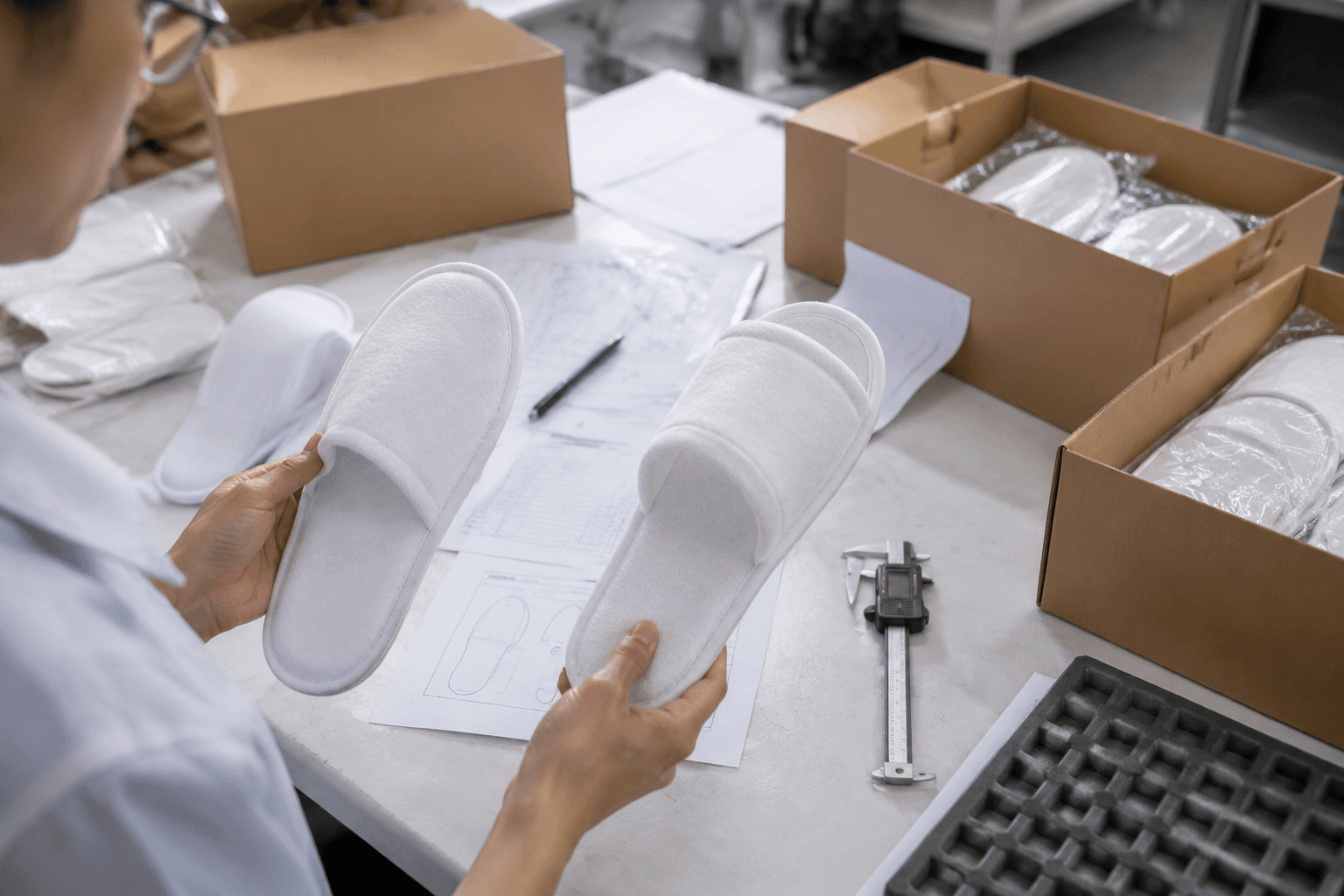
Author, Sources, and Limits
Byline: Vincent Xi, Editorial Author, https://slipperforge.com/authors/vincent-xi/. The author attribution is based on the SlipperForge author profile at that URL.
This guide compares closed toe vs open toe hotel slippers from a procurement angle. It focuses on RFQ variables buyers normally need before asking for a quote: toe construction, upper material, lining, binding tape, EVA outsole thickness, logo method, packaging format, MOQ by SKU, carton dimensions, inspection scope, and document review.
Source context 1: SlipperForge author attribution comes from the approved author profile at https://slipperforge.com/authors/vincent-xi/. Source context 2: the commercial assumptions in this guide are buyer-side RFQ planning examples for hotel slipper procurement, not live price lists, factory capacity statements, or certification claims.
Method used: numeric examples were built from stated RFQ assumptions or direct arithmetic, then labeled so buyers can check them against supplier quotations, sealed samples, carton data, and purchase orders. No client names, factory visits, test results, rankings, awards, or certification claims are used.
Limitations to verify before ordering: exact unit prices, available terry, waffle, non-woven, fleece, or cotton-blend fabric, sole material, MOQ, lead time, carton dimensions, compliance documents, and inspection outcomes depend on the supplier's current quotation and the exact product ordered.
- Use the figures as RFQ checks, not as fixed supplier terms.
- Ask for current documents for the exact material, color, logo method, packaging, and finished slipper.
- Approve a physical sample before bulk production, not only a catalog photo or rendering.
Start With the Use Zone
The practical question is not whether closed toe vs open toe hotel slippers are better in general. The question is where the guest will wear them, how long they will be used, and how the property wants the amenity to feel at handover.
Choose closed toe hotel slippers when the slipper is part of the guestroom comfort package. A closed toe terry or fleece slipper looks more complete beside a robe, works better for cold tile or winter stays, and gives the foot more coverage when the guest uses it inside the room.
Choose open toe hotel slippers when speed, ventilation, or damp-foot use matters more than coverage. Spa, pool, gym, cruise, and warm-climate programs usually need a slipper that is easy to put on after bathing and less likely to feel hot.
Use two styles when the property has two jobs to solve. A closed toe room slipper and an open toe spa slipper can prevent the common mistake of forcing one product to serve both room presentation and wet-area convenience.
Do not let the lowest unit price decide the toe style. A cheap open toe slipper may still cost more after freight if it has bulky retail packaging, and a closed toe slipper may still be economical if it uses a simple upper, thin EVA sole, and flat packing.
- Guestroom priority: warmth, coverage, shelf appearance, robe pairing, and quiet in-room use.
- Spa or pool priority: ventilation, easy entry, comfortable vamp edge, outsole texture, and back-of-house handling.
- Distributor priority: SKU discipline, repeatable carton data, reorder consistency, and clear segmentation for sales teams.
Compare the Same Specification
A quote is not useful if one supplier prices a closed toe terry slipper with a 4 millimeter EVA outsole while another prices an open toe non-woven slipper with a 2 millimeter outsole. Fix the specification first, then ask for the toe-style price difference.
Upper material changes both cost and guest perception. Non-woven is usually used for economy disposable hotel slippers. Terry cloth, waffle weave, fleece, velvet, linen-look, and cotton-blend uppers change softness, lint behavior, compression, drying feel, and presentation.
Outsole thickness can matter more than toe style. A thin EVA sole may hit a low price target but feel weak on cold bathroom floors. A thicker EVA outsole can improve underfoot feel but adds material, carton weight, and carton volume.
Lining and padding should be stated clearly. Some closed toe hotel slippers use sponge foam under the upper for structure, while some open toe slippers use padded vamps for a softer instep. Those changes affect cutting, lamination, sewing, compression, and packing density.
Logo method affects sampling risk. Embroidery may suit closed toe room slippers because the front upper is visible, but it adds placement tolerance, thread color control, and possible backing comfort issues. Printing can be cheaper, but buyers should review rub resistance and placement on high-contact areas.
Packaging can reverse the cost comparison. One pair in a clear polybag, a paper band, printed sleeve, kraft box, or retail kit pack each changes unit cost, carton cube, receiving rules, and warehouse handling.
- Hold constant: adult length, outsole material, outsole thickness, upper material, lining, binding, logo method, and packaging format.
- Ask suppliers to state any difference in upper area, cutting loss, sewing steps, packing density, and defect risk between the two styles.
- Reject vague quotes that do not state material, size, sole thickness, packing, MOQ, and carton data.
Cost Fields to Put in the RFQ
Ask the supplier to quote closed toe and open toe hotel slippers under the same base specification. This makes the toe construction visible instead of hiding the difference inside changed materials, thinner soles, or simpler packaging.
Request upper fabric details by material, color, lining, binding, and GSM or other fabric weight if available. For closed toe, confirm whether the toe panel uses the same material as the rest of the upper. For open toe, confirm whether the vamp is padded, bound, folded, laminated, or raw-edged.
Request outsole details by material, thickness in millimeters, surface texture, color, flexibility, odor expectation, and density if available. If the slipper is for wet-area use, ask the buyer's safety or operations team which review method applies before making any grip claim.
Request logo details by artwork version, size in centimeters, position, color reference, and approval process. A one-color print, embroidery, woven label, heat transfer, or debossed logo can create different tooling, sampling, and defect checks.
Example calculation to verify: if one master carton measures 60 centimeters length by 40 centimeters width by 50 centimeters height, the carton volume is 0.12 cubic meters for that carton; if it holds 100 pairs, packing density is 833 pairs per cubic meter before pallet loss; scope: hotel slipper freight planning example; date context: January 2026; source context: arithmetic from the stated carton dimensions, not supplier-specific data.
- RFQ field: toe style, use zone, adult length in centimeters, width if required, and tolerance.
- RFQ field: upper material, color, lining, binding, fabric weight if available, padding or foam layer, and skin-contact comfort requirement.
- RFQ field: outsole material, outsole thickness in millimeters, texture, color, odor expectation, flexibility, and density if available.
- RFQ field: logo method, logo size in centimeters, placement, artwork version, color reference, and sample approval route.
- RFQ field: packing method, pairs per carton, carton dimensions, gross weight, net weight, carton marks, and mixed-SKU rules.
MOQ and Lead Time
Calculate MOQ by SKU, not by total order volume. A 30,000 pair order can split into small production lots if it includes two toe styles, three colors, two logo versions, and separate packaging formats.
Ask whether the closed toe and open toe versions can share outsole sheets, fabric stock, labels, packaging, and carton marks. Shared materials can reduce planning friction, but each toe style still needs its own cutting, sewing, sample, and inspection reference.
Example MOQ planning range to verify: stock-style logo customization may require 3,000 pairs to 5,000 pairs per SKU, while deeper customization involving special fabric, exclusive outsole color, custom size grading, or retail packaging may require 10,000 pairs to 30,000 pairs per SKU; scope: disposable and semi-disposable hotel slipper procurement planning; date context: January 2026; source context: buyer-side RFQ assumption, not a supplier guarantee.
Separate sample time from production time. Example lead-time assumption to verify: first sample preparation may take 5 working days to 10 working days when stock materials are available, and bulk production may take 20 calendar days to 35 calendar days after sample approval and deposit; scope: hotel slipper export order planning; date context: January 2026; source context: buyer-side planning assumption, not a guaranteed schedule.
Lock artwork and packing before the sample deadline. Toe style may be decided quickly, but embroidery placement, barcode data, carton marks, printed sleeves, and customer PO labels can hold the order longer than the slipper itself.
- Ask MOQ separately for closed toe and open toe hotel slipper SKUs.
- Ask what changes MOQ: terry color, waffle color, outsole color, logo method, size, packaging, or carton labels.
- Track sample lead time, revision time, bulk production time, inspection window, and freight booking time as separate dates.
- Require written approval before fabric, sole, adhesive, logo, packaging, or carton substitutions.
Sample Approval
Approve the sample as a measured product. Record toe style, adult length, outsole thickness, pair weight, upper material, lining, color, logo position, packing format, and carton plan before the purchase order is released.
For closed toe slippers, compress the sample in the intended packing method and check whether the toe collapses, twists, or wrinkles. A closed toe slipper can look acceptable on a table but poor after being packed tightly for shipment.
For open toe slippers, check the vamp on a foot form or through the buyer's practical fit review. A vamp set too far forward can feel loose; a vamp set too far back can rub the instep.
For both styles, check odor, stains, thread trimming, outsole alignment, edge comfort, logo accuracy, pair matching, packaging condition, and carton label format. If the slipper will be used in a bathroom, spa, or pool area, add the buyer's own floor-condition review instead of relying on appearance alone.
- Closed toe checks: toe shape after compression, toe seam symmetry, toe height consistency, binding neatness, and left-right match.
- Open toe checks: vamp position, opening width, edge softness, stitch strength, adhesive exposure, and foot hold.
- Shared checks: adult length, outsole thickness, pair weight, logo placement, odor, stains, packing, and carton marks.
- Sample file: quote version, sample date, artwork version, material description, packing method, and approval status.
Carton Cube and Landed Cost
Hotel slippers are light, but they can consume freight space. For importers and distributors, carton cube can change the landed cost more than a small ex-factory price difference.
Ask for carton data on both toe styles. Open toe hotel slippers often nest flatter, while closed toe hotel slippers can take more room when the front upper is plush, padded, or shaped.
Example freight calculation to verify: for an order of 10,000 pairs packed at 100 pairs per carton, the order uses 100 cartons; if each carton is 0.12 cubic meters, total carton volume is 12 cubic meters before pallet loss; scope: hotel slipper freight planning calculation; date context: January 2026; source context: arithmetic based on stated carton and order assumptions, not supplier-specific data.
Compare cubic meters per 1,000 accepted pairs, not only price per pair. This catches poor packing density, rework losses, and receiving problems that a unit-price quote does not show.
Match packaging to the channel. Hotels may prefer one pair per clear polybag for housekeeping control. Spas may use banded or controlled bulk packing. Retail kits may need printed sleeves, barcodes, product labels, destination labels, and stronger cartons.
- Request carton length, width, height, gross weight, net weight, pairs per carton, carton count, and total CBM.
- Confirm whether slippers are packed flat, nested, toe-to-heel, individually bagged, banded, sleeved, boxed, or bulk packed.
- Ask for packing photos before shipment showing inner packing, pair count, carton marks, and sealed carton condition.
- For warehouse customers, confirm SKU code, barcode, PO number, mixed-carton rule, and carton-label placement before production.
QC by Toe Style
Do not use one generic defect list for both products. Closed toe and open toe slippers fail in different visible places, so the inspection checklist should name the likely defects for each style.
Closed toe inspection should focus on toe enclosure shape. Uneven toe height, twisted front panels, puckered seams, loose binding, collapsed uppers, and left-right mismatch are easy for hotel staff or guests to notice.
Open toe inspection should focus on vamp position and edge comfort. Skewed vamps, inconsistent opening width, rough strap edges, loose stitching, exposed adhesive, and weak foot hold can make the slipper feel cheap or uncomfortable.
Shared checks should cover upper color, stains, odor, outsole sheet thickness, outsole alignment, sole separation, logo position, packing error, and carton marks. Incoming material checks should also confirm fabric nap direction where relevant and outsole consistency before assembly starts.
If the buyer uses AQL sampling, define major and minor defects in the PO. Major defects may include detached outsole, broken stitching, wrong logo, incorrect size, severe stain, strong chemical odor, unsafe sharp edge, or wrong packing. Minor defects may include small thread tails, slight packaging wrinkles, or small color variation within the approved tolerance.
- Closed toe major risks: uneven toe shape, collapsed toe box, twisted upper, puckered seam, loose binding, and left-right mismatch.
- Open toe major risks: skewed vamp, uneven opening width, rough edge, loose stitch, exposed adhesive, and poor foot hold.
- Shared risks: stains, odor, incorrect logo, wrong size, outsole misalignment, sole separation, poor trimming, and packing error.
- PO control: bulk goods must match the approved sample for material, color, size, logo, sole thickness, packing, and carton marks.
Documents and Standards
Document requirements depend on destination market, customer policy, material composition, packaging, and sales channel. A hotel using slippers internally may request a different file from a retailer selling a private-label amenity kit.
Ask for material declarations, restricted-substance test reports when required, packaging material statements, country-of-origin information, barcode data, and customer-specific labeling documents. If packaging includes disposal, recycled-content, or material claims, review those claims before printing.
For the European Union, buyers may need to consider REACH-related restricted-substance expectations depending on material and customer policy. For the United States, buyers may need to check retailer, state-level, chemical, labeling, and customer-specific requirements. These are buyer verification points, not product certification claims.
Separate supplier practice from documented compliance. A statement that a material is low odor or azo-free is not the same as a current test report for the exact material or finished slipper. Put the document name, accepted lab or issuer if applicable, report date requirement, and product scope into the RFQ and PO.
- Ask which documents are available for the exact material, color, logo method, packaging, and finished slipper.
- Confirm whether reports are current, complete, and accepted by the buyer's market or end customer.
- Do not describe a slipper as certified unless a valid certificate or test report supports the exact product claim.
- Include packaging and labeling requirements for retail, distributor, and private-label channels.
- For wet-area use, verify outsole expectations through the buyer's own safety, operations, or compliance process.
RFQ Wording
Use one RFQ to force a clean closed toe vs open toe hotel slippers comparison. Ask suppliers to quote both toe styles against the same material, size, sole, logo, and packaging assumptions, with separate prices and carton data for each.
RFQ wording example to verify: Please quote closed toe and open toe hotel slippers under the same specification: adult length 28 centimeters with plus or minus 0.5 centimeter tolerance, white terry upper with material weight stated by supplier, 4 millimeter EVA outsole with plus or minus 0.5 millimeter tolerance, unbranded sample first, optional one-color logo quote, one pair per clear polybag, master carton data required, and quotation valid date stated. Scope: example RFQ wording for adult hotel slipper sourcing; date context: January 2026; source context: buyer-side template language to adapt before use.
Carton wording example to verify: Please state pairs per carton, carton length in centimeters, carton width in centimeters, carton height in centimeters, gross weight in kilograms, net weight in kilograms, total CBM, carton mark format, and whether mixed SKUs are allowed in one master carton. Scope: example logistics field request for hotel slipper procurement; date context: January 2026; source context: buyer-side template language to adapt before use.
Inspection wording example to verify: Bulk goods must match the approved sample for toe style, upper material, outsole thickness, color, logo position, size, odor, packing, and carton marks. Major defects include detached outsole, broken stitching, wrong logo, wrong size, severe stain, strong odor, unsafe sharp edge, and incorrect packing. Scope: example inspection wording for hotel slipper purchase orders; date context: January 2026; source context: buyer-side template language to adapt before use.
- Ask for closed toe and open toe prices under the same specification.
- Ask for MOQ, sample cost, sample lead time, production lead time, and quotation validity by SKU.
- Ask for carton dimensions, carton weight, pair count, total CBM, and packing photos.
- Ask for material substitution rules and the approval process for any change after sample signoff.
- Ask the supplier to identify likely defects for the chosen toe style and how they are checked during production.
Buyer Decision Notes
Importers should build the range around real customer segments. One economical open toe style can serve warm-climate, spa, or high-turnover accounts, while one stronger closed toe style can serve guestrooms, suites, colder regions, and robe-paired programs.
Distributors should protect repeatability. Keep sealed samples by SKU, record outsole thickness, upper material, logo method, packaging, carton data, and reorder history. When any material changes, update the sample before offering the next batch.
Hotel procurement managers should match the slipper to the guest journey. Closed toe usually works better when slippers are placed in the room with robes. Open toe usually works better when slippers are issued near showers, treatment rooms, pools, or changing areas.
Retail buyers and brand founders should treat toe style as part of positioning. Closed toe can support a softer in-room or giftable amenity feel; open toe can support resort, wellness, travel-light, or spa positioning. Either choice still needs physical sample approval.
- Choose closed toe when coverage, warmth, and room presentation drive the purchase.
- Choose open toe when ventilation, spa use, humid climate, quick wear, and flatter packing matter more.
- Use both styles when room and wet-area needs are clearly different.
- Limit SKU growth by controlling colors, sizes, logo versions, and packaging formats.
- Approve landed cost after reviewing unit price, carton cube, freight assumptions, inspection plan, and defect tolerance.
Image Brief
Create a realistic procurement-style product image showing two unbranded hotel slippers on a clean sourcing desk: one white closed toe terry slipper and one white open toe waffle slipper. Show the toe seam, vamp opening, EVA outsole edge, binding tape, heel profile, and clear polybag packaging nearby.
Add practical buying context: a ruler or caliper for scale, neutral material swatches, and a plain kraft master carton sample in the background. Include a small QC checklist sheet with marks or lines only, with no readable text.
Lighting should be natural and neutral, with sharp focus on texture, stitching, sole thickness, and packing details. The image should look like a sample approval desk, not a hotel lifestyle advertisement.
Avoid logos, brand names, readable claims, fake certificates, people, uniforms, hands, watermarks, decorative luxury staging, and machinery.
- Products: one closed toe terry hotel slipper and one open toe waffle hotel slipper.
- Visible details: toe coverage difference, outsole thickness, stitching, binding, clear polybag, carton context, and measurement tool.
- Composition: clean desk surface, neutral background, enough negative space for desktop and mobile article crops.
Purchase Order Checks
Before issuing the PO, confirm that the quote, sample, specification sheet, carton plan, document list, and inspection plan describe the same product. Many disputes start when one of these files is older than the others.
For closed toe slippers, approve the toe shape after compression in the intended packing format. For open toe slippers, approve vamp position, opening width, and edge comfort. For both styles, approve sole thickness, pair weight, logo position, stitch quality, color, odor, packaging, and carton marks.
Confirm commercial terms in writing: MOQ by SKU, unit price, setup charge, sample cost, payment terms, incoterms, sample lead time, bulk lead time, inspection window, carton dimensions, pairs per carton, gross weight, net weight, and material substitution rules.
Check the landed-cost picture before choosing the cheaper quote. A low unit price can lose value if the slipper uses thinner material, needs repacking, increases freight cube, fails receiving rules, or creates extra defect sorting.
- Verify sample: toe style, size, feel, toe shape or vamp position, sole thickness, logo, packaging, and pair matching.
- Verify documents: current test reports if required, material statements, origin details, packaging information, and customer-specific labels.
- Verify production: MOQ by SKU, production lead time, inspection window, approved sample reference, and material substitution rules.
- Verify logistics: pairs per carton, carton CBM, gross weight, carton marks, pallet plan if required, and freight schedule.
- Verify acceptance: defect definitions, tolerance fields, rework responsibility, replacement terms, and inspection access.
FAQ
Closed toe vs open toe hotel slippers: which costs more? Closed toe hotel slippers often cost more when the same adult size, upper material, EVA outsole thickness, logo method, and packing are held constant because the toe enclosure may use more fabric and more visible sewing control. Open toe hotel slippers are not automatically cheaper; a padded waffle vamp, thicker EVA sole, embroidery, printed sleeve, or retail packing can make the open toe version cost more.
Which hotel slippers are better for guestrooms, closed toe or open toe? Closed toe hotel slippers are usually better for guestrooms, suites, serviced apartments, cold climates, and robe-paired amenities because they feel warmer and more covered. Open toe hotel slippers usually work better for spas, pool zones, humid climates, gyms, cruise amenities, and quick-use areas because they are easier to wear after bathing and feel more ventilated.
What MOQ should buyers expect for custom closed toe or open toe hotel slippers? Example planning range to verify in supplier quote: stock-style logo customization may require 3,000 pairs to 5,000 pairs per SKU, while deeper customization may require 10,000 pairs to 30,000 pairs per SKU. Scope: hotel slipper procurement planning; date context: January 2026; source context: buyer-side RFQ assumption, not a supplier guarantee. MOQ can change by toe style, fabric color, outsole color, adult size, logo method, packaging, and carton label rules.
How should buyers approve closed toe and open toe slipper samples? Buyers should approve physical samples for adult length, upper material, outsole thickness, toe shape or vamp placement, logo position, packaging, pair weight, color, odor, and carton packing. Closed toe samples should be checked after compression in the intended packing format. Open toe samples should be checked for vamp hold, opening width, edge comfort, and stitch strength.
Which slipper type usually packs more efficiently for freight? Open toe hotel slippers often pack flatter, especially with non-woven, waffle, or thin terry uppers. Closed toe hotel slippers can require more carton space if the toe area is plush, padded, foam-lined, or shaped. Buyers should request pairs per carton, carton dimensions, gross weight, net weight, and cubic meters for each toe style before comparing landed cost.
What defects are common in closed toe and open toe hotel slippers? Closed toe slippers need checks for uneven toe shape, puckered seams, loose binding, collapsed toe boxes, and left-right mismatch. Open toe slippers need checks for skewed vamp placement, loose stitching, rough edges, exposed adhesive, inconsistent opening width, and weak foot hold. Both styles should be checked for stains, odor, outsole alignment, logo accuracy, size, and packing errors.