
What this guide covers
This hotel slipper carton packing guide is for buyers who need to compare quotes before placing an order. The central decision is whether two suppliers are quoting the same commercial result: same slipper construction, same inner packing, same master carton size, same gross weight basis, and the same document responsibility.
Use it for disposable hotel slippers, custom hotel slippers, spa slippers, private-label amenity programs, hotel slippers wholesale replenishment, and retail-packed slipper orders. Do not use it to estimate another product unless outsole length, upper material, lining, EVA sole thickness, toe shape, logo method, inner packing, and master carton format are also the same.
Byline: Vincent Xi, Editorial Author, SlipperForge, https://slipperforge.com/authors/vincent-xi/. The approved author basis is the SlipperForge author profile. This article does not claim factory visits, laboratory testing, client outcomes, awards, company certifications, or first-person production experience.
- Buyer decision: whether the quote is complete enough for freight pre-rating.
- Buyer decision: whether carton packing protects slipper shape, cleanliness, barcode readability, and guest-room presentation after unpacking.
- Buyer decision: whether MOQ, sample timing, compliance documents, and inspection checkpoints are tied to the final product specification.
Evidence and limits
The calculations use buyer-side RFQ fields, carrier dimensional-weight guidance, EU legal source context, and example carton math for a lightweight hotel slipper order. The examples are planning calculations, not SlipperForge factory standards and not supplier quotes.
Source context: DHL Express dimensional weight guidance, accessed 2026-07-21, uses length x width x height in centimeters divided by 5,000 to calculate volumetric weight for many express shipments. Source context: EUR-Lex publication of Regulation (EU) 2023/988, accessed 2026-07-21, states that the General Product Safety Regulation applies from 13 December 2024. Source context: EU REACH Annex XVII Entry 43, as referenced by ECHA and EU legal texts accessed 2026-07-21, restricts certain azo colorants in covered textile and leather articles to 30 mg/kg for listed aromatic amines.
Method note: carton CBM is calculated from sealed outside carton dimensions. Dimensional weight examples compare carton volume with actual gross weight. MOQ and lead-time ranges are labeled as assumptions to verify because they depend on supplier capability, material availability, artwork approval, packaging print schedules, inspection booking, and shipment routing.
Limitations: freight divisors, minimum charges, pallet rules, warehouse charges, destination fees, test requirements, and compliance scope vary by forwarder, carrier, route, destination market, and slipper material. Verify all numbers in the supplier quote, forwarder quote, inspection report, packing list, or current order-specific document before purchase order release.
- Exact source-based data point: DHL dimensional weight divisor of 5,000 cm3/kg for many express shipments, accessed 2026-07-21.
- Exact source-based data point: Regulation (EU) 2023/988 applies from 13 December 2024, according to EUR-Lex, accessed 2026-07-21.
- Exact source-based data point: REACH Annex XVII Entry 43 restricts certain azo colorants to 30 mg/kg for listed aromatic amines in covered textile and leather articles, according to ECHA/EU legal texts accessed 2026-07-21.
Start with sealed carton data
A hotel slipper quote without carton dimensions is not ready for price comparison. Lightweight slippers can fill cartons long before they create much actual weight, so the buyer needs carton data before asking a forwarder for courier, air, LCL, or FCL cost.
Ask for sealed outside carton length, width, and height in centimeters, not only a carton drawing. A 60 cm x 40 cm x 35 cm carton on paper can rate differently if the sealed carton bulges after slippers are compressed and taped.
Require the supplier to say how the hotel slipper master carton size was obtained. A packed sample measurement is stronger than a carton supplier drawing, and a carton supplier drawing is stronger than copied data from another slipper style.
- Mandatory RFQ field: pairs per master carton.
- Mandatory RFQ field: sealed outside carton L x W x H in centimeters.
- Mandatory RFQ field: CBM per carton and total CBM for the quoted quantity.
- Mandatory RFQ field: net weight and gross weight in kilograms.
- Mandatory RFQ field: inner packing method, such as individual OPP bag, paper band, printed sleeve, retail box, amenity bundle, or master-carton-only packing.
- Mandatory RFQ field: carton board description, carton mark plan, total carton count, and whether dimensions include tape, straps, labels, corner protectors, and normal side-wall bulge.
Freeze the slipper before freezing the carton
Carton count is unreliable until the slipper specification is locked. A 28 cm open-toe non-woven slipper with a 3 mm EVA sole will not pack like a 30 cm closed-toe terry slipper with a 5 mm EVA sole and embroidered logo.
Approve the sample, packaging, and carton plan together. If the buyer approves only the slipper sample, the final packing may later change carton cube, barcode placement, shipping marks, retail presentation, and freight cost.
Hotel slipper MOQ should be quoted against the final specification. As an example planning assumption to verify in the supplier quote, a plain stock-like disposable slipper program may be planned at 3,000 to 5,000 pairs per color and specification. Custom-dyed fabric, custom binding, embroidery, printed bands, molded sole work, or retail boxes may require a higher MOQ depending on material and print minimums.
- Size: outsole length in centimeters, size tolerance in millimeters, toe shape, open-toe or closed-toe construction, and one-size or mixed-size plan.
- Upper: non-woven, terry, waffle, coral fleece, linen-look fabric, velvet, or other material, with GSM, thickness, or supplier material code when available.
- Sole: EVA, TPR, fabric sole, anti-slip dot pattern, sole thickness in millimeters, color, hardness if specified, and bend recovery expectation after unpacking.
- Logo: embroidery, screen print, heat transfer, woven label, debossed sole mark, logo size in millimeters, placement tolerance, and approved artwork version.
- Packing: individual OPP bag, paper band, belly band, retail box, barcode label, amenity-kit bundle, plastic-reduction requirement, or master-carton-only packing.
Packing density is a tradeoff
Choose dense packing when the order is a simple replenishment item, the slipper is thin, the route is direct, and presentation recovery has been tested. Dense packing can reduce cartons, CBM, storage cube, and chargeable weight per pair.
Choose lower density when the slipper has a closed toe, thick upper, paper band, retail box, delicate logo, or presentation requirement. Lower density can protect shape and shelf appearance even when freight per pair increases.
For LCL, mixed routing, or distributor handling, carton strength may matter more than shaving a small amount of CBM. A low-density but stronger carton can be cheaper than a dense carton that arrives crushed, mislabeled, or hard to count.
- Hotel replenishment check: can housekeeping remove pairs quickly without damaged bags or tangled slippers?
- Distributor check: can the warehouse stack cartons without side-wall collapse?
- Retail check: do barcodes stay flat and scannable after handling?
- Brand check: do paper bands, logo positions, toe shape, and upper cleanliness still look acceptable after unpacking?
- Receiving check: are colors, sizes, room types, or property codes separated clearly enough to avoid sorting errors?
Worked hotel slipper CBM calculation
Example scope and date: buyer-side planning calculation for a lightweight open-toe disposable hotel slipper order, prepared as of 2026-07-21. Assumed carton to verify in the supplier quote: 100 pairs per carton, sealed carton size 60 cm length x 40 cm width x 35 cm height, and 10.0 kg gross weight per carton.
The hotel slipper CBM calculation is 0.60 m x 0.40 m x 0.35 m = 0.084 CBM per carton. For an example order of 10,000 pairs, 100 pairs per carton requires 100 cartons. Total volume is 100 cartons x 0.084 CBM = 8.4 CBM.
The actual gross weight is 100 cartons x 10.0 kg = 1,000 kg for the example order. This number is useful for warehouse receiving and freight comparison, but it is not always the billable weight for express or air freight.
- Example carton assumption to verify: 60 cm x 40 cm x 35 cm sealed outside size.
- Example packing assumption to verify: 100 pairs per carton.
- Example weight assumption to verify: 10.0 kg gross weight per carton.
- Example order assumption to verify: 10,000 pairs packed in 100 cartons.
- Example calculated result: 0.084 CBM per carton, 8.4 CBM total volume, and 1,000 kg total actual gross weight.
Convert volume into freight weight
For express pre-rating, apply the carrier's divisor to each carton. Using the DHL source-context formula accessed 2026-07-21, the example carton rates at 60 cm x 40 cm x 35 cm / 5,000 = 16.8 kg dimensional weight. If the courier bills the greater of actual and dimensional weight, this carton is rated at 16.8 kg instead of its 10.0 kg actual gross weight.
For air freight planning, use the divisor stated in the forwarder quote. As an assumption to verify, if a quote uses 6,000 cm3/kg, the same carton rates at 60 cm x 40 cm x 35 cm / 6,000 = 14.0 kg dimensional weight. Across 100 cartons, that becomes 1,400 kg chargeable weight under this assumed air divisor.
For LCL sea freight, ask the forwarder how weight-or-measure, minimum revenue, CFS charges, port charges, and destination fees apply. In the example, 8.4 CBM versus 1,000 kg actual gross weight is likely volume-sensitive under many planning conventions, but the final landed cost still depends on the quote terms.
- Express example: 16.8 kg dimensional weight per carton using the DHL 5,000 cm3/kg source context accessed 2026-07-21.
- Air example: 14.0 kg dimensional weight per carton using a 6,000 cm3/kg forwarder divisor assumption to verify.
- Order example: 1,400 kg chargeable weight by air for 100 cartons under the 6,000 cm3/kg assumption.
- Bulge example: if the sealed carton measures 63 cm x 42 cm x 37 cm, volume becomes 0.0979 CBM per carton, about 16.5 percent more than 0.084 CBM.
- Buyer action: send carton data to the forwarder before purchase order release, not after production is packed.
Use pair-level metrics
Total CBM tells procurement how much space the shipment takes. Pair-level metrics tell buyers whether the hotel slipper carton packing plan is efficient enough for repeat ordering, distributor margin, warehouse slotting, and retail replenishment.
In the example, 100 pairs divided by 0.084 CBM equals about 1,190 pairs per CBM. Express dimensional weight of 16.8 kg divided by 100 pairs equals 0.168 kg chargeable weight per pair.
If a premium closed-toe slipper packs 60 pairs in the same 0.084 CBM carton, density falls to about 714 pairs per CBM. That may be acceptable for a higher-value spa slipper, but it changes landed cost, storage cube, and replenishment planning.
- Pairs per CBM = pairs per carton divided by carton CBM.
- Actual gross weight per pair = carton gross weight divided by pairs per carton.
- Dimensional weight per pair = dimensional weight per carton divided by pairs per carton.
- Storage cube per 1,000 pairs = 1,000 divided by pairs per CBM.
- Quote check: if a thicker slipper is quoted with the same carton size, same pair count, and same gross weight as a thin slipper, ask for packed-carton proof.
MOQ and lead time
Do not accept a category-level MOQ for hotel slippers if the order includes custom color, binding, logo, paper band, barcode label, or printed carton. The limiting component may be fabric, EVA sole sheet, embroidery setup, packaging print run, carton mark, or label supply.
As an example planning assumption to verify in the supplier quote, sample preparation for a simple hotel slipper may be budgeted at 5 to 10 calendar days after artwork and material confirmation. As another example planning assumption to verify, bulk production may be budgeted at 20 to 35 calendar days after approved sample and deposit.
The purchase order should define the lead-time trigger. A schedule based on deposit receipt is different from a schedule based on approved artwork, approved swatch, approved pre-production sample, buyer-supplied label arrival, or final packaging proof approval.
- Ask for separate timing lines for sample making, material purchase, packaging printing, production, inspection, document preparation, and booking.
- For a new custom hotel slipper program, request one pre-production sample in final material, final color, final logo method, final inner packing, and final carton plan.
- For repeat orders, confirm whether swatches, screens, cutting dies, molds, logo files, and packaging artwork remain available and for how long.
- For urgent replenishment, compare partial air shipment for the short quantity against sea freight for the balance instead of moving the full order by express.
QC before cartons are sealed
Inspect slipper construction before carton sealing because correction is cheaper at the packing table than at destination. Key checks include outsole length, left-right matching, sole bonding, binding tension, upper cleanliness, logo placement, color consistency, odor, lint, and toe-shape recovery.
Inspect packing before export cartons leave the supplier. Count pairs, confirm size and color splits, check inner bag seals, read barcode labels where required, verify carton marks, and measure sealed outside carton dimensions.
If ANSI/ASQ Z1.4 or ISO 2859-1 sampling is used, the purchase order must define inspection level, AQL values, defect classes, lot definition, acceptance rules, and reinspection rules. Naming a sampling standard alone does not define buyer acceptance.
- Material check: upper fabric, sole sheet, binding, logo material, packaging film or paper, carton board, and adhesive condition.
- Bonding check: glue coverage, edge lift, pressing marks, sole alignment, and delamination risk after bending.
- Logo check: position, size, color, edge sharpness, thread cleanliness, print adhesion, and consistency across colors or sizes.
- Packing check: pair count, inner pack, carton quantity, net weight, gross weight, sealed carton dimensions, and moisture condition.
- Presentation check: shape recovery after unpacking, folded toe caps, wrinkled uppers, torn paper bands, and crushed retail boxes.
Documents and standards
Request compliance documents by destination market, material, color, coating, adhesive, packaging, and sales channel. A hotel internal-use program, distributor wholesale order, and retail pack can require different document sets.
For EU market placement, Regulation (EU) 2023/988, the General Product Safety Regulation, applies from 13 December 2024 according to EUR-Lex source context accessed 2026-07-21. This is a legal framework, not a company certification claim.
For dyed textile or leather materials with direct skin contact, REACH Annex XVII Entry 43 may be relevant because it restricts certain azo colorants to 30 mg/kg for listed aromatic amines in covered articles, according to ECHA/EU source context accessed 2026-07-21.
Use standards carefully. ISO 780:2015 may be relevant if the buyer requires standardized handling marks. ISTA procedures may be relevant if the buyer wants defined transit testing. A handling-mark standard or packaging test protocol is not a company certification unless a current document proves holder, scope, date, and product coverage.
- Request material composition declarations for upper, lining, binding, sole, logo material, adhesive, inner packing, and master carton.
- Request market-specific documents such as REACH review for EU chemical restrictions, Prop 65 review for California exposure risk where relevant, and retailer restricted substance list testing if the buyer requires it.
- Request packaging documents such as carton specification, recycled content statement only if claimed, and FSC chain-of-custody certificate only if FSC material is requested and currently documented.
- Request commercial documents such as proforma invoice, packing list, country-of-origin statement where needed, booking data, and shipping marks matching the purchase order.
- Verify certificate number, holder name, product scope, issuing body, test date, sample description, and validity date before using any test or certification claim.
RFQ wording to send
A strong hotel slipper RFQ removes guesswork. The supplier should be able to quote the same slipper, the same inner packing, and the same carton plan that the buyer will use for freight and inspection.
Ask for unit price by quantity tier, sample fee and refund rule, setup fees, lead time, incoterms, payment terms, document availability, inspection cooperation, and packed-carton evidence. The best comparison is the quote with fewer unknowns, not the lowest FOB line.
- Product: quote open-toe hotel slipper, outsole length 28 cm, upper material [buyer to specify], EVA sole thickness [buyer to specify] mm, color [Pantone or swatch], logo method [embroidery/print/none], and target use [guest room/spa/retail].
- Quantity: quote [quantity] pairs, split by [color/size/style], with buyer-selected price tiers such as 3,000 pairs, 5,000 pairs, and 10,000 pairs to verify.
- Packing: quote individual OPP bag, paper band, retail box, master carton only, barcode label, plastic-reduction requirement, and inner pack photo.
- Carton: provide pairs per master carton, sealed outside carton L x W x H in centimeters, net weight in kilograms, gross weight in kilograms, CBM per carton, total carton count, and photos of the actual packed carton.
- Freight: state whether the carton data is suitable for courier, air, LCL, or FCL quote comparison, and identify pallet size, pallet height, cartons per pallet, and gross pallet weight if pallets are included.
- Quality: confirm approved sample control, inspection access, defect classification, replacement or credit rule, carton measurement tolerance, and document deadline before shipment.
- Compliance: confirm available test reports and declarations for the destination market, material scope, color scope, sample date, issuing body, report number, and validity.
Purchase-order checks
Check carton data for internal consistency before issuing the purchase order. If the quote lists 100 pairs, 8.0 kg net weight, and 10.0 kg gross weight, the buyer can infer about 100 g gross packed weight per pair in that carton. A thicker slipper with the same carton size, same pair count, and same gross weight needs renewed evidence.
Ask the forwarder to pre-rate the supplier's carton data before production starts. This catches dimensional-weight surprises while the buyer can still adjust pair count, carton strength, pallet plan, shipment split, or delivery schedule.
Keep the approved packed-carton photos with the purchase order. Inspection and receiving teams need the same reference for pair orientation, inner packing, carton marks, size split, and sealed carton measurement.
- Confirm whether dimensions are sealed outside dimensions, inside dimensions, pallet dimensions, or carton drawing dimensions.
- Confirm whether weights include slippers, inner bags, labels, paper bands, boxes, desiccants, cartons, tape, straps, and corner protection.
- Confirm that total carton count equals order quantity divided by pairs per carton, with mixed cartons listed separately.
- Require updated packing list data after mass production if actual gross weight or sealed dimensions differ from RFQ values.
- Do not allow mixed sizes, colors, or style codes in one carton unless the carton mark and packing list state the exact split.
Visual brief for image production
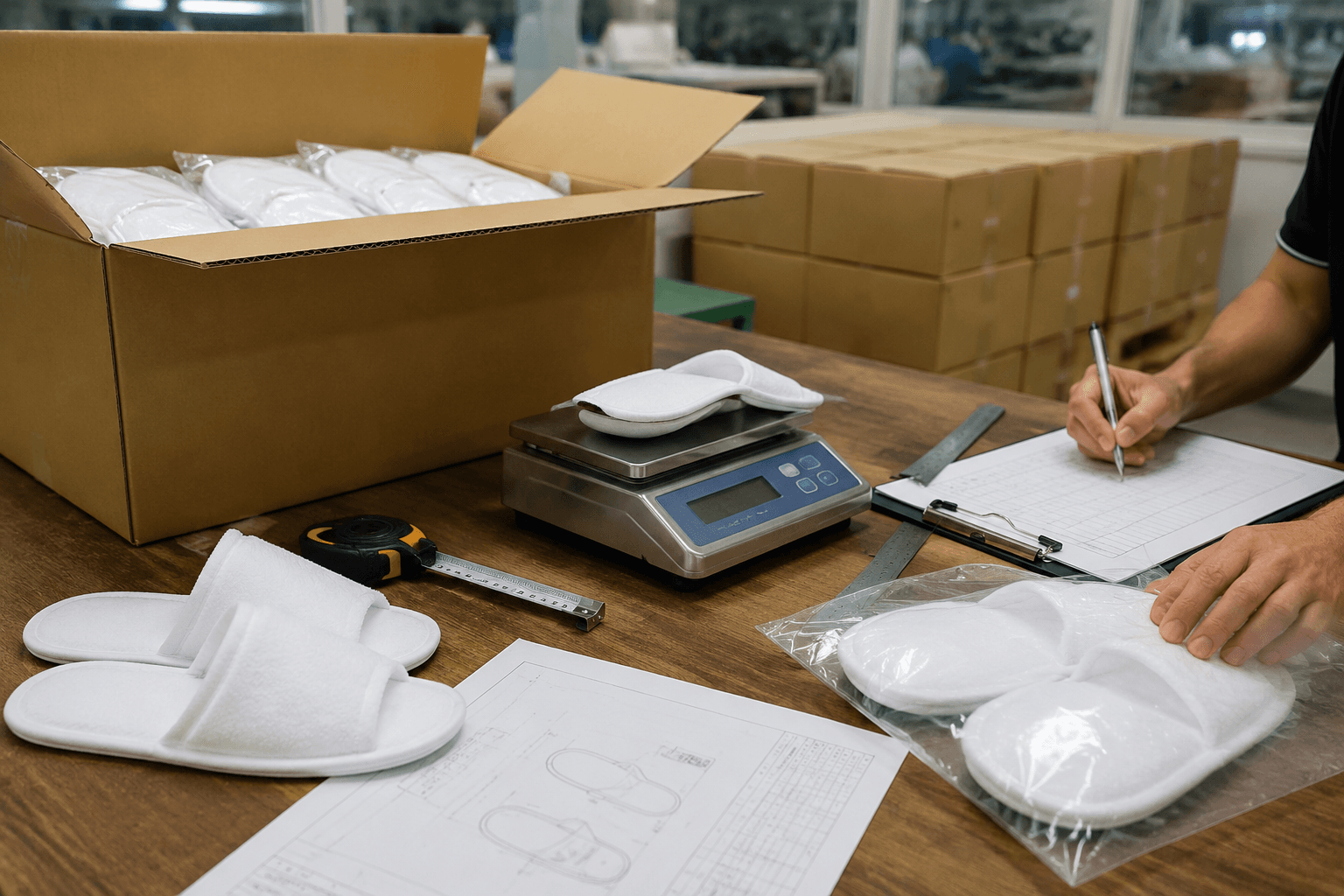
Create a realistic procurement and QC scene for hotel slipper carton packing. Show a clean packing bench with white open-toe disposable hotel slippers made from non-woven upper material and light EVA soles, clear individual bags, a blank export carton, a tape measure, a digital scale, a caliper, and slippers stacked in rows before carton sealing.
The main carton should visually match the example planning size of about 60 cm x 40 cm x 35 cm without showing readable text. Include one sealed carton with blank shipping-mark blocks, visible tape seams, and slight realistic side-wall pressure to suggest carton bulge after packing.
The image should make the buyer understand slipper thickness, pair orientation, carton dimensions, gross weight checking, and volumetric freight risk. The setting should look like a procurement inspection table before carton approval, not a hotel room, retail catalog, or lifestyle scene.
- Visible objects: slippers, inner bags, export carton, scale, tape measure, caliper, blank sample approval sheet, and non-readable carton layout blocks.
- Product focus: packing density, sealed carton measurement, gross weight check, pair orientation, and QC readiness.
- Avoid readable text, logos, brand marks, certificates, customer names, impossible machinery, and identifiable people.
FAQ
What carton details should be mandatory in a hotel slipper quote? Require pairs per master carton, sealed outside carton length, width, and height in centimeters, net weight, gross weight, CBM per carton, inner packing method, carton board description, carton mark plan, and total carton count. The quote should also state whether the data comes from an actual packed sample, a pre-production packing test, a carton drawing, or an estimate.
How do I calculate hotel slipper carton CBM? Measure the sealed outside carton dimensions, then multiply length x width x height in meters. In the example planning calculation prepared as of 2026-07-21, a 60 cm x 40 cm x 35 cm carton equals 0.60 m x 0.40 m x 0.35 m = 0.084 CBM per carton. Verify the final value against the supplier's packed-carton measurement.
Why can hotel slipper freight billable weight be higher than actual gross weight? Lightweight slippers can occupy a large carton while weighing little. For express shipments, carriers may compare actual gross weight with dimensional weight and bill the higher number. Using the DHL source-context formula accessed 2026-07-21, a 60 cm x 40 cm x 35 cm carton equals 16.8 kg dimensional weight when divided by 5,000, even if the example actual gross weight is 10.0 kg.
Can buyers reduce freight cost by packing more pairs per carton? Sometimes. Higher pair count can reduce carton count, CBM, storage cube, and chargeable weight per pair. The buyer should stop increasing density when slippers show bent EVA soles, wrinkled uppers, deformed closed toes, torn paper bands, collapsed retail boxes, carton bulge, or poor recovery after unpacking.
What is a realistic MOQ for custom hotel slippers? There is no universal hotel slipper MOQ because the limiting component can be fabric, EVA sole sheet, binding, embroidery, printing, carton marks, or retail packaging. As an example planning assumption to verify in the supplier quote, a plain stock-like disposable slipper program may be planned at 3,000 to 5,000 pairs per color and specification. Custom-dyed fabric, molded sole work, retail boxes, or printed packaging may require a higher MOQ.
When should hotel slipper carton approval happen? Carton approval should happen with sample approval, not after the slipper design is already locked. Approve the slipper, logo, inner packing, pairs per carton, sealed carton dimensions, carton marks, and carton measurement method before mass production.