
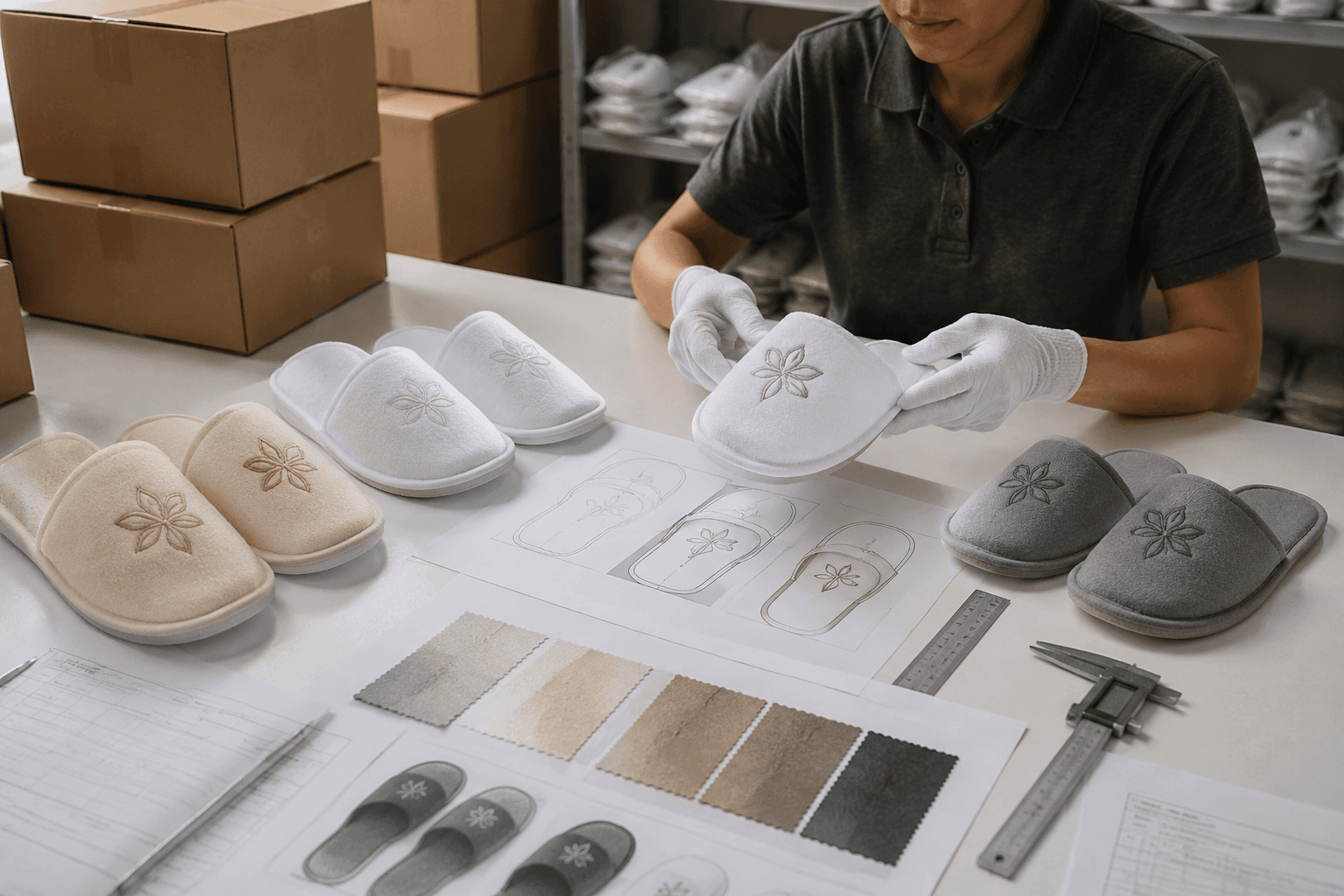
When This Checklist Is Needed
Use this low MOQ custom hotel slippers embroidery artwork approval checklist when a small hotel, resort, serviced apartment, spa, cruise operator, amenity distributor, or private-label buyer wants embroidered slippers but does not have enough order volume to absorb repeated sampling mistakes. A low MOQ order can still block a launch if the logo is unreadable, the thread shade misses the brand guide, left and right slippers do not match, or carton labels fail warehouse receiving.
The first buyer decision is whether the order is a stock-base customization or a deeper custom build. A stock disposable hotel slipper with one-position embroidery usually needs fewer approvals than a new upper color, custom terry GSM, waffle fabric texture, velour upper, special EVA outsole, printed box, barcode label, and mixed-size carton plan. Treat those as different procurement projects even if the finished item has the same product name.
Author note: Vincent Xi is the named Editorial Author for this SlipperForge article. The approved author source is https://slipperforge.com/authors/vincent-xi/. This article uses buyer-facing editorial analysis and does not claim factory visits, product tests, certification, client results, or first-person experience.
- Use case: low MOQ embroidered slippers for hotels, serviced apartments, spas, resorts, airlines, cruises, amenity distributors, and private-label guestroom suppliers.
- Main risk: approving the logo image without controlling stitch file, thread reference, logo size, placement, upper fabric, left-right orientation, packing, and carton data.
- Approval target: one controlled approval pack that sourcing, design, QA, logistics, warehouse, and accounts teams can check against the same version.
- Minimum evidence: original artwork, supplier digitizing preview, stitched sample on final upper fabric, signed pre-production sample record, and packing proof.
Decide the MOQ Scope Before Price Negotiation
Do not ask only, what is your MOQ. Ask what the MOQ is counted against. A supplier may count MOQ by style, color, size set, upper fabric, logo file, thread color set, sole type, packaging artwork, or purchase order. A buyer who thinks it is placing one 600-pair order may actually be asking for several separate setups.
For comparison, request example RFQ tiers such as 300 pairs, 500 pairs, and 1,000 pairs per style, color, size run, sole type, embroidery position, and packing method. These quantities are example planning tiers to verify in the supplier quote, not universal MOQs. Ask the supplier to state what changes at each tier: unit price, sample fee, digitizing fee, embroidery charge, packaging cost, and production lead time.
If the first order is a market test, decide which custom elements matter now. Embroidery on a stock white terry slipper may support a hotel opening order. Custom upper color, contrast binding, printed carton, retail box, QR or barcode label, and separate packing for each room category may be better held for a reorder once demand is clearer.
- Ask whether MOQ applies per style, color, size set, embroidery file, thread color set, packaging artwork, outsole type, or shipment.
- Request sample charge, digitizing charge, unit price, embroidery charge, packing cost, carton cost, and inspection sample allowance as separate fields.
- Ask whether quoted quantities include spare pairs, retained samples, inspection samples, showroom samples, photo samples, and replacement allowance.
- State the incoterm basis, such as EXW, FOB, CIF, or DAP, and ask for the named place or port.
- Confirm whether the embroidery setup can be reused for reorders and whether repeat-order sampling fees apply.
Send Artwork That Can Be Produced
Embroidery is not a printed logo. Fine lines, small serif letters, location text, and detailed hotel crests may disappear into terry loops or distort on waffle fabric. Before sampling, decide whether the mark should be simplified into initials, a larger monogram, a border-only version, a woven label, a heat-transfer label, or printed packaging instead of embroidery.
The supplier needs more than a file. Give the logo width and height in millimeters, color reference, thread count, desired stitch look, placement point, and left-right orientation. If both slippers carry the logo, state whether the embroidery faces the same direction or is mirrored as a pair.
Example specification to verify with the supplier: logo width 38 millimeters and height 18 millimeters per slipper, centered on the vamp of the approved size M sample, with the bottom stitch edge 42 millimeters from the toe seam. These dimensions are example assumptions for quote and sample discussion; the final values must match the approved sample and supplier process capability.
- Artwork file: AI, EPS, editable PDF, SVG, or another supplier-approved vector format.
- Avoid relying only on PNG or JPG when embroidery digitizing is required.
- Logo size: width and height in millimeters, measured from outer stitch edge after embroidery.
- Thread color: Pantone reference where available, plus the supplier's closest stocked embroidery thread code.
- Placement: distance from toe edge, vamp opening, centerline, binding, or another visible construction point.
- Orientation: left slipper only, right slipper only, both slippers same direction, or mirrored pair.
- Version control: use artwork revision codes and final approval date so old logo files are not pulled into production.
Approve Stitching on the Real Upper Fabric
A digital mockup can answer one decision: does the logo position look roughly right. It cannot answer whether the stitch sinks into terry, puckers waffle fabric, shines on velour, leaves visible backing, or feels stiff over the top of the foot.
Ask for the stitched sample on the final upper material before bulk panel cutting. Loose test cloth is useful for thread checks, but it does not prove how the embroidery behaves after the slipper upper is cut, shaped, bound, lined, stitched, and paired with the outsole.
If the supplier flags readability problems, do not treat that as a delay. It may be the cheapest point to revise the logo. Thick fill areas, tight lettering, and multi-color borders can increase stitch density, thread breaks, puckering, needle marks, and hand-feel problems.
- Confirm stitch type: flat embroidery, satin stitch, fill stitch, border stitch, chain stitch, or applique where relevant.
- Confirm color count: one-color embroidery is simpler; multi-color embroidery adds setup and shade-match risk.
- Confirm backing method: visible stabilizer trimmed away, hidden by lining, or otherwise controlled by the construction.
- Confirm comfort: dense stitching should not create a rough or hard patch where the foot contacts the upper.
- Confirm cleanup: loose threads, skipped stitches, broken stitches, exposed backing, oil marks, and puckering should be classified before production.
Use a Sample Sequence That Matches the Risk
For a simple stock-base order, a buyer may approve a digital layout, stitched vamp sample, and final pre-production sample. For a custom upper, outsole, lining, foam, binding, or packaging order, add construction and packaging samples before final approval. The sequence should match the number of things that can go wrong.
The construction sample answers fit-for-use questions that embroidery cannot answer: toe opening shape, binding alignment, foam thickness, EVA or TPR outsole grip, pair symmetry, size marking, heel height, insole feel, and packing neatness. A good logo on the wrong slipper construction still fails the buyer's room standard.
The final pre-production sample should tie the commercial order to the physical item. Record the date, version number, sample quantity, thread reference, logo dimensions, placement measurement, upper material, lining material, foam thickness, sole type, packaging method, carton mark version, and approver role.
- Digital layout: confirms rough scale, position, orientation, and packaging artwork direction.
- Embroidery swatch: confirms thread color, stitch density, readability, edge cleanup, and backing method.
- Construction sample: confirms upper fabric, lining, foam, outsole, size range, pair shape, and general fit.
- Packaging proof: confirms pair folding, polybag, belly band, tissue wrap, printed box, barcode, SKU label, and carton mark.
- Pre-production sample: confirms the complete product before mass cutting, embroidery, stitching, assembly, packing, and shipment.
- Change control: require written approval before changing logo size, thread color, upper fabric, outsole, packing method, or carton count.
Put Tolerances in the PO
A purchase order should not rely on phrases such as premium quality, centered logo, or same as sample without measurement points. Put the measurable fields in the PO and attach the approved sample record. That gives the supplier, inspector, warehouse, and accounts team the same reference.
Example tolerance assumption to verify with the supplier: logo size tolerance of plus or minus 1 millimeter per embroidered logo and placement tolerance of plus or minus 2 millimeters per approved size sample. These tolerances are examples only; textured fabrics, cutting variation, foam recovery, and slipper shaping may require different agreed limits.
For carton planning, example calculation to verify in the supplier quote: a 1,000-pair order packed at 50 pairs per export carton requires 20 export cartons before retained samples, mixed-SKU cartons, palletization, or special master-carton rules. Ask for final carton dimensions and weights after packaging approval.
- Logo measurement: width and height in millimeters, measured from outer stitch edges after embroidery.
- Placement measurement: distance from toe edge, vamp opening, centerline, or binding in millimeters.
- Material fields: upper fabric type, upper GSM if available, lining, foam thickness in millimeters, outsole type, and outsole thickness in millimeters.
- Color fields: upper color reference, binding color reference, thread reference, shade approval route, and approval lighting condition where relevant.
- Size fields: size set, insole length or outsole length in millimeters where applicable, size label position, and size assortment per carton.
- Packaging fields: pair pack method, inner bag or wrap, SKU label, barcode, carton mark, pairs per carton, carton sealing method, and mixed-SKU rule.
- Inspection fields: approved sample reference, defect categories, sampling plan if agreed, inspection timing, measurement tools, and photo evidence requirements.
Inspect Before Full Assembly
Embroidery is usually applied to upper panels before assembly. That is the practical checkpoint. If wrong thread color, off-center placement, mirrored-pair error, or puckering is found after packing, the correction may require unpacking, sorting, remaking panels, re-stitching uppers, or repacking cartons.
Some buyers reference ISO 2859-1, an international standard for sampling procedures for inspection by attributes. Referencing ISO 2859-1 does not mean a supplier is certified, and it does not choose the buyer's AQL values. The buyer must state inspection level, defect classes, acceptance rules, and reinspection responsibility.
Example defect classification to verify in the inspection checklist: missing logo, wrong logo, wrong thread color, and severe off-center embroidery may be major defects for a hotel amenity order. The final classification should be agreed before inspection booking because a cosmetic issue for one buyer may be a commercial rejection for another.
- Incoming check: upper fabric color, texture, width, cleanliness, thread color, foam, outsole material, adhesive, and packaging materials.
- First-piece embroidery check: approve the first stitched panel against the signed artwork file before mass embroidery continues.
- Panel-stage check: verify logo size, placement, orientation, thread shade, backing cleanup, and fabric puckering before assembly.
- Inline assembly check: verify pair matching, toe shape, binding alignment, outsole adhesion, sole cleanliness, and embroidery position after stitching.
- Packing check: verify pair count, left-right pair matching, polybag or wrap, insert card, barcode, SKU label, carton mark, and carton quantity.
- Final inspection: check sampled cartons against the specification, approved sample, packing list, and defect classification before shipment release.
- Records: request dated photos of embroidery setup, first-piece approval, packed cartons, carton marks, and final pallet or loading condition where applicable.
Confirm Packaging Before Freight Booking
Packaging is a branding decision and a logistics decision. Clear polybag, paper belly band, recycled paper sleeve, printed kraft box, cotton bag, and room-ready amenity kit each change unit cost, packing speed, carton volume, barcode handling, and document needs. For low MOQ orders, packaging MOQ can be higher than slipper MOQ.
Ask for carton data during the RFQ, not after production. Procurement needs pairs per carton and packing method; forwarders need carton dimensions in centimeters, gross weight in kilograms, net weight in kilograms, and volume in cubic meters; warehouses need SKU labels, carton marks, mixed-SKU rules, and carton numbering.
Example freight calculation to verify with the supplier: if one export carton measures 60 centimeters by 40 centimeters by 50 centimeters, the carton volume is 0.12 cubic meter per carton. For 10 export cartons, calculated volume is 1.20 cubic meters before palletization, rounding, and carrier dimensional-weight rules. These are assumed carton dimensions for planning only.
- Confirm whether slippers are packed one pair per polybag, paper wrap, belly band, cotton bag, printed box, or bulk carton.
- Ask whether packaging artwork has its own proof, print tolerance, barcode proof, and approval sample.
- Request carton dimensions in centimeters, gross weight in kilograms, net weight in kilograms, and pairs per carton.
- Ask for carton mark content: buyer code, SKU, color, size, quantity, country of origin where required, PO number, carton number, and handling marks.
- Confirm whether the shipment uses loose cartons, palletized cartons, mixed-SKU cartons, or single-SKU cartons.
- Check whether branded packaging changes shipment volume enough to affect air freight, courier dimensional charges, storage cost, or warehouse receiving rules.
Request Destination-Market Documents
Ask for compliance documents early when slippers are imported into regulated markets or sold through distributors with onboarding manuals. A general supplier statement such as materials are safe is not enough for a buyer file.
Relevant requests may include material composition, country-of-origin details, commercial invoice, packing list, restricted-substance declarations, and test reports where applicable. For European Union sourcing discussions, REACH restricted-substance context may be relevant depending on materials, dyes, adhesives, inks, thread, outsole, and packaging. For the United States, buyers may need to verify labeling, customs classification support, and retailer-specific restricted substance lists.
Naming a standard or regulation in the RFQ is not proof of compliance. Check report date, tested component, product description, sample photo, issuing organization, and whether the report covers the exact material lot or batch. This article does not certify any SlipperForge product, supplier, material, adhesive, dye, ink, thread, outsole, or packaging component.
- Request material composition for upper, lining, foam, outsole, thread, binding, adhesive, and packaging.
- Ask for current test reports only where relevant, and check product description, sample photo, test date, tested components, and issuing organization.
- Confirm country-of-origin marking requirements with the importer, customs broker, or destination-market compliance adviser.
- Ask whether packaging inks, stickers, bags, or printed boxes are included in any restricted-substance review.
- Verify whether hotel, distributor, or retail buyer manuals require extra carton labels, barcode formats, packaging material declarations, or sustainability documentation.
- Do not treat old certificates, unrelated reports, screenshots, or documents for a different material as proof for a new custom batch without review.
RFQ Fields to Send Before Final Price
A good RFQ lets the supplier quote the actual product instead of guessing. It should be specific enough to show cost drivers and flexible enough for the supplier to flag embroidery readability issues, packaging MOQ conflicts, stock-material substitutions, thread availability, or carton-volume problems before sampling.
Keep commercial, technical, packaging, inspection, and logistics fields in one controlled RFQ version. When details are split across email threads, old attachments, and chat messages, the supplier may quote the wrong logo, wrong packing, wrong sole, or wrong material grade.
Example timing assumptions to verify with the supplier: quote clarification may take 3 to 7 business days after a complete RFQ is received, sample preparation may take 5 to 10 business days after editable artwork and material choices are confirmed, and bulk production may take 20 to 35 calendar days after sample approval and deposit. These are planning ranges only; the supplier's written schedule controls.
- Buyer details: company name, destination market, importer of record if known, target hotel or channel type, delivery deadline, and incoterm.
- Product details: open-toe or closed-toe, disposable or reusable positioning, upper material, lining material, color, size range, sole type, sole thickness, foam thickness, and expected room category.
- Embroidery details: artwork file, logo size in millimeters, thread reference, color count, placement measurement, left-right orientation, backing method, and approval version.
- MOQ request: ask for price at 300 pairs, 500 pairs, 1,000 pairs, and a reorder quantity where relevant; these are example RFQ tiers to verify in the supplier quote.
- Cost breakdown: request sample fee, digitizing fee, unit price, embroidery charge, packaging cost, carton cost, and inspection sample allowance.
- Packaging request: pair pack, inner label, barcode, carton mark, pairs per carton, carton dimensions, gross weight estimate, and mixed-SKU rule.
- Compliance request: destination-market documents, material declarations, test reports if needed, country-of-origin marking, and buyer manual requirements.
- Inspection request: approved sample reference, defect classifications, AQL-style sampling if agreed, inspection timing, measurement method, and photo record expectations.
RFQ Wording Buyers Can Adapt
Price request: Please quote low MOQ custom embroidered hotel slippers based on the attached editable logo file and specification sheet. Quote example planning tiers of 300 pairs, 500 pairs, and 1,000 pairs per style, color, size set, embroidery position, and packaging method. Please state whether MOQ is counted per SKU, logo file, thread color set, packaging artwork, outsole type, or purchase order.
Artwork request: Please provide an embroidery digitizing preview before sampling. Example target logo size to verify is 38 millimeters wide by 18 millimeters high, centered on the vamp of the approved size M sample. Please state the closest stocked thread code to the buyer's color reference and flag any readability issue before stitching.
Production and shipment request: Do not start bulk panel cutting until the stitched sample and complete pre-production sample are approved in writing. Please confirm pairs per carton, carton dimensions in centimeters, gross weight in kilograms, net weight in kilograms, mixed-SKU packing rules, carton mark layout, incoterm basis, and named place or port. Please mark any deviation from this RFQ in a separate exception column.
- Use one RFQ version number and keep all attachments under that version.
- Ask the supplier to quote exceptions instead of silently replacing material, sole, logo size, thread shade, or packaging.
- Require written approval before changing thread color, logo size, embroidery position, upper fabric, outsole, or packing method.
- Keep the supplier's signed quote, approved sample photos, pre-production sample record, and final PO specification in the same procurement file.
Prevent First-Order and Reorder Rework
Most preventable embroidery failures start at approval: the buyer approves a mockup without stitch proof, the supplier chooses a close thread color without confirmation, the logo is centered on a flat panel but shifts after shaping, or both slippers are embroidered in the same direction when the buyer expected a mirrored pair.
Low MOQ orders need restraint. Each extra customization creates another approval point: upper color, embroidery, outsole color, retail box, barcode label, hangtag, sustainability claim, and mixed-size carton. Choose the custom elements that affect the buyer's room standard now and leave low-value variations for a reorder.
Protect the reorder by storing the approved embroidery file, thread code, upper material code, sole specification, packaging artwork, carton plan, and inspection record. Example reorder-risk window to verify against the buyer's purchasing cycle: a reorder placed 6 months after the first shipment can drift if the supplier and buyer rely only on a product name instead of the approved specification pack.
- Risk: logo too small for embroidery. Control: approve stitched sample and simplify fine text before production.
- Risk: wrong thread shade. Control: confirm supplier thread code against Pantone or approved physical sample under neutral light.
- Risk: off-center placement. Control: specify measurement from defined construction points and inspect first stitched panels.
- Risk: dense embroidery feels uncomfortable. Control: test the logo on the final upper material and assess stiffness before approval.
- Risk: left-right orientation error. Control: include pair orientation instructions in the RFQ and pre-production sample approval.
- Risk: packaging mismatch. Control: approve barcode, SKU label, carton mark, and pair-packing method before final packing.
- Risk: shipment volume surprise. Control: obtain carton dimensions, gross weight, net weight, and pairs per carton before booking freight.
FAQ
What should a low MOQ custom hotel slippers embroidery artwork approval checklist include? It should include editable artwork, embroidery digitizing preview, thread color reference, logo width and height in millimeters, placement measurement, upper material, backing method, stitched sample, pre-production sample record, packaging proof, carton plan, QC checkpoints, compliance document request, and written tolerance fields.
What is a realistic MOQ for custom embroidered hotel slippers? MOQ depends on supplier setup, base slipper availability, upper fabric, color, logo complexity, sole type, size run, and packaging. Example RFQ tiers to verify are 300 pairs for a stock base slipper with one-position embroidery, 500 pairs for custom upper color, and 1,000 pairs for more customized construction or packaging. These are planning examples only; the supplier's written quote controls.
Is a digital mockup enough to approve embroidery artwork on hotel slippers? No. A digital mockup is useful for layout and scale, but it does not prove stitch quality, thread shade, logo readability, terry pile distortion, waffle fabric puckering, backing visibility, or comfort. Buyers should approve a stitched sample on the final upper material before mass production.
Which embroidery tolerances should be written into the purchase order? The PO should state logo width and height in millimeters, placement measurement from a defined point, allowed size and placement tolerance, thread reference, orientation, and defect classification. Example assumptions to verify are plus or minus 1 millimeter for logo size and plus or minus 2 millimeters for placement.
Which materials affect embroidered slipper MOQ and sampling? Upper fabric such as terry, waffle, velour, cotton blend, microfiber, or non-woven material can affect stitch readability and MOQ. Foam thickness, lining material, binding color, EVA outsole thickness, TPR outsole choice, thread colors, and branded packaging can also create separate setup or sampling requirements.
What packaging details should be approved for hotel slipper orders? Approve pair packing, polybag or paper wrap, belly band, insert card, printed box if used, barcode, SKU label, carton mark, pairs per carton, carton dimensions, gross weight, net weight, and mixed-SKU rules. Packaging affects landed cost, warehouse receiving, housekeeping distribution, and freight volume.