
Byline, Sources, And Limits
Byline: Vincent Xi, Editorial Author. Author profile: https://slipperforge.com/authors/vincent-xi/. The same Person data should be used for Article or BlogPosting structured data: name Vincent Xi, jobTitle Editorial Author, URL https://slipperforge.com/authors/vincent-xi/.
The source contexts for this guide are narrow: the SlipperForge author profile for attribution, accessed July 2026; ICC Incoterms 2020 for trade-term language; and ISO 2859-1 or ANSI/ASQ Z1.4 only when a buyer chooses those lot-sampling references for inspection. None of those sources proves that a specific slipper, supplier, component, shipment, or packaging claim is certified.
Method note: the exact timing ranges, MOQ ranges, tolerance examples, and carton math are July 2026 quote-planning assumptions to verify with the supplier. They are not promises about any specific factory, order, capacity window, freight lane, or destination market.
Verify before deposit: current quote validity, material availability, production slot, sample charge, logo setup fee, mold fee if applicable, certificate scope, test-report scope, packaging rules, destination-market requirements, retailer receiving rules, and forwarder pricing basis.
- Use the article as an RFQ and approval-file checklist, not as a substitute for a signed supplier quote.
- Keep compliance claims out of artwork, cartons, marketplace listings, and buyer files unless current traceable documents support the exact material, color, component, and date range.
- If a document covers a similar material instead of the quoted slipper, treat it as a gap until the buyer accepts that scope in writing.
When The Sample Clock Starts
The private label amenity slippers sample approval timeline starts only after the buyer freezes the commercial brief: slipper type, target guest or kit use, destination market, branding method, packaging method, target landed-cost ceiling, required documents, receiving rules, and inspection plan. If those inputs are still moving, the sample room may make a good-looking slipper that cannot meet the buyer's MOQ, carton, compliance, or launch constraints.
For July 2026 quote planning, a practical example timeline to verify in the supplier quote is business days 1-3 for RFQ clarification after specification freeze, business days 4-10 for sample making after material and artwork approval, business days 3-6 for courier movement after dispatch from an East Asia supplier to a North America or Western Europe buyer office, business days 2-4 for buyer review after physical receipt, and business days 5-10 for a revised sample if construction, logo execution, upper color, packaging, or carton method changes. The scope is sample approval planning, not bulk-production lead time.
- Separate supplier sample-making time from courier time, customs delay, holiday closure, remote-area delivery, and buyer review time.
- Name decision owners for construction, branding, packaging, and compliance files so supplier comments do not conflict.
- Ask whether stock terry, waffle, nonwoven upper, EVA outsole, binding tape, and bag material can be reserved before final approval or only after deposit.
- Ask whether a revised sample restarts the schedule or qualifies as a correction using the same pattern, upper material, outsole, logo method, and packing method.
RFQ Inputs That Prevent Drift
The buyer's first decision is where private label begins. A distributor may only need a stock white open-toe terry slipper with a small woven label. A retail spa-kit buyer may need a closed-toe waffle slipper, branded bag, insert card, barcode label, restricted-substance files, and carton marks that match a warehouse booking. Those are different sampling jobs and should not share the same RFQ wording.
For July 2026 MOQ planning, use these example assumptions to verify in the supplier quote: 500-1,000 pairs per SKU for stock-material open-toe or closed-toe amenity slippers, 1,000-3,000 pairs per SKU for custom upper color, embroidery, binding, or printed packaging, and 3,000-5,000 pairs per outsole color or molded-logo outsole setup where material setup or mold setup is dedicated. The supplier should state whether MOQ is controlled by finished pairs, component setup quantity, color batch, or logo version.
- Product fields: open toe or closed toe, guest size range, finished outsole length in millimeters, upper material, lining material, foam layer, EVA or TPR outsole material if quoted, outsole thickness, binding color, and use channel.
- Branding fields: embroidery, woven label, heat transfer, printed upper, or printed bag; artwork file format; logo width and height in millimeters; placement reference point; thread or ink color reference; and physical approval requirement.
- Packaging fields: individual OPP bag, biodegradable bag if required and documented, kraft paper band, insert card size, barcode or SKU label, pair-folding method, pair count per carton, carton marks, pallet rule, and plastic-reduction requirement if relevant.
- Commercial fields: MOQ by SKU, sample fee, logo setup fee, printing plate fee if applicable, mold fee if applicable, production lead-time assumption, payment terms, ICC Incoterms 2020 trade term, quote validity, and sample revision cost.
Sample Gates Buyers Should Not Merge
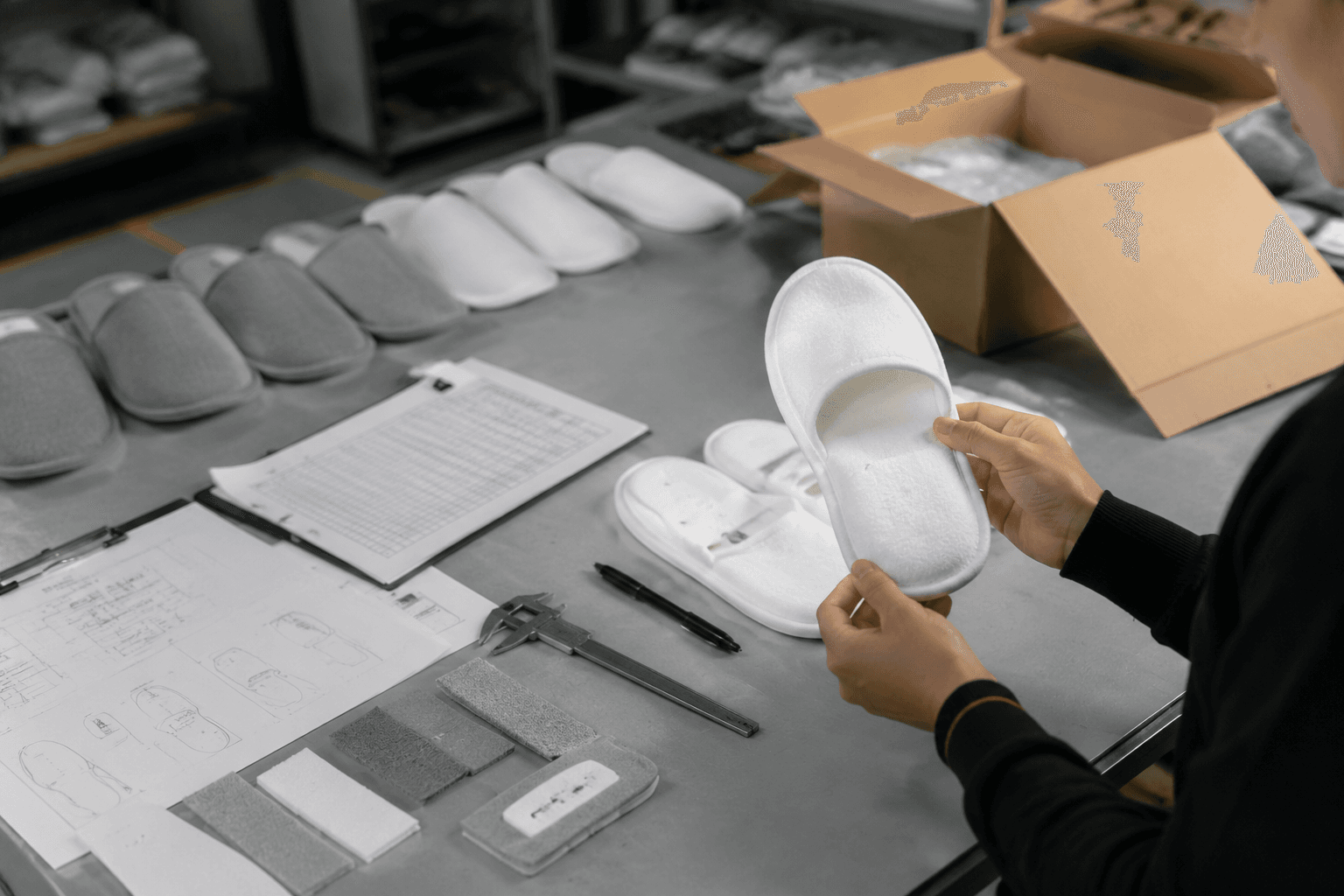
A construction sample answers a product question: does the slipper shape, upper, lining, outsole, foam layer, stitching, binding, grip texture, and finish suit the channel? It should not be used to silently approve logo color, bag artwork, barcode placement, carton count, or compliance scope.
A logo sample answers a branding question: will embroidery density, thread shade, woven-label edge, heat-transfer adhesion, printed upper artwork, or bag printing look acceptable on the actual material? This matters most on terry, waffle, nonwoven, and curved closed-toe uppers, where a logo can shift or distort after stitching and folding.
An amenity slipper packaging approval answers a receiving question: can the buyer accept the pair fold, bag fit, insert size, barcode position, carton quantity, carton mark, and carton compression? For retail or distributor programs, late packaging approval can be more expensive than late construction approval because labels, inserts, bags, and cartons may already be printed.
The custom hotel slipper pre-production sample should combine the confirmed construction, confirmed logo method, confirmed packaging, and intended production route. If the buyer skips this gate to save time, the purchase file should state which checks move to inline inspection or pre-shipment inspection.
- Label each physical sample as construction sample, logo sample, packaging sample, revised sample, or pre-production sample.
- Keep approved photos for top view, side view, outsole, toe opening, logo placement area, bagged pair, carton mark, and measurement points.
- Require supplier comments when a requested change affects MOQ, unit price, setup fee, material lead time, carton dimensions, carton quantity, or production start date.
Tolerances Worth Signing
A signed sample without measurements leaves too much room for dispute. A short outsole can make a hotel amenity feel cheap. A logo placed too low on a closed-toe upper may disappear from the presentation angle. A thinner EVA sole can reduce perceived value and change carton compression. A larger insert card can change freight volume even when the slipper is unchanged.
For July 2026 specification planning, example tolerance assumptions to verify in the signed supplier spec are finished outsole length at plus or minus 3 millimeters per pair, sole thickness at plus or minus 0.5 millimeter at forefoot and heel, logo placement at plus or minus 2 millimeters from the approved artwork position, and carton gross weight at plus or minus 1 kilogram per export carton. The scope is buyer-supplier inspection control for amenity slippers, not a default SlipperForge production tolerance.
- Measure: finished outsole length, upper height, toe opening width, sole layer count, EVA or foam thickness, binding width, left-right pairing, and size mark if used.
- Define materials: terry cloth, waffle fabric, nonwoven fabric, brushed fabric, lining fabric, foam density if quoted, EVA outsole, TPR outsole if quoted, outsole grip pattern, binding material, thread, glue type if documented, and approved shade reference.
- Define branding: logo method, logo size, logo color reference, logo placement from heel or toe reference point, artwork version, stitch density or print method if relevant, and acceptable logo skew.
- Define packaging: bag type, insert size, barcode label position, pair count, inner count if applicable, export carton dimensions in centimeters, gross weight in kilograms, carton mark layout, and carton sealing method.
Packaging And Carton Math
Approve packaging before sample signoff when the buyer has retail, distributor, property, marketplace, or warehouse rules. Bag thickness, insert fit, folding method, label position, carton quantity, and carton compression can change landed cost and receiving acceptance. For hotel back-of-house replenishment, bulk cartons may be enough; for retail spa kits, the pack may need individual bags, insert cards, barcode labels, and cleaner presentation after transit.
For July 2026 carton planning, an example calculation to verify with the supplier and forwarder is 200 pairs per export carton for a lightweight open-toe amenity-slipper SKU, carton dimensions of 60 centimeters by 45 centimeters by 45 centimeters, and 13 kilograms gross weight per export carton. The carton volume in this example is 0.1215 cubic meter, derived from 0.60 meter multiplied by 0.45 meter multiplied by 0.45 meter. The buyer should check whether the carton bulges, whether compression crushes uppers, and whether freight is priced by actual weight, cubic meter, dimensional weight, or another chargeable-weight method.
- Approve whether each pair is compressed, nested, folded, sleeved, bagged, paper-banded, or laid flat.
- Check carton marks for SKU, size, color, quantity, country of origin, PO number, destination, carton sequence, and property or channel code if split distribution is used.
- Ask for packing photos before the pre-production sample is signed, not after the production cartons are sealed.
- Request plastic-reduction, recycled-content, FSC paper, or marketplace packaging documents only when the channel and market actually require them, and verify the document scope before using the claim.
Compliance Files Before Deposit
Compliance scope should be decided before sample approval because material changes can invalidate a document request. A hospitality-only amenity slipper, retail spa kit, airline amenity pack, children's hospitality item, marketplace-listed private-label product, and branded gift set may need different document sets.
Relevant requests may include material composition, restricted-substance declarations, component-level test reports, packaging declarations, country-of-origin support, and current certificates where applicable. REACH, CPSIA, California Proposition 65, and OEKO-TEX Standard 100 should be named only when the buyer's destination market, user group, channel, or brand policy requires them.
Naming a regulation or standard in an RFQ creates a verification task. It is not evidence that the quoted slipper, upper fabric, logo thread, glue, outsole, bag, insert, or carton is certified unless the supplier provides a current traceable document covering the same material, component, color, supplier, and date range.
- Ask whether each report covers the finished product, a component, a raw material, or a similar material.
- Record document type, issue date, tested component, tested color, tested material, issuing body, scope, and expiry date if applicable.
- Do not release bulk production when required files are expired, missing, outside market scope, tied to another color, or tied to a different component.
QC Checkpoints After Approval
The approved sample is a reference, not an inspection plan. Buyers should define checkpoints for incoming material review, cutting and size sorting, stitching or binding, outsole attachment, logo execution, packing verification, carton sealing, and pre-shipment inspection. Common buyer-side risks include shade mismatch, weak sole bonding, uneven embroidery, loose binding, lint, odor, dirty packing, crushed uppers, barcode error, wrong carton count, and mixed sizes.
If the buyer or inspection company uses ISO 2859-1 or ANSI/ASQ Z1.4, state that choice in the purchase file as a lot-sampling method. These standards are not product certifications. The defect list still needs plain-language rules for critical, major, and minor issues because wrong branding, missing labels, moisture-damaged cartons, and minor trimming defects should not be treated alike.
- Incoming material check: compare bulk upper fabric, lining, binding, outsole, thread, and bag material against the approved swatch and approved sample under consistent lighting.
- In-process check: measure slipper length, sole thickness, toe opening, outsole bonding, logo position, stitching, binding, and left-right pairing before full packing starts.
- Packing check: open cartons during inspection to confirm pair count, bagging, insert card, barcode label position, carton marks, carton strength, and carton sealing method.
- Inspection booking question: confirm whether inspection can happen before full carton sealing and ask for the latest booking date relative to the planned shipment-ready date.
Freight And Launch Release
Final sample approval should trigger order release, deposit timing, material booking, production slot confirmation, inspection date, and freight booking. Do not compare supplier quotations only by ex-factory unit price when carton data is missing. Amenity slippers can be light but bulky, and underfilled or oversized cartons can damage landed-cost planning.
For July 2026 sample logistics planning, an example assumption to verify with the courier or forwarder is business days 3-6 after dispatch from an East Asia supplier to a North America or Western Europe buyer office, excluding customs holds, holidays, missing paperwork, and remote-area delivery delays. For bulk shipment, compare quotes only after carton count, gross weight, net weight, carton dimensions, and the agreed ICC Incoterms 2020 trade term with named handover point are visible.
- Ask the supplier to quote EXW, FOB, FCA, CIF, DAP, or another agreed ICC Incoterms 2020 trade term with the named warehouse, port, or handover point.
- Estimate landed cost after carton data, packing method, unit quantity, duties, destination charges, and forwarder assumptions are visible.
- Check whether split shipments, property-by-property carton marks, seasonal launch dates, retail booking windows, or holiday closures affect the production plan.
- Release deposit only when the buyer has the signed sample, signed spec sheet, artwork approval, packaging approval, document plan, carton data, and inspection approach.
Supplier Wording For The RFQ
Use wording the supplier can answer line by line. The goal is not to make the RFQ longer; it is to stop silent substitutions in upper fabric, outsole thickness, logo method, bag style, insert size, carton quantity, and inspection files.
Ask the supplier to mark each item as confirmed, estimated, unavailable, or requiring buyer approval. That format makes quote comparison easier for importers, distributors, retail buyers, brand founders, and procurement managers.
- Product: Quote open-toe or closed-toe amenity slippers with finished outsole length in millimeters, upper material, lining material, sole material, sole thickness in millimeters, binding color, and target guest-use channel.
- MOQ: Confirm MOQ by SKU, size, upper color, logo version, packaging version, outsole setup, delivery batch, and purchase-order line.
- Branding: Quote logo method separately and provide a physical approval sample for embroidery, woven label, heat transfer, printed upper, or printed bag before bulk production.
- Packaging: Quote individual pair bag, insert card, barcode label, inner carton if applicable, export carton quantity, export carton dimensions, carton gross weight, and carton marks as approval items.
- Tolerance: Bulk production must follow the signed sample and signed specification for length, sole thickness, logo placement, shade, packaging, carton count, and carton gross weight.
- Revision: State cost and lead time for revised samples if the buyer changes construction, upper color, logo artwork, logo position, bag artwork, insert size, or carton method after the first sample.
FAQ
What is a realistic private label amenity slippers sample approval timeline? For July 2026 quote planning, an example assumption to verify in the supplier quote is business days 1-3 for RFQ clarification after specification freeze, business days 4-10 for sample making after material and artwork approval, business days 3-6 for courier movement after dispatch, and business days 2-4 for buyer review after receipt. A revised sample can add business days 5-10 if construction, logo, upper color, packaging, or carton method changes.
What MOQ should a distributor expect for private label amenity slippers? For July 2026 MOQ planning, example assumptions to verify in the supplier quote are 500-1,000 pairs per SKU for stock-material amenity slippers, 1,000-3,000 pairs per SKU for custom upper color, embroidery, binding, or printed packaging, and 3,000-5,000 pairs per outsole color or molded-logo outsole setup when dedicated setup is required. Ask whether MOQ is counted by SKU, color, size, outsole setup, logo version, packaging version, or delivery batch.
Do hotel amenity slippers need a pre-production sample? A pre-production sample is useful when the order includes a custom upper, logo embroidery, woven label, printed bag, insert card, barcode label, private carton mark, or buyer-specific inspection rule. It should combine the approved construction, logo method, packaging, and production route before bulk release.
Should logo approval and packaging approval happen before the pre-production sample? Yes. The construction sample can approve material and shape direction, but private label programs should check logo execution and packaging before the pre-production sample is signed. Embroidery density, woven-label edge, heat-transfer placement, bag printing, insert fit, barcode label position, carton quantity, and carton marks can all create rework if left until bulk packing.
Which tolerances should be written into the approved sample file? For July 2026 specification planning, example assumptions to verify in the signed supplier spec are outsole length at plus or minus 3 millimeters per pair, sole thickness at plus or minus 0.5 millimeter at forefoot and heel, logo placement at plus or minus 2 millimeters from the approved artwork position, and carton gross weight at plus or minus 1 kilogram per export carton. Final tolerances should match the buyer's channel, inspection method, and supplier capability.
Which compliance documents should buyers request before deposit? Request documents based on destination market, user group, packaging claim, and sales channel. Useful files can include material composition, restricted-substance declarations, component-level test reports, packaging declarations, country-of-origin support, and current certificates where applicable. REACH, CPSIA, California Proposition 65, and OEKO-TEX Standard 100 should be named only when the buyer has a real requirement for that market, channel, or brand policy.