
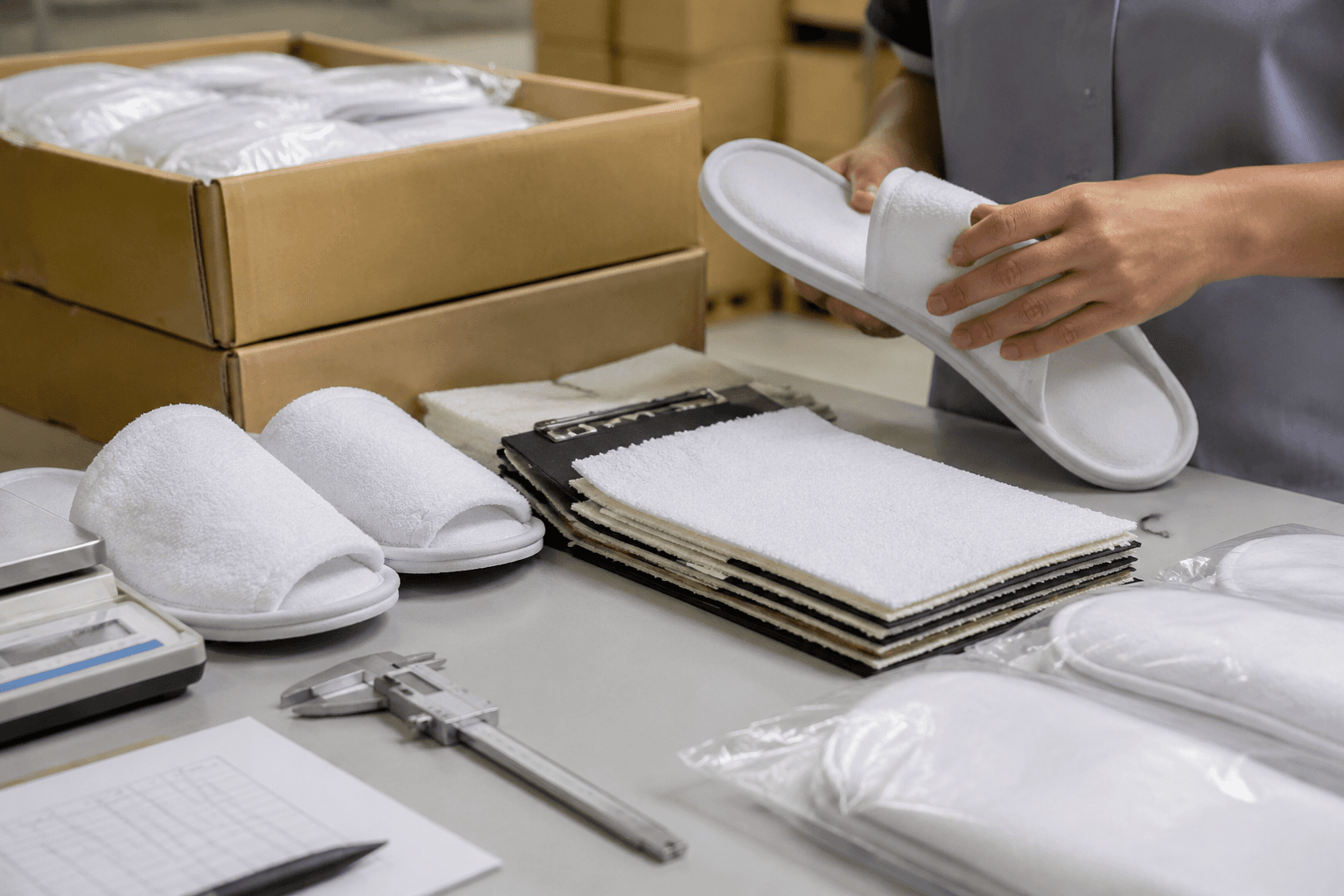
Author And Evidence Basis
Byline: Vincent Xi, Editorial Author, https://slipperforge.com/authors/vincent-xi/. The author attribution is based on the SlipperForge author profile only. This article does not claim factory visits, laboratory testing, customer outcomes, rankings, certifications, or first-person sourcing experience.
Methodology: this terry cloth hotel slipper GSM shrinkage guide is built from buyer RFQ fields, common hospitality slipper construction variables, textile dimensional-stability considerations, carton planning logic, and finished-goods inspection controls. Exact order numbers are marked as example assumptions or example calculations because MOQ, lead time, shrinkage acceptance, carton cube, document requirements, and pricing depend on the actual material, logo method, packaging, destination market, and production slot.
Source context 1: ISO 3758:2023 covers care labeling symbols for textiles. It can support care communication when a reusable slipper program needs laundering instructions, but it does not set a terry slipper GSM target and does not certify a supplier.
Source context 2: ISO 2859-1:1999, including later amendments, is commonly used for sampling procedures by attributes. It provides a sampling framework; the buyer still has to define defect categories, acceptance levels, and the inspection checklist.
Limitations: this guide does not verify SlipperForge, any supplier, or any factory certification. Buyers should request current documents, sample records, test reports, fabric roll data, carton measurements, and inspection evidence for the specific terry cloth hotel slipper order under negotiation.
Start With The Use Case
A terry cloth hotel slipper GSM shrinkage sourcing decision should begin with the room program, not the fabric number. A limited-service guest-room slipper is usually judged on clean presentation, short-use comfort, low odor, compact packing, replenishment speed, and stable cost. A spa or suite slipper is judged on thicker hand feel, more secure outsole, better dimensional stability, and stronger presentation after handling.
The first buyer decision is whether the slipper is disposable, semi-reusable, or reusable. Disposable terry hotel slippers may need storage-stability checks more than wash testing. Reusable slippers need a written wash assumption, drying method, measurement points, and shrinkage tolerance before sample approval. Semi-reusable spa slippers sit between those two positions and need tighter checks on binding, foam recovery, damp handling, and toe fit.
The second decision is whether the order is a hotel amenity, distributor stock item, or private-label retail pack. Amenity programs often prioritize carton efficiency and fast room replenishment. Distributor programs need repeatable specifications across reorder cycles. Retail packs add barcode, label, sleeve, pouch, country-of-origin marking, and customer routing requirements.
- Disposable guest-room program: prioritize hygiene packing, pair consistency, odor, clean terry surface, outsole adhesion, and carton efficiency.
- Spa or suite program: add thicker foam, better outsole texture, more controlled toe shape, and stronger sample records.
- Reusable program: define wash cycle, drying method, shrinkage tolerance, care communication, seam behavior, and post-wash distortion checks.
- Private-label hotel slipper program: price the base slipper separately from embroidery, woven label, printed band, pouch, barcode, and carton mark work.
GSM Is Useful Only When The Layer Is Named
GSM means grams per square meter of fabric. In terry cloth hotel slippers, that number can describe upper fabric, lining, footbed fabric, bonded fabric, or a supplier's finished assembly calculation. If one quote gives 220 g/m2 terry before bonding and another gives 280 g/m2 bonded material after foam lamination, the buyer is comparing different things.
Ask for a layer table before discussing whether the slipper is plush enough. The table should list terry upper GSM, lining or footbed material, foam thickness in mm, outsole material, outsole thickness in mm, binding material, finished length in mm, pair weight in g, and packing method. That structure exposes whether a low price comes from thinner terry, thinner foam, cheaper outsole, fewer stitches, simpler packing, or looser dimensions.
Do not use GSM as a shortcut for comfort. A heavier terry upper can still feel weak if the foam collapses, the binding rubs, the toe opening is low, or the outsole curls. A lower GSM option can be acceptable for economy hotel rooms when lamination, footbed feel, sole grip, size tolerance, and packing are controlled.
- Require suppliers to state whether GSM is measured on bulk fabric, bonded material, cut components, or finished slippers.
- Request fabric composition when destination rules, buyer policy, or labeling requirements make it relevant.
- Ask for a pile appearance reference and color shade reference if the slipper will be displayed in guest rooms, suites, spas, or retail packaging.
- Keep one sealed physical sample for inspection comparison and one counter sample with the supplier.
Hotel Slipper GSM Specification Starting Points
For economy disposable terry hotel slippers, a buyer may start with a lighter terry specification and spend more attention on foam, sole, toe shape, odor, and packing. Example assumption to verify in supplier quote: 180-220 g/m2 terry upper fabric, measured before bonding and cutting, with 2.0-3.0 mm foam and a 2.0-3.0 mm EVA or nonwoven outsole, scope: adult open-toe guest-room slipper, date context: 2026 RFQ, source: buyer specification assumption.
For terry cloth spa slippers, suite slippers, or upgraded private-label hotel slippers, the buyer may move to a denser terry and a more stable sole. Example assumption to verify in supplier quote: 260-320 g/m2 terry upper or footbed fabric, measured before bonding and cutting, with 4.0-6.0 mm foam and a thicker EVA, TPR, or textured outsole, scope: adult spa or suite slipper, date context: 2026 RFQ, source: buyer specification assumption.
These hotel slipper GSM specification ranges are not standards and should not be copied into a purchase order without sample review. The buyer should approve by finished slipper behavior: length, width, toe height, pair weight, sole adhesion, pile appearance, odor, logo clarity, packing fit, and carton data.
Terry Slipper Shrinkage Test Language
Shrinkage matters when the approved sample must stay within size and shape limits after washing, damp handling, humid storage, or carton compression. Terry fabric, binding, foam, adhesive, and outsole material do not always react the same way. The result can be a shorter slipper, a tighter toe opening, puckered binding, a curled sole, or a logo that shifts relative to the upper.
For reusable terry cloth hotel slippers, write the test as a finished-product check. Example assumption to verify in supplier quote: finished slipper length shrinkage not more than 3% after one buyer-specified wash cycle, measured from heel edge to toe front in mm and percentage after the stated drying and conditioning period, scope: reusable hospitality slipper pre-production sample approval, date context: 2026 RFQ, source: buyer acceptance assumption.
For disposable hotel slippers, packed-goods stability may be more relevant than laundering. Example assumption to verify in supplier quote: packed finished samples conditioned for 24 hours under buyer-stated warehouse conditions, then checked for flattened pile, odor, deformation, wet packing, pair mismatch, and carton recovery, scope: disposable hotel slipper shipment approval, date context: 2026 RFQ, source: buyer storage-stability assumption.
- State whether the test applies to fabric swatch, bonded material, unfinished upper, or completed slipper.
- Record washing temperature, cycle count, detergent assumption if used, drying method, and conditioning time before measurement.
- Measure heel-to-toe length, footbed width, toe opening height, and visible distortion where fit matters.
- Ask whether the supplier's shrinkage data comes from current order material, a current pre-production sample, or an older standard record.
Finished Size Controls Fit Better Than Size Names
A quoted adult one-size slipper may be 280 mm, 285 mm, 290 mm, or another finished length depending on supplier tooling and market habit. If the RFQ only says adult size, several suppliers can quote different products under the same name.
Example assumption to verify in supplier quote: adult open-toe guest-room slipper finished length 285 mm with tolerance of +/-5 mm per pair, outsole width measured at the widest footbed point, and toe opening height recorded from footbed to upper edge, scope: standard one-size hotel room slipper, date context: 2026 pre-production approval, source: buyer size-control assumption.
Closed-toe terry slippers need more than length control. A closed upper can feel short if the toe box is low, seam bulk is high, foam compresses unevenly, or the upper shrinks after conditioning. For these styles, add toe height, upper depth, footbed width, left-right matching, and visual symmetry to the size sheet.
- Size fields: adult or children's size, one-size or size-specific, open toe or closed toe, left-right shape, and target finished length in mm.
- Measurement fields: heel-to-toe length, outsole width, footbed width, toe opening height, sole thickness, foam thickness, and pair weight.
- Tolerance fields: finished length tolerance, logo placement tolerance, pair matching tolerance, carton quantity tolerance, and shade variation range.
- Reorder fields: approved length, width, GSM range, pair weight, outsole reference, packing method, and carton quantity.
Custom Terry Hotel Slippers MOQ And Lead Time
Custom terry hotel slippers MOQ is driven by components and setup, not by the words terry hotel slipper. Example assumption to verify in supplier quote: 3,000-5,000 pairs per plain style may be workable when using supplier-stock white terry and standard outsole materials, scope: adult hotel slipper sourcing plan, date context: 2026 RFQ, source: buyer planning assumption.
Custom work changes the floor. Example assumption to verify in supplier quote: 10,000-30,000 pairs may be required for custom terry color, embroidered logo, dyed binding, printed sleeve, or private-label carton marks, scope: custom hospitality slipper program, date context: 2026 RFQ, source: buyer planning assumption.
Lead time should name the starting event. Example assumption to verify in supplier quote: 7-14 calendar days for sample development after complete artwork, size sheet, material scope, and packing method; 25-45 calendar days for bulk production after deposit, approved pre-production sample, and material confirmation, scope: wholesale terry hotel slipper order, date context: 2026 RFQ, source: buyer timeline assumption.
- Ask whether MOQ is driven by fabric dyeing, embroidery setup, printed packaging, outsole material, carton marks, or size split.
- Confirm who pays for revised samples if GSM, shrinkage, logo placement, sole adhesion, or packing misses the RFQ.
- Define whether the approved sample is a sales sample, fit sample, pre-production sample, shipment sample, or sealed inspection reference.
RFQ Fields For Wholesale Terry Hotel Slippers
The RFQ should make substitutions visible. A supplier offering a lower price should have to show whether the saving comes from lower GSM, thinner foam, different outsole, fewer pairs per carton, simpler packaging, changed logo method, or looser tolerances.
For an economy disposable slipper, use direct wording. Quote adult open-toe terry cloth hotel slippers for guest-room use; terry upper fabric 180-220 g/m2 measured before bonding and cutting; foam 2.0-3.0 mm; EVA or nonwoven outsole with thickness stated in mm; finished length target 285 mm with tolerance of +/-5 mm; individual polybag and paper band quoted separately; carton dimensions and gross weight required before order approval; scope: 2026 hospitality replenishment program; source: buyer example specification to verify in supplier quote.
For a spa or suite slipper, the RFQ should force construction detail. Quote adult terry cloth spa slipper with terry upper or footbed fabric 260-320 g/m2 measured before bonding and cutting; foam 4.0-6.0 mm; outsole material and thickness stated; shrinkage result required if reusable handling is intended; finished length, footbed width, toe height, pair weight, and logo placement tolerance recorded on the pre-production sample; scope: 2026 premium hospitality order; source: buyer example specification to verify in supplier quote.
For a distributor or private-label hotel slipper program, separate the base slipper from branding and packing. Quote embroidery, woven label, printed band, retail sleeve, pouch, barcode sticker, carton mark, and document requirements as separate fields where possible. This helps the buyer decide whether cost is sitting in the slipper itself or in presentation.
- Construction: open toe or closed toe, terry upper, lining or footbed, foam, outsole, binding, and stitching.
- Material: terry GSM in g/m2, measurement scope, fabric composition if required, color reference, foam thickness in mm, outsole thickness in mm, and outsole material.
- Branding: embroidery, woven label, printed logo, debossed sole, printed band, thread color, placement in mm, and artwork file format.
- Packing: pair pack, inner carton, master carton, pairs per carton, carton dimensions in cm, gross weight in kg, net weight in kg, carton marks, barcode, and country-of-origin marking.
- Commercial: MOQ, sample fee, setup fee, Incoterms, payment terms, price validity, lead time, inspection point, rework responsibility, and document list.
QC From Fabric Roll To Packed Carton
Incoming terry fabric should be checked before cutting. The buyer's risk is not only low GSM; it is shade variation between rolls, pile inconsistency, odor, stains, holes, skew, wet material, and unclear roll identity. Once unstable fabric is cut, final inspection has limited room to recover the order.
In-process checks should focus on construction defects that change fit and presentation. Watch foam placement, upper alignment, toe symmetry, binding tension, stitch cleanliness, logo placement, and sole bonding. Terry pile can hide early defects until pairs are packed and compressed.
Final inspection can reference ISO 2859-1:1999 sampling by attributes, including later amendments, if the buyer uses that framework. The standard does not decide what counts as critical, major, or minor for a hotel slipper. The buyer should classify contamination, sharp objects, mildew odor, and unsafe construction as critical if that matches buyer policy; wrong logo, visible stains, outsole delamination, wrong size, and wrong packing are usually treated as major buyer-controlled defects.
- Incoming check: GSM, shade, pile appearance, odor, stains, holes, roll identity, usable width, and moisture condition.
- In-process check: cutting accuracy, foam placement, upper alignment, toe symmetry, logo placement, stitching tension, binding, and sole bonding.
- Finished-goods check: pair matching, finished length, footbed width, toe height, appearance, outsole grip impression, edge comfort, odor, packing count, and carton marks.
- Document check: purchase order, approved sample, packing list, commercial invoice, certificate of origin if required, and current test reports if specified.
- Shipment check: carton size, gross weight, net weight, pairs per carton, pallet plan if used, container loading method, and moisture protection.
Packaging And Carton Cube
Packaging affects more than presentation. Individual polybags are compact and easy to count. Paper belly bands can improve presentation and reduce plastic use, but they need to hold on thicker pile. Kraft sleeves and pouches suit retail or private-label hotel slipper programs, yet they usually add packing labor and carton volume.
Example calculation to verify in supplier quote: if one master carton holds 100 pairs and measures 60 cm x 40 cm x 50 cm, carton volume is 0.12 cubic meter per carton, scope: freight estimate for terry hotel slippers, date context: 2026 procurement planning, source: buyer example calculation.
Example calculation to verify in supplier quote: an order of 10,000 pairs packed at 100 pairs per carton requires 100 cartons and about 12 cubic meters before palletization, scope: freight estimate for terry hotel slippers, date context: 2026 procurement planning, source: buyer example calculation. The supplier's packed sample or bulk carton record should confirm the actual cube.
- Ask for carton dimensions in cm, gross weight in kg, net weight in kg, pairs per inner pack, and pairs per master carton.
- Check whether thicker terry, retail sleeves, or pouch packing reduces pairs per carton.
- Approve carton marks before production when distributors, hotel groups, or retail customers have receiving rules.
- Ask whether carton cube is measured from a packed sample, a standard carton estimate, or previous-order data.
Documents And Claims To Verify
Compliance depends on destination market, buyer policy, material composition, and sales channel. Hospitality buyers may request material declarations, fiber content records, restricted-substance test reports, packaging material declarations, country-of-origin documentation, and flammability-related information where applicable. Retail channels may add barcode, labeling, packaging waste, and customer routing requirements.
Separate a test report from a certification claim. A supplier may hold a report for one fabric, foam, adhesive, dye, or finished sample; that does not prove the next order uses the same material. A certificate may expire, cover a different site, or apply to a scope that excludes the ordered slipper. Ask for issuer, report number, sample description, test date, referenced standard or regulation, applicant, and conclusion.
Late document requests can hold up shipment even when the slippers are packed. Decide the document list before production starts, especially when the order includes dyed terry, printed packaging, adhesive changes, EVA or TPR outsoles, retail labels, or private-label artwork.
- Request current documents for the actual material and destination-market requirement.
- Check report date, sample description, applicant name, supplier name, issuer, test scope, and conclusion.
- Do not treat an old fabric report as proof for a new dyed terry, changed foam, changed outsole, changed adhesive, or new printed packaging.
- For private-label programs, confirm artwork rights, trademarks, labels, barcodes, carton marks, and country-of-origin marking before production.
Terry-Specific Defect Risks
Terry pile creates defects that smooth nonwoven slippers do not show in the same way. Pile can snag, flatten, shed lint, or show shade bands. Binding can pull the edge into waves. Embroidery can sink into the pile or distort the upper if stitch density is high. Printed logos can lose definition on textured fabric.
Shrinkage defects often appear after the first acceptable-looking sample. If the upper shrinks and the sole does not, the slipper can curl. If binding shrinks differently from terry, the opening can pucker. If the toe height drops after conditioning, the finished length may pass but the slipper still feels tight.
Reorder drift is a real purchasing risk for bulk hotel slippers. A second shipment can change because the terry supplier, foam density, adhesive, outsole material, packing count, or carton size changed quietly. Put the approved GSM range, dimensions, pair weight, outsole reference, packing method, and carton quantity into each reorder purchase order.
- Visual defects: stains, shade variation, pile lines, lint, flattened pile, loose threads, dirty packing, and fabric skew.
- Fit defects: short length, narrow footbed, tight toe opening, low toe height, left-right mismatch, curled sole, and twisted upper.
- Branding defects: embroidery misplacement, logo distortion, low contrast, thread color mismatch, print blur, and artwork scaling errors.
- Functional defects: outsole delamination, slippery sole, hard seam edge, foam collapse, odor, weak binding, and exposed adhesive.
- Packing defects: wrong pair count, mixed sizes, missing carton marks, crushed slippers, wet cartons, incorrect barcode, and unapproved packaging material.
Buyer Checklist Before Deposit
Before paying a deposit, the buyer should be able to compare terry cloth hotel slippers wholesale quotes on the same construction file. The goal is to remove hidden substitutions, not to create paperwork for its own sake.
The approved sample file should contain the physical sample, terry GSM scope, foam and outsole thickness, finished measurements, pair weight, logo method, packing method, carton data, accepted deviations, document list, and inspection plan. A photo can support the record, but it should not replace the physical sample.
For repeat orders, copy the approved construction into the new purchase order and require written approval before changing terry source, GSM range, foam density, outsole material, adhesive, logo method, packing count, or carton size.
- Use case: hotel room, spa, suite, airline lounge, cruise cabin, serviced apartment, retail pack, or promotional gift.
- Style: open toe or closed toe, adult or children's size, unisex or size-specific, left-right shape, and target finished length.
- Terry specification: GSM in g/m2, measurement scope, color, pile appearance, fabric composition if required, and shrinkage data if relevant.
- Layer construction: upper, lining or footbed, foam thickness in mm, outsole material, outsole thickness in mm, binding, and stitching method.
- Logo and branding: embroidery, woven label, print, debossing, color reference, placement in mm, artwork file format, and approval sample.
- Packaging: individual polybag, paper band, sleeve, pouch, inner carton, master carton, barcode, carton marks, and packing count.
- Carton data: carton dimensions in cm, gross weight in kg, net weight in kg, pairs per carton, packed sample basis, and pallet plan if required.
- MOQ and price: MOQ by style, color, size, logo, packaging, Incoterms, currency, validity period, sample fee, setup fee, and payment terms.
Visual Brief
Create a realistic B2B procurement-table scene for a terry cloth hotel slipper sourcing article. Show two pairs of white terry cloth hotel slippers: one lighter disposable open-toe pair and one thicker spa-style closed-toe or padded pair. Place them beside a caliper, fabric GSM swatch cards, a compact digital scale, outsole samples, foam cross-section pieces, a carton mock-up, clear pair packing, a paper belly band, and a QC checklist with no readable text. Terry pile texture should be visible, with a clear difference between lighter and denser fabric.
The product details should support procurement decisions: EVA sole edge, foam layer thickness, terry upper texture, footbed width, toe opening, individual packing, carton planning, and sample approval tools. Use a neutral hotel procurement desk surface, natural lighting, accurate proportions, and close-up detail suitable for discussing GSM, shrinkage, sole adhesion, packaging, and carton cube.
Avoid logos, brand names, watermarks, readable labels, fake certificates, impossible machinery, and identifiable people. The scene should look like a buyer's sample review before bulk approval, not a luxury advertising image.
- Primary subject: terry cloth hotel slipper samples under procurement review.
- Key objects: GSM swatches, caliper, digital scale, outsole samples, foam cross-section, packing options, carton sample, and QC checklist without readable text.
- Mood: practical, neutral, B2B sourcing desk, sample approval setting.
- Accuracy priority: visible terry texture, realistic foam and outsole thickness, no exaggerated pile, no readable text or logos.
- Composition: close enough to inspect pile, stitching, sole edge, and packing while still showing carton and QC tools.
Buying Position
Approve terry cloth hotel slippers as finished goods, not as a GSM number. GSM helps set the fabric baseline, but shrinkage behavior, foam recovery, outsole construction, finished dimensions, logo method, packing, carton cube, documents, and inspection rules decide whether the order works for a hotel, distributor, retail buyer, or brand founder.
Treat every exact number in a supplier quote as order-specific evidence. Ask where it was measured, how it was tested, which material it applies to, when it was confirmed, and whether it links to the current sample or production batch. That discipline is what keeps a low unit price from becoming a dispute over fit, feel, shrinkage, packing, or freight cost.
FAQ
What GSM should buyers request for terry cloth hotel slippers? As an example assumption to verify in the supplier quote, buyers may request 180-220 g/m2 terry upper fabric for economy disposable hotel slippers and 260-320 g/m2 terry upper or footbed fabric for thicker spa or suite slippers, measured before bonding and cutting, scope: 2026 hospitality slipper RFQ planning, source: buyer specification assumption. These are not universal standards. The quote should state whether GSM applies to the terry upper, lining, footbed, bonded fabric, or finished assembly.
How should a terry slipper shrinkage test be written into an RFQ? Write the tested item, wash or conditioning method, measurement points, maximum allowed change, and sample approval stage. Example assumption to verify in supplier quote: finished slipper length shrinkage not more than 3% after one buyer-specified wash cycle, measured heel edge to toe front after drying and conditioning, scope: reusable hospitality slipper sample approval, date context: 2026 RFQ, source: buyer acceptance assumption. Disposable slippers may need packed-goods stability checks instead of laundering tests.
What finished length tolerance should buyers use for terry hotel slippers? As an example assumption to verify in the supplier quote, a buyer may set an adult open-toe slipper finished length of 285 mm with tolerance of +/-5 mm per pair, scope: standard one-size hotel room slipper, date context: 2026 pre-production approval, source: buyer size-control assumption. The buyer should also define footbed width, toe opening height, sole thickness, and pair matching tolerance.
What MOQ should importers expect for custom terry hotel slippers? As a planning assumption to verify in the supplier quote, stock-material plain styles may start around 3,000-5,000 pairs per style, while custom terry color, embroidered logo, dyed binding, or printed private-label packaging may require 10,000-30,000 pairs. The scope is 2026 B2B hotel slipper sourcing, and the source is a buyer RFQ planning assumption, not a supplier commitment.
Which QC checks matter most for terry cloth hotel slippers wholesale orders? Important checks include terry GSM, fabric shade, pile appearance, odor, cutting accuracy, foam placement, toe shape, stitching, binding, logo placement, outsole adhesion, finished length, footbed width, toe opening height, pair matching, packing count, carton marks, gross weight, and carton condition. Buyers should classify defects as critical, major, or minor before inspection.
Does higher terry GSM always mean a better hotel slipper? No. Higher GSM can improve perceived softness and pile density, but the finished slipper also depends on foam thickness, outsole material, binding comfort, toe shape, logo method, moisture control, and packing. A heavier terry slipper can also increase carton volume and freight cost. Buyers should compare approved samples, finished dimensions, pair weight, and carton data, not GSM alone.