
Start With the Floor, Not the Product Name
An anti slip sole pattern QC checklist for spa slippers wholesale should begin with the floor where the slipper will be used. A dry guestroom slipper and a damp changing-room slipper should not be sourced from the same short brief.
Before asking for price, decide whether the slipper will be used on dry tile, damp bathroom floor, treatment-room vinyl, wooden spa flooring, pool-adjacent walkway, shower-adjacent changing area, or in a retail home-spa pack.
If the slipper will be used near damp floors, say that in the RFQ. If it is only a dry amenity slipper for guestroom carpet, state that too. This decision affects outsole material, sole thickness, edge construction, carton quantity, and price.
Decide whether the slipper is disposable, semi-disposable, or retail-positioned. Disposable open-toe slippers usually prioritize low weight and clean issue to guests. Semi-disposable resort slippers may need a thicker EVA sole and stronger edge control. Retail spa slippers need steadier sizing, barcode control, packaging consistency, and shelf-readiness checks.
- RFQ use-case field: dry guestroom, damp spa room, shower-adjacent changing area, poolside transition, or retail home-spa pack.
- RFQ user field: one-time guest use, multi-day hotel stay, treatment bundle, staff-issued indoor slipper, or retail consumer use.
- Supplier answer required: confirm whether the quoted sole construction fits the stated floor environment or recommend a different outsole.
- SEO buying term to keep in the brief: wholesale spa slippers with anti slip EVA sole, if EVA is the intended material.
Write the Outsole Spec So Quotes Are Comparable
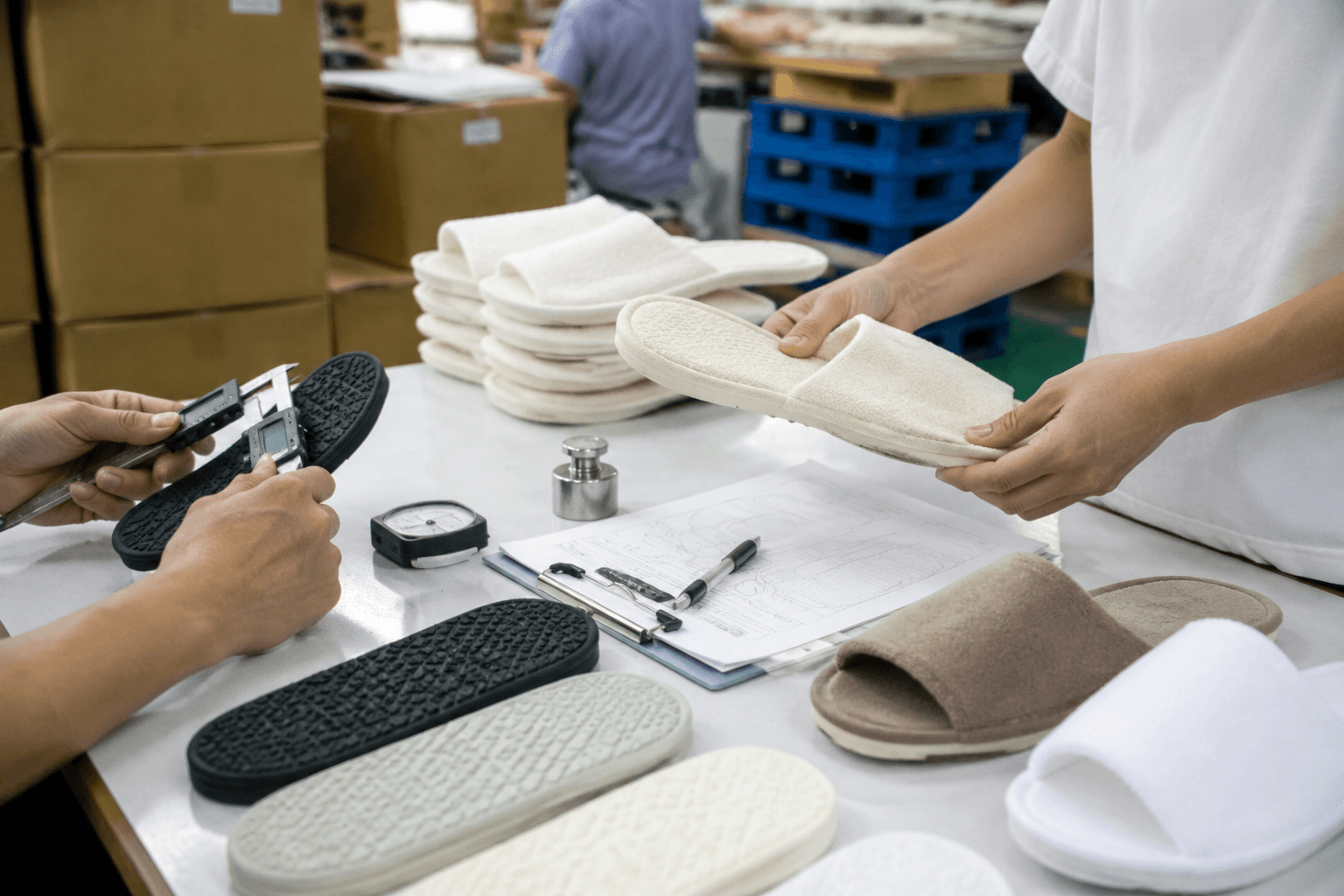
Ask for a sole-bottom specification, not a general anti-slip claim. The RFQ should require outsole material, approximate sole thickness in millimeters, pattern type, pattern coverage, surface finish, outsole color, bonding or stitching method, and whether the pattern comes from an existing supplier sheet, existing mold, or custom tooling.
Use observable pattern language. Diamond embossing, wave grooves, raised dots, grid texture, herringbone grooves, crosshatch embossing, printed PVC dots, and supplier pattern code are clearer than strong grip or premium texture. If the supplier uses a pattern code, keep that code in the approved sample record.
Coverage is a separate buying decision. Full outsole coverage, heel-and-forefoot coverage, and small contact-zone coverage are not equivalent. Ask for a sole-bottom photo of both left and right slippers, then mark the coverage expected before the supplier cuts bulk material.
Pattern depth can be useful when the process supports measurement. As a 2026 RFQ planning example to verify in the supplier quote, a buyer may ask for 0.3 millimeter to 0.8 millimeter embossed EVA pattern depth, measured on the approved sample at the forefoot, midfoot, and heel with a caliper. This example is not a slip-resistance standard.
- Material field: EVA sheet, PE film, textile sole with printed dots, sponge laminate, TPR sheet, PVC dot coating, or supplier-confirmed alternative.
- Pattern field: diamond, wave, dot, grid, herringbone, crosshatch, molded pattern, printed dot coating, or supplier pattern code.
- Coverage field: full outsole, heel-and-forefoot zones, or contact zones marked on a sole-bottom reference photo.
- Finish field: no oily residue, no powder buildup, no glossy film, no uncured dot transfer, and no visible contamination.
- Process field: sheet embossing, molded outsole, printed dots, lamination, glue bonding, stitched edge, or combined bonding and stitching.
Check Construction Risks Before Approving the Sample
The same outsole pattern can behave differently on different slipper bodies. A thin foam base may bend too much and reduce practical floor contact. A thicker EVA sole may hold embossing more clearly but can increase pair weight, carton volume, and cost. A PE-coated sole can resist moisture better than plain fabric but may feel smooth if the texture is weak.
Upper choice can change sole contact. Terry cloth, waffle fabric, coral fleece, velour, non-woven fabric, and closed-toe toweling can pull the outsole in different directions. For open-toe styles, check whether the strap distorts the forefoot. For closed-toe styles, check whether the toe curls after assembly.
Bonding failure turns a good-looking outsole into a quality risk. During sample review, flex the toe edge, heel edge, and side edge lightly by hand and record any opening, bubbling, whitening, uneven glue line, or loose stitching. If the buyer wants destructive peel checks, define the method and sample quantity before inspection because the check damages product.
The approval file should include the retained physical pair, sole-bottom close-ups, material swatches or supplier material codes, size measurement sheet, logo artwork version, packing sample, carton label approach, and approval date. Bulk production should be compared with that file, not only with a product rendering.
- Upper risk: fabric tension or strap placement curls the sole and reduces floor contact.
- Outsole risk: a thin or glossy sole shows texture in photos but feels nearly flat under pressure.
- Bonding risk: weak glue, uneven lamination, or poor stitching opens at the toe, heel, or side edge.
- Substitution risk: supplier changes to a similar-color outsole sheet with different hardness, finish, weight, or pattern depth.
- Retail risk: pouch, sleeve, barcode label, or gift-box packing changes compression and carton volume.
Approve the Pre-Production Pair With QC Measurements
The pre-production pair should use the actual upper fabric, outsole material, pattern, logo method, packing method, and carton label plan intended for the order. A showroom sample is useful for style direction, but it may not show the production construction.
Soft slippers need realistic tolerances. As a 2026 RFQ planning example to verify with the supplier, a buyer may discuss outsole length tolerance of plus or minus 3 millimeters per size, outsole width tolerance of plus or minus 2 millimeters per size, sole thickness tolerance of plus or minus 0.5 millimeter for the specified material, and logo placement tolerance of plus or minus 3 millimeters from the approved artwork position.
Each tolerance needs a measurement point. Measure outsole length heel to toe along the center line. Measure outsole width at the widest forefoot point. Measure sole thickness at heel and forefoot where construction allows. Measure pattern depth only at agreed outsole points when the pattern is measurable. Measure logo placement from a defined edge, center line, or artwork reference.
Set change triggers before bulk production. If the supplier changes outsole material, sole thickness, pattern type, pattern direction, coverage, glue, stitching, size grade, logo method, packing style, or carton quantity after approval, production should pause until the buyer gives written approval.
- Sample check: sole sits flat on a level surface with no unapproved toe curl or heel lift.
- Sample check: left and right outsole patterns match in direction, coverage, color, thickness, and trimming.
- Sample check: embossing or dots are visible in the agreed forefoot, midfoot, heel, and perimeter zones.
- Sample check: logo size, color, position, artwork version, and placement tolerance match the approved file.
- Sample check: packing does not crush the upper, deform the sole, transfer color, hide labels, or create odor concerns.
- Sample check: pair count, size ratio, and SKU label match the buyer's spa slipper wholesale order split.
Use Wet Handling Checks Carefully
A damp-tile hand check can help compare samples, but it should stay in the procurement file as an informal handling observation. It is not a certified slip-resistance result, and it should not be turned into a product claim.
If the importer or retailer needs documented slip evidence, define it before ordering. The RFQ should name the test method, laboratory requirement, sample quantity, outsole condition, floor surface condition, report date requirement, and acceptance criterion. The buyer's compliance adviser should confirm which method applies to the destination market and product category.
Routine QC language should stay tied to the approved sample: no visible oil or release-agent residue, no powder buildup, no uncured dot transfer to white cloth, no major shallow-pattern zones compared with the retained pair, no delamination after agreed flexing, and no material change without written approval.
- Do not claim certified slip-resistant unless a current report covers the exact material, product scope, test date, method, and acceptance criterion.
- Do require the outsole pattern and surface finish to match the approved pre-production sample.
- Do keep the retained reference pair available for final inspection and receiving checks.
- Do require supplier notification before any outsole material, pattern, thickness, glue, logo, packing, or carton change.
- Do separate internal wet-floor handling notes from advertising, packaging, and product-page claims.
Price the SKU Split, Not Just the Pair
MOQ should be quoted by SKU drivers. One fabric, one color, one outsole, one logo, and one packing method is a different order from a program split across several sizes, colors, logos, outsole patterns, and retail packs.
As a 2026 RFQ planning example to verify in the supplier quote, a simple wholesale spa slipper using an existing anti-slip outsole pattern may be discussed around 1,000 to 3,000 pairs per style/color. This is a quoting prompt, not a statement about any supplier's inventory or capacity.
Lead time should be split into sample and bulk milestones. As a 2026 RFQ planning example to verify, sample development may take 5 to 10 business days after artwork and material direction are confirmed, and a straightforward existing-pattern bulk order may take 20 to 35 calendar days after approved sample and deposit. Custom outsole tooling, revised artwork, retail packaging, holiday congestion, inspection booking, and compliance review can change the schedule.
Compare prices only after construction and packing match. A thicker outsole may improve perceived quality but reduce pairs per carton. A retail pouch may improve presentation but add packing labor and freight volume. A cheaper quote may simply be a thinner sole, smaller pattern area, looser tolerance, lower density foam, or different packing method.
- Commercial field: MOQ by style, color, size, outsole pattern, logo version, and packing version.
- Cost field: price by quantity break and whether price changes by size, color, logo method, outsole material, or packing method.
- Sample field: sample fee, sample lead time in business days, courier fee, refund rule if any, and retained sample process.
- Tooling field: custom outsole mold, custom embossed sheet, artwork plate, embroidery setup, barcode label, or packing dieline cost.
- Timing field: material booking date, sample approval date, bulk start date, inspection window, packing completion date, and export handover point.
Make Carton Data Part of the QC Checklist
Packing choice affects both unit cost and defect rate. Loose bulk packing may suit back-of-house spa issue. Individual bags keep pairs cleaner during warehouse handling but add plastic-use and labeling questions. Paper bands, kraft sleeves, retail pouches, and gift boxes need artwork, barcode, and compression checks.
Ask for carton data before comparing final prices. As a 2026 example calculation to verify against the supplier's packing plan, if one export carton holds 100 pairs of a thin disposable spa slipper and another holds 60 pairs of a thicker EVA-sole slipper, freight cost per pair can change even when the unit price looks lower. The supplier must confirm carton dimensions in centimeters, gross weight in kilograms, net weight in kilograms, and cubic meters per carton for the exact construction.
Packing can damage anti-slip soles. Dark soles may mark light uppers under compression. Printed dots may transfer if not cured. EVA soles may deform if cartons are over-compressed. A packing trial should check compression, color transfer, odor, barcode placement, carton label content, and carton quantity.
Receiving teams need carton marks that match the purchase order. Ask for carton labels showing purchase order, SKU, color, size, quantity, destination, and carton number format if required. Request photos of the packed pair, open carton, sealed carton, carton mark, and packing-list draft before shipment.
- Packing option: loose pair, OPP bag, paper band, kraft sleeve, retail pouch, gift-box set, or buyer-specified format.
- Carton data: pairs per carton, carton size in centimeters, gross weight in kilograms, net weight in kilograms, and cubic meters per carton.
- Packing risk: upper crushing, sole deformation, dark-sole transfer, uncured dot transfer, odor retention, barcode mismatch, and carton-label error.
- Supplier photo request: outsole close-up, packed pair, open carton, sealed carton, carton mark, and packing-list draft.
- Receiving check: compare carton count, SKU, size, color, and packing version against the purchase order before releasing stock.
Separate Quality Documents From Compliance Documents
Physical QC and compliance review answer different questions. The outsole checklist asks whether production matches the approved sample. Compliance review asks whether the product, labels, packaging, materials, and documents fit the destination market and sales channel.
Source context for U.S. shipments: the U.S. Consumer Product Safety Commission publishes public guidance for consumer products sold in the United States. As of July 2026, applicability can depend on product type, material, age grading, labeling, sales channel, and importer role, so buyers should verify the current document list with a compliance adviser.
Source context for EU shipments: the European Commission publishes product safety and market access information for goods placed on the EU market. As of July 2026, general product safety, labeling, material composition, and importer obligations should be checked against the current product classification and sales channel.
ISO 2859-1 may be relevant when a buyer uses it as an inspection sampling procedure. It does not certify spa slippers and does not prove slip resistance. If referenced, the purchase order or inspection booking should state inspection level, AQL values, defect classes, product scope, and acceptance thresholds.
- Document field: material composition by component, including upper, lining, outsole, thread, glue, logo material, and packaging.
- Labeling field: country of origin, fiber content if applicable, care information, barcode, warning language if required, and importer details if required.
- Report field: current test reports that match the ordered material, color, product type, date, and destination requirement.
- Inspection field: sampling plan, inspection level, AQL values if used, major defects, minor defects, critical defects, and acceptance thresholds.
- Certification caution: do not imply certification unless a current certificate or report covers the exact product, scope, date, and issuing body.
Defects That Should Stop Packing
Shallow embossing should be caught early. If early production shows repeated flat zones at the forefoot, heel, or agreed contact areas, pause packing and check outsole sheet quality, embossing pressure, mold condition, and whether the material matches the approved sample.
Delamination should be treated as a major defect. Inspect the heel edge, toe edge, sidewall, stitched seam, and laminated layers. If the patterned sole separates from the base, the slipper can curl, feel unstable, or fail during use.
Contamination should not be dismissed as a cosmetic issue. Oily residue, release agent, dust, powder, or uncured printing can reduce grip feel and mark packaging or floors. A white-cloth wipe check is a practical QC screen, not a lab performance result.
Size and balance defects can reduce outsole contact. If the outsole is narrow, off-center, curled, or cut unevenly, the slipper can roll at the edge. Open-toe slippers need strap alignment checks. Closed-toe slippers need toe-shape and sole-flatness checks after assembly.
- Major defect examples: outsole delamination, wrong outsole material, wrong pattern, severe size mismatch, exposed sharp edge, heavy contamination, or construction materially different from the approved sample.
- Minor defect examples: small trimming irregularity, slight thread end, mild packing wrinkle, or small shade variation within approved tolerance.
- Critical concern examples: unsafe foreign object, strong chemical odor beyond buyer-defined limit, incorrect compliance label, or materially wrong legal labeling.
- Receiving trigger: sample cartons from different carton numbers and pallet positions, not only the top carton or supplier-selected photo sample.
- Process trigger: pause packing if a new outsole roll, new glue batch, new operator setup, or changed packing compression creates a visible difference from the approved pair.
RFQ Wording Buyers Can Send
Please quote wholesale spa slippers with a defined anti-slip outsole. Confirm open-toe or closed-toe construction, upper material, outsole material, outsole thickness in millimeters, anti-slip pattern type, pattern coverage, measurable pattern depth if available, surface finish, bonding or stitching method, size range, logo method, packing method, carton plan, MOQ by SKU, sample lead time, bulk lead time, inspection process, and available compliance documents.
Intended use: damp spa changing-room use. Individual pair packing required. No readable supplier branding on product or retail pack. Barcode label required on each pouch. Carton marks must show purchase order, SKU, color, size, and quantity. Supplier must notify buyer before changing outsole material, pattern, thickness, glue, logo method, packing, or carton quantity.
Please provide sole-bottom close-up photos of left and right slippers, material references, packing photos, carton dimensions in centimeters, gross weight in kilograms, net weight in kilograms, cubic meters per carton, and a packing-list draft before final price comparison.
- Product: open-toe or closed-toe spa slipper; disposable, semi-disposable, or retail-positioned.
- Upper: terry, waffle, coral fleece, velour, non-woven fabric, color, size range, lining, padding, binding, and fabric weight if available.
- Outsole: EVA, PE-coated fabric, textile sole with printed dots, TPR sheet, thickness in millimeters, pattern type, pattern coverage, pattern depth target if measurable, color, and supplier pattern code if used.
- Logo: embroidery, woven label, printed logo, heat transfer, artwork file version, size in millimeters, position, color reference, and placement tolerance.
- Packing: loose, OPP bag, paper band, sleeve, retail pouch, gift box, barcode position, care label, and carton mark format.
- Quality: approved sample process, retained reference pair, in-line checks, final inspection plan, AQL level if used, defect classification, and material-change notification rule.
- Documents: material composition declaration, packing list, commercial invoice, country-of-origin marking, product photos, carton marks, and applicable destination-market test reports.
Evidence, Method, and Limits
Publication attribution: Vincent Xi is listed as Editorial Author for SlipperForge at https://slipperforge.com/authors/vincent-xi/. This article does not make first-person factory visit, laboratory testing, client outcome, award, certification, or proprietary capacity claims.
Methodology: the checklist is derived from common procurement fields used to specify textile spa slippers, disposable guest slippers, private-label hotel slippers, and similar light indoor footwear. Public CPSC and European Commission source contexts are used only for compliance framing. All MOQ, lead-time, tolerance, pattern-depth, and carton figures are labeled as 2026 RFQ planning examples or example calculations to verify.
Limitations: this article does not provide certified slip-resistance data, legal advice, factory capacity confirmation, product certification, or a warranty of performance. Before placing an order, verify the outsole material, pattern, sample approval date, packaging plan, carton plan, inspection criteria, and destination-market document list in the supplier quote, purchase order, inspection booking, and shipment file.
- Example data point to verify: 1,000 to 3,000 pairs per style/color for a simple existing-pattern spa slipper RFQ in 2026 sourcing discussions.
- Example data point to verify: 5 to 10 business days for sample development after artwork and material direction are confirmed in a 2026 RFQ.
- Example data point to verify: 20 to 35 calendar days for straightforward existing-pattern bulk production after approved sample and deposit in a 2026 RFQ.
- Example data point to verify: 0.3 millimeter to 0.8 millimeter embossed EVA outsole pattern depth, measured at agreed outsole points on the approved sample in a 2026 RFQ.
- Example data point to verify: plus or minus 3 millimeters for outsole length or logo placement tolerance in a 2026 soft-slipper RFQ.
- Example calculation to verify: 100 pairs per carton for a thin disposable spa slipper versus 60 pairs per carton for a thicker EVA-sole slipper can change freight cost per pair, subject to the supplier's exact carton dimensions and weights.
FAQ
What should an anti slip sole pattern QC checklist for spa slippers wholesale include? It should include outsole material, sole thickness, pattern type, pattern coverage, pattern depth target if measurable, surface finish, bonding method, left-right consistency, sole flatness, size measurements, logo placement, packing method, carton data, inspection plan, defect classifications, and compliance document requirements. Tie the checklist to an approved physical sample.
Is an embossed EVA outsole enough to prove a spa slipper is slip resistant? No. An embossed EVA outsole is a construction feature, not proof of certified slip resistance. If a buyer needs a defined result, the RFQ should state the test method, lab requirement, sample scope, outsole condition, surface condition, report date requirement, and acceptance criterion.
What outsole details should buyers put in a wholesale spa slipper RFQ? Ask for outsole material, thickness in millimeters, pattern type, supplier pattern code if used, full or partial coverage, pattern depth target if measurable, color, surface finish, bonding or stitching method, and whether the pattern is existing or custom. Request sole-bottom close-up photos and a physical sample before bulk approval.
What MOQ should buyers expect for wholesale spa slippers with anti-slip soles? MOQ depends on style, material, color, size split, logo, outsole pattern, and packing method. As a 2026 RFQ planning example to verify in the supplier quote, a simple existing-pattern spa slipper may be discussed around 1,000 to 3,000 pairs per style/color. Custom patterns, custom packing, or many SKU splits may require different quantities.
How should buyers approve anti-slip spa slipper samples before bulk production? Approve a physical pre-production sample that includes the real upper material, outsole material, anti-slip pattern, logo method, size, packing, and carton label approach. Keep a retained reference pair and compare early production against it for pattern clarity, sole flatness, bonding, size, logo position, and packing.
Which tolerance fields matter most for spa slipper outsole QC? Useful tolerance fields include outsole length, outsole width, sole thickness, pattern depth if measurable, upper opening, logo placement, pair weight if freight planning depends on it, carton quantity, and carton dimensions. As a 2026 RFQ example to verify, a buyer may discuss plus or minus 3 millimeters for outsole length or logo placement, but final tolerances should match the supplier process and buyer channel.