Spa Slipper Sourcing Digital Integration Readiness for European Procurement
Byline: Vincent Xi, Editorial Author, SlipperForge (author profile). Job title is Editorial Author only. This briefing does not claim factory visits, named hotel accounts, laboratory tests, awards, certifications, or first-person production experience.
European hotel, spa, and wellness buyers should treat spa slipper sourcing digital integration readiness as a contract gate, not a post-award IT cleanup. For spa slipper programmes (guest amenity and spa-floor pairs), award volume only after a bidder proves four items on the buyer stack: a complete product master for the spa slipper size run; a test transaction on the named channel; a lot or QR payload that can be archived at goods receipt; and named owners for exceptions and invoice match.
Before award, specify how product-master, order, inventory, despatch-advice, invoice, and batch-traceability data will move from the slipper supplier into the e-procurement, ERP, or property system. Require each bidder to declare supported channels—supplier portal, email, punchout, EDI, or API—and to complete catalog, test-transaction, and exception onboarding. A 2026 hotel-procurement software supplier-readiness guide frames that onboarding around catalog completeness, integration questions, exception handling, product-master work, transaction testing, named ownership, and a 30-day readiness plan.
Treat QR-on-sole specification access, real-time customization, and MES-linked order sync as evidence items to test, not as market defaults. A published account of digital upgrading in China’s slipper manufacturing describes QR access to specifications, 3D diagrams and certificates, real-time customization, and MES order sync.
This is a Europe spa slipper procurement briefing published under Vincent Xi, Editorial Author at SlipperForge. It is not a factory capability statement and it is not a legal, customs, or tax opinion. Use the decision table, then issue an RFQ that a factory, a 3PL, and finance and IT owners can execute for the named European destinations.
What spa slipper sourcing digital integration readiness means before award
Digital integration readiness is the supplier’s proven ability to exchange structured, reusable data at quotation and sample lock, first bulk PO, replenishment, carton/lot recall, and invoice match. It is not a marketing portal login, a PDF catalogue, or a photo of a carton.
Go / no-go (fail closed). Do not award if the bid file is missing any of: a product master that can carry the EU size run, pack quantities, and artwork version; a recorded test of the named production channel (punchout cart, EDI message, API POST, or the email/portal template that will actually be used); a QR or label that returns lot, size, and material rather than a marketing page; an invoice sample AP would accept for the paying legal entity; a named supplier integration owner and a dated onboarding calendar.
Score readiness on four objects, not on a single API slogan:
- Product master — SKU, EU size run, colour, upper/outsole material, pair count per inner and per export carton, net/gross weight, HS heading as the supplier currently declares it, and artwork version.
- Transaction set — quote, PO acknowledgement, order change, advanced shipping notice (ASN), invoice, and credit note.
- Exception set — short ship, size-run split, quality hold, artwork revision, and duplicate invoice.
- Lot payload — what a carton label or QR actually returns (static spec versus live lot, mill, and inspection status).
Do not assume one order channel or one AP workflow for every European site. A central purchasing organisation in the EU or EEA, a UK group, and a single-site spa can sit on different stacks. The RFQ must name the buyer channel and the test messages that will be run.
A 2026 sourcing whitepaper on wellness and recovery slippers describes buyer demand for data credibility, ESG compliance, and verifiable technology, including documented design and manufacturing pathways. Translate that demand into European spa slipper files as document requests with dates, not as adjectives on the purchase order.
Integration channels: portal, email, punchout, EDI, and API trade-offs
Specify one primary path for production POs and one fallback for the first sample/PO cycle.
| Channel | Fit for spa slippers | Cost-to-serve to price (qualitative; not a surveyed average) | Failure mode to test | Ready in the bid file |
|---|---|---|---|---|
| Email + portal | Samples and low-line custom; sites without punchout | Manual match labour; pair price is not total cost | Size-run and artwork version drift | Named inbox, order template, buyer-specified ack test |
| Punchout (cXML/OCI or equivalent) | Repeating amenity SKUs in a hotel e-procurement suite | Catalog mapping plus a live punchout test | Stale prices; missing EU size matrix; VAT fields wrong by paying entity | Live punchout to a test hotel entity; cart returns buyer SKU IDs |
| EDI | Stable replenishment of locked SKUs | Mapping, test mailbox, message qualification | Unmapped size or carton fields; silent drops | Implementation guide, test mailbox, PO/ASN/invoice in the required standard |
| API | Inventory, order status, lot lookup, multi-property roll-up | Design, auth, exception codes, signed test log | Sandbox not equal to production; no exception codes | OpenAPI or equivalent, auth, rate limits, status codes, signed test log |
Do not treat a portal login as equivalent to punchout or API. Portal self-service still leaves AP matching PDFs. Punchout and EDI cut re-keying only if the spa slipper size run sits in the catalog, not in a comment field. If the programme uses a hotel amenity range such as 36–45 EU, treat that range as an example to confirm on the quote (unit: EU size; scope: this programme’s size matrix; assumption to verify against the properties’ actual mix). Map S–XL only if that mapping lives inside the catalog feed.
For email/portal acknowledgement, put the target on the RFQ as a buyer-specified test. Example assumption to replace on the quote: 1 business day (unit: business days; scope: acknowledgement of the sample/PO path that will actually be used; as-of: buyer protocol for this RFQ; verify against the supplier’s written schedule).
A factory that only emails may quote a lower pair price but cost more in receiving errors on mixed size runs; API/EDI may need a longer onboarding window. Use a 30-day readiness plan (unit: calendar days; scope: supplier onboarding of product master, test transactions, and named owners; as-of: 2026 hotel-procurement software supplier-readiness guide) as a planning assumption to confirm or replace in the supplier’s written schedule. The same 2026 guide describes a 30-day readiness plan covering product master, transaction testing, and ownership assignment.
For Europe, invoice format is not uniform across the EU, EEA, and the UK. Name the format AP will reject (PDF-only, missing buyer VAT, missing line-level pair quantity). If a paying entity uses a Peppol route or a national e-invoicing route, put that on the RFQ as a buyer-stated requirement for that entity. Do not assume an EU-wide invoice API, and do not apply one country’s mandate to the EEA, the UK, or another EU member state without AP confirmation.
Catalog, 3D specs, and samples before the bulk spa slipper PO
Treat sample lock as a high-risk integration moment. Require a single identifier from digital spec to physical sample to bulk lot.
Ask for, in writing:
- File set: 2D tech pack plus, if offered, 3D sole/upper views. State units (mm for sole thickness and insole length; EU size; pair) and the CAD/mesh formats the buyer can open.
- Revision control: who may change embroidery, sole colour, or carton mark after golden sample, and how the product-master version increments.
- Physical sample path: pair count, EU sizes, whether washed/compressed samples are included for terry programmes, and photo names that match SKU IDs.
- Catalog fields for punchout/API: internal item code, supplier item code, GTIN if used, inner pack quantity, export carton quantity, and Europe inbound terms (Incoterms® rule and named place—confirm the current Incoterms® edition on the quote).
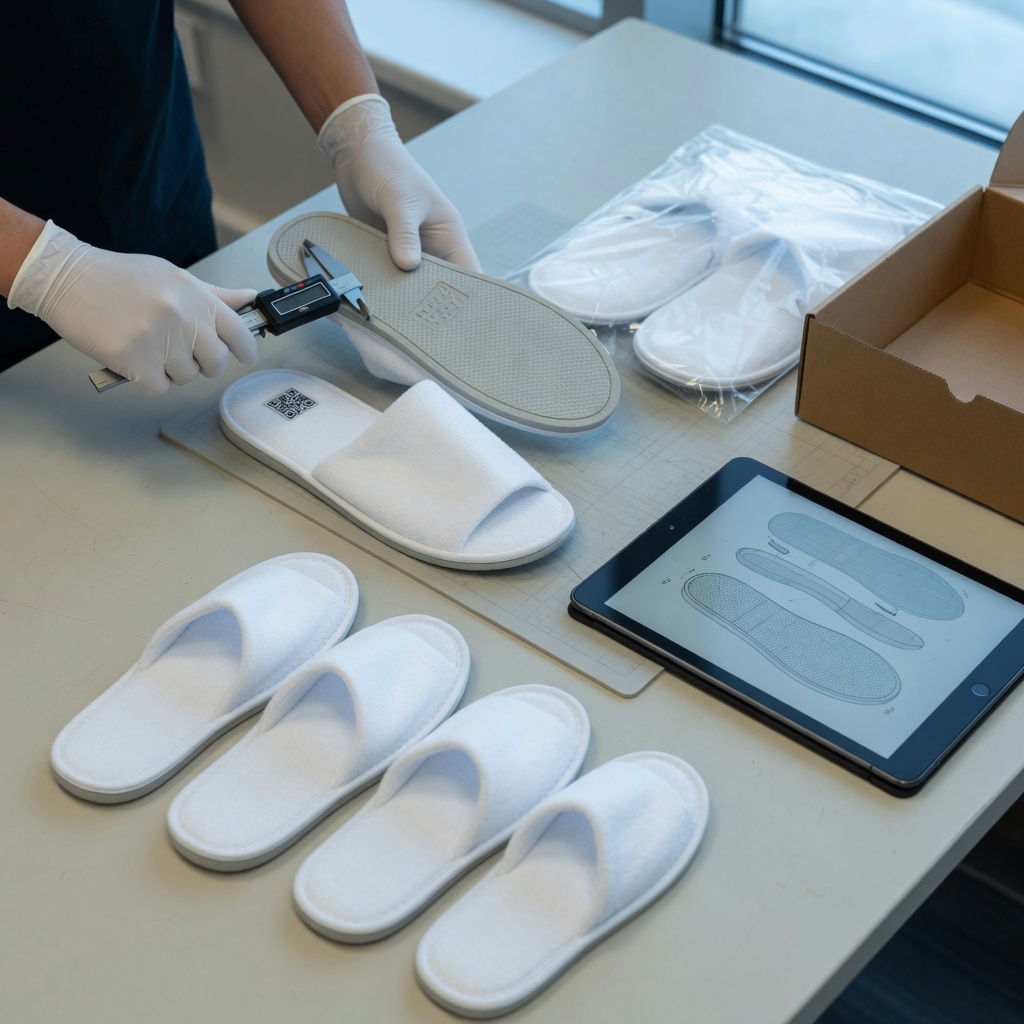
Industry reporting on digitally upgraded slipper plants describes buyers scanning a sole QR to open specifications, 3D diagrams, and compliance files, then customizing in real time. That workflow is reported in coverage of industrial-chain upgrading in China’s slipper manufacturing. Use it as a verification script, not as a promised UX: in the pre-award sample, scan the code on three pairs from two sizes (unit: pairs and sizes; scope: pre-award sample test the buyer will run; buyer protocol, not a factory SLA) and archive the payload. If the QR opens a marketing page with no lot, size, or material list, score the supplier as catalog-only.
A 2026 wellness and recovery slipper sourcing whitepaper discusses 3D-printing pathways using ISO 13485 and OEM additive routes for modular custom insoles. Those pathways appear in that whitepaper’s innovation and sourcing discussion. ISO 13485 is a medical-device quality-management standard. It does not automatically cover a hotel guest spa slipper sold as an amenity with no medical claim. If the RFQ positions the pair as a medical recovery device, require the current certificate, scope, legal manufacturer, and Unique Device Identifier approach. If it is a guest amenity, do not paste medical-device language onto the PO; request the product-safety and labeling file for the destination (EU/EEA versus UK versus a specific country of first import). Never imply certification without a current document attached to the bid.
Measurable development-cycle comparison (not a SlipperForge SLA): the same manufacturing-upgrade article reports development time falling from 45 days to 15 days (unit: calendar days; scope: reported digital-transformation example in China’s slipper manufacturing; as-of: as stated in that article) and MOQ falling from 3,000 pairs to 300 pairs (unit: pairs; scope: reported example in that article; as-of: as stated in that article). Those figures are reported as outcomes of digital transformation in that article. Put both numbers on the RFQ as questions: state development calendar from locked 3D/tech pack to golden sample, in calendar days, for this EU size run; state MOQ in pairs per colourway and per size split. Do not copy 15 days or 300 pairs onto the award unless the quote repeats them with a date and a SKU scope.
QR codes, MES sync, and lot traceability: specify the payload
QR, MES, and real-time production claims only help spa slipper procurement if they shorten receiving, recall, and invoice match. Specify payload and latency.
QR / product access. Name the audience (receiving clerk, spa attendant, or guest). Guest-facing codes should not carry personal data. Minimum B2B lot payload: SKU, EU size, colour, lot/batch, production date, carton ID, and a file list (spec, inspection summary). State the months the URL must resolve, or store the payload in MDM at GRN. A 24-month URL life (unit: months; scope: lot-URL retrievability after GRN; example assumption to verify in the supplier quote) is a planning figure only—replace it with the supplier’s written retention period. Scan at sample, pre-production, and first bulk GRN; save screenshots and raw URLs in the award file.
MES-linked production sync. Coverage of digitally upgraded slipper factories reports orders syncing to a smart factory via MES in 30 seconds (unit: seconds; scope: reported order-sync example in that manufacturing-upgrade article; as-of: as stated in that article). The 30-second MES sync is described in that account of QR-enabled ordering and factory integration. For a European hotel programme, convert that headline into a contractual acknowledgement target: PO acknowledgement in X minutes during the supplier’s stated production-office hours, ASN by scan-handover, and a lot query that returns pass/fail status. Time-stamp a test PO during RFQ. If the supplier cannot show a test log, treat 30 seconds as journalism about a specific digital plant, not as the SLA.
Traceability and data protection in Europe. Guest-amenity spa slippers are issued in volume at a low unit price, but lots still matter for fibre/chemical claims, needle/metal detection if specified, colour-lot continuity, and carton mix-ups. Ask whether the lot is one colourway / one size run / one production day or a merged export load. If integration carries guest, staff, or property-level personal data, EU/EEA processing and UK processing are separate regimes. Require the correct data-processing terms for the controller’s location, name sub-processors, and state whether production or backup systems sit outside that regime. Do not put guest names in QR codes or carton marks. This article is not legal advice; counsel should approve the DPA set for each controller location.
Europe-specific checks that stay inside the spa slipper RFQ
Keep the product and digital RFQ primary. Use country rules only where they change the data collected for this spa slipper award.
- Destination split: state whether first import is EU, EEA, UK, or a mix. Labeling language, importer/responsible-person details, and marking can differ; put destination on the product-master record, not only on the commercial invoice.
- VAT and invoice match: require line-level pair quantity, SKU, and legal entity. Country e-invoicing mandates differ; the buyer names the rule for each paying entity. Do not write one invoice rule for Europe as a whole.
- Product-safety file: for a guest amenity spa slipper, request the current safety/labeling dossier for the named destination. Do not imply a single Europe certificate, and do not imply ISO 13485, CE medical, or UKCA medical status unless the SKU is placed on the market as a medical device and current documents are attached.
- ESG pack: Wellness-slipper sourcing commentary highlights ESG compliance and verifiable technology as buyer demands. Ask for dated test reports and mill declarations that match the actual upper, midsole, outsole, and packaging on the golden sample. Corporate sustainability reporting duties (for example under EU CSRD/ESRS for in-scope entities) are the buyer’s obligation if applicable. Do not treat EU CSRD/ESRS scope as applying automatically to a UK-only operator, or the reverse, and do not treat a factory ESG brochure as a substitute for lot-level reports.
- Units and size: lock EU sizes on the PO. If the factory default is US/UK sizing, require a mapping table inside the catalog feed, not in an email.
Buyer decision table: score digital integration readiness
Use this table in supplier comparison. Every row should produce a specification, a test, or a go/no-go before award.
| Decision item | Specify in the RFQ | Compare | Europe check | Verify / order |
|---|---|---|---|---|
| Primary order channel | Portal, email, punchout, EDI, or API as the production path | Production versus slideware | Paying-entity invoice rule (named EU/EEA country versus UK) | One test PO per channel; log in the award file |
| Product master | SKU, EU size matrix, materials, inner/export pack, weights | Missing size or pack fields | Label language versus destination | Reject a catalog that cannot punch out or EDI the size run |
| Sample-to-bulk ID | One ID from 3D/tech pack to GRN | Manual rename versus system ID | Importer name on artwork for the named market | Golden-sample sign-off tied to that ID |
| QR payload | Lot, size, SKU, file list, retention | Marketing URL versus lot URL | No guest personal data on the code | Scan 3 pairs × 2 sizes at sample and first bulk |
| MES / status latency | PO ack, WIP visibility, ASN timing | Claimed seconds versus written SLA | Production-office time zone versus receiving sites | Time-stamped test; do not accept 30 seconds unless tested |
| MOQ and size split | Pairs per colourway and per size | Quoted MOQ versus reported examples (300–3,000 pairs in one article) | Mix for European hotel size curves | Written MOQ on quote; trial PO quantity |
| Development calendar | Days from locked spec to golden sample | 15-day versus 45-day reported example versus this SKU | Artwork/legal marks for EU versus UK versus a named EEA country | Calendar on quote, not in a sales deck |
| Invoice matching | Line SKU, pairs, tax IDs, credit-note path | PDF-only versus structured invoice | Country format named by AP for each entity | Three-way match on first shipment |
| Exception codes | Short ship, hold, artwork change | Email narrative versus coded event | Who may accept a substitute size | Named owner on both sides |
| Quality evidence | Tests that match this construction | ESG PDF versus lot-level report | Destination safety file, not a generic EU certificate | Documents dated and scoped to the golden sample |
| Data processing | Systems that see contacts or personal data | Hosting and sub-processors | EU/EEA versus UK terms as applicable | Counsel-approved DPA before go-live |
| Ownership | Supplier integration owner plus buyer IT/AP/QA | No named owner = not ready | Language/time zone coverage for the sites | 30-day onboarding plan with names and test dates |
RFQ checklist for spa slipper procurement (digital integration)
Copy these items into the RFQ. Each line is a specify / compare / verify / approve / order action.
- SKU and destination: Pair type (open-toe terry, closed-toe, EVA, waffle, or other), EU size run, colourways, programme type (guest amenity, spa-floor loaner, or resale). List EU, EEA, UK, and any country of first import separately; require labeling and importer fields per destination.
- Primary channel and messages: Name portal, email, punchout, EDI, or API for production POs and a week-one fallback. List quote, PO, PO change, ack, ASN, invoice, and credit note with the standard or API resource in use.
- Catalog fields: Supplier SKU, buyer SKU, EU size, pack quantities, weights, HS heading as currently used, Incoterms® rule and named place.
- Punchout/API proof: Sandbox or test entity and a recorded cart-to-PO or API POST within the bid validity period.
- Tech pack, samples, and QR: Required files and units (mm, pairs, EU size); revision IDs; sample quantity, sizes, due date; whether QR is already on the sample sole. Specify mandatory QR fields; require raw URL plus archive copy; forbid guest personal data.
- Lot definition: One colourway / one day versus merged load; carton mark fields; needle/metal or other tests if required.
- Calendars and MES: Calendar days from locked files to golden sample for this construction (compare to the supplier’s history, not to a 15-day press figure unless restated for this SKU). State production days after golden sample and after replenishment PO separately. Set PO ack time, ASN trigger, and lot-query response; treat a 30-second MES example as not applicable if it cannot be evidenced.
- MOQ: Pairs per colourway, per size, and for a mixed size-run carton; trial MOQ versus contract MOQ.
- Invoice test: Sample invoice for each EU/EEA paying entity and, if used, each UK entity; tax IDs and pair-level lines.
- Exceptions, quality, and medical-claim gate: Coded events for short ship, failed QC, and artwork change; who may approve substitutes. Reports that match golden-sample materials; reject generic ESG brochures. Request ISO 13485 only if the SKU is a medical device; otherwise state amenity, no medical claim.
- Personal-data map: Systems, sub-processors, and EU/EEA versus UK terms if personal data flows.
- Owners, 30-day plan, retention, award file: Supplier integration owner, buyer AP, buyer QA; dates for product-master freeze, test messages, and first live PO. State months that lot URLs and inspection files remain retrievable (replace any 24-month planning figure with the quoted period). Attach the test log, scanned QR payloads, and golden-sample photos to the PO.
Order sequence after a pass: freeze the product-master version → sign the golden sample against that ID → run the invoice test for the first paying entity → place a trial PO on the primary channel → only then release bulk quantity.
How this briefing was derived, and what to verify
Source context 1 — hotel digital procurement (2026). Catalog preparation, portal/email/punchout/EDI/API intake, invoice matching, and a 30-day product-master, test-transaction, and ownership plan. Hotel-procurement software supplier-readiness guide.
Source context 2 — digitally upgraded slipper manufacturing (article as published). QR-on-sole specs, 3D diagrams, compliance files, real-time customization, 30-second MES sync, 45-to-15-day development, and 3,000-to-300-pair MOQ as reported examples. Industrial-chain upgrading in China’s slipper manufacturing.
Source context 3 — wellness/recovery slipper sourcing (2026 whitepaper). Data credibility, ESG compliance, verifiable technology, and 3D-printing pathways using ISO 13485 for wellness/recovery slippers. 2026 global sourcing whitepaper.
Method. Claims are limited to those published points, restated with units and scope, then turned into RFQ tests a European buyer can run. Concrete sourced figures used as questions, not as award defaults, are: a 30-day readiness plan (calendar days; product master, test transactions, named owners; as-of the 2026 hotel-procurement software supplier-readiness guide); development time of 45 days reduced to 15 days (calendar days; reported example in the manufacturing-upgrade article; as stated in that article); MOQ of 3,000 pairs reduced to 300 pairs (pairs; reported example in that article; as stated in that article); and MES order sync in 30 seconds (seconds; reported example in that article; as stated in that article). No SlipperForge production capacity, price, certificate, or customer result is asserted. Author attribution is the named Editorial Author role only.
Limitations / what to verify on the quote. Digital headlines age quickly. Confirm current API/EDI guides, punchout credentials (if any), sandbox versus production behaviour, QR URL retention, lot definition, MOQ in pairs, development and production calendars, invoice format per paying country, EU/EEA versus UK data terms, and whether ISO 13485 or any other named standard is in scope for this SKU. Treat every exact number in third-party articles as an example to confirm or replace in the supplier quote. Product-safety marking, importer identity, and e-invoicing duties are jurisdiction-specific; this briefing is not a legal or customs opinion.
Issue the RFQ only after the decision table has a named owner, a test date, and a destination list. That is the operational meaning of digital integration readiness for spa slipper procurement in Europe.
Discuss Your Requirements
Review our manufacturing capabilities, then share your specifications for a supplier-fit review.