Spa Slipper OEM Digital Integration Readiness for New Zealand Buyers
By Vincent Xi, Editorial Author, SlipperForge. Profile: https://slipperforge.com/authors/vincent-xi/. This briefing does not report a factory visit, wear trial, client project, or first-hand production test.
New Zealand buyers should treat spa slipper OEM digital integration readiness as a strict quote qualification condition. The overseas manufacturer must demonstrate exactly how a technical specification, artwork revision, size grading, and pair quantity translate into a physical spa slipper batch, and how those units are reconciled against an immutable order record post-packing. For a hotel procurement group, day spa, or hospitality amenity importer in New Zealand, the evaluation is practical rather than theoretical: verify whether an OEM can ingest, revise, manufacture, and verify an order without breaking data continuity between the approved specification file and the delivered cartons.
A 12 February 2026 report examining slipper manufacturing in China described a procurement specialist scanning a QR code on a slipper sole to access product specifications, 3D diagrams, and compliance certificates, subsequent colour and pattern adjustments, and direct synchronisation of a 3,000-pair order to a smart factory (People's Daily, 12 February 2026). That report noted that integrated digital infrastructure, including Manufacturing Execution Systems (MES), shortened new-product development from 45 days to 15 days and reduced minimum order quantities (MOQs) from 3,000 pairs to 300 pairs. Those numbers reflect industry benchmarks documented in that specific report. They do not constitute a SlipperForge operational baseline, nor do they represent automatic commitments for any New Zealand purchase agreement.
What Digital Integration Readiness Requires in Spa Slipper Manufacturing
In contract manufacturing, digital integration readiness means order parameters pass between the commercial buyer and the shop floor without manual transcription into disconnected spreadsheets or messaging threads. The essential data payload consists of style code, bill of materials (BOM), revision timestamp, upper fabric, sole construction, size run, branding coordinates, total pair count, carton configuration, and final quality control (QC) release records. If any parameter exists solely in an unversioned email attachment or chat message, the production pipeline lacks digital readiness regardless of how automated the production line claims to be.
The 12 February 2026 report identifies an operational payload of real utility: technical specifications, 3D diagrams, and compliance certificates indexed directly to a physical identifier on the slipper sole (People's Daily, 12 February 2026). For a New Zealand commercial buyer, evaluating readiness requires distinguishing between three structural layers:
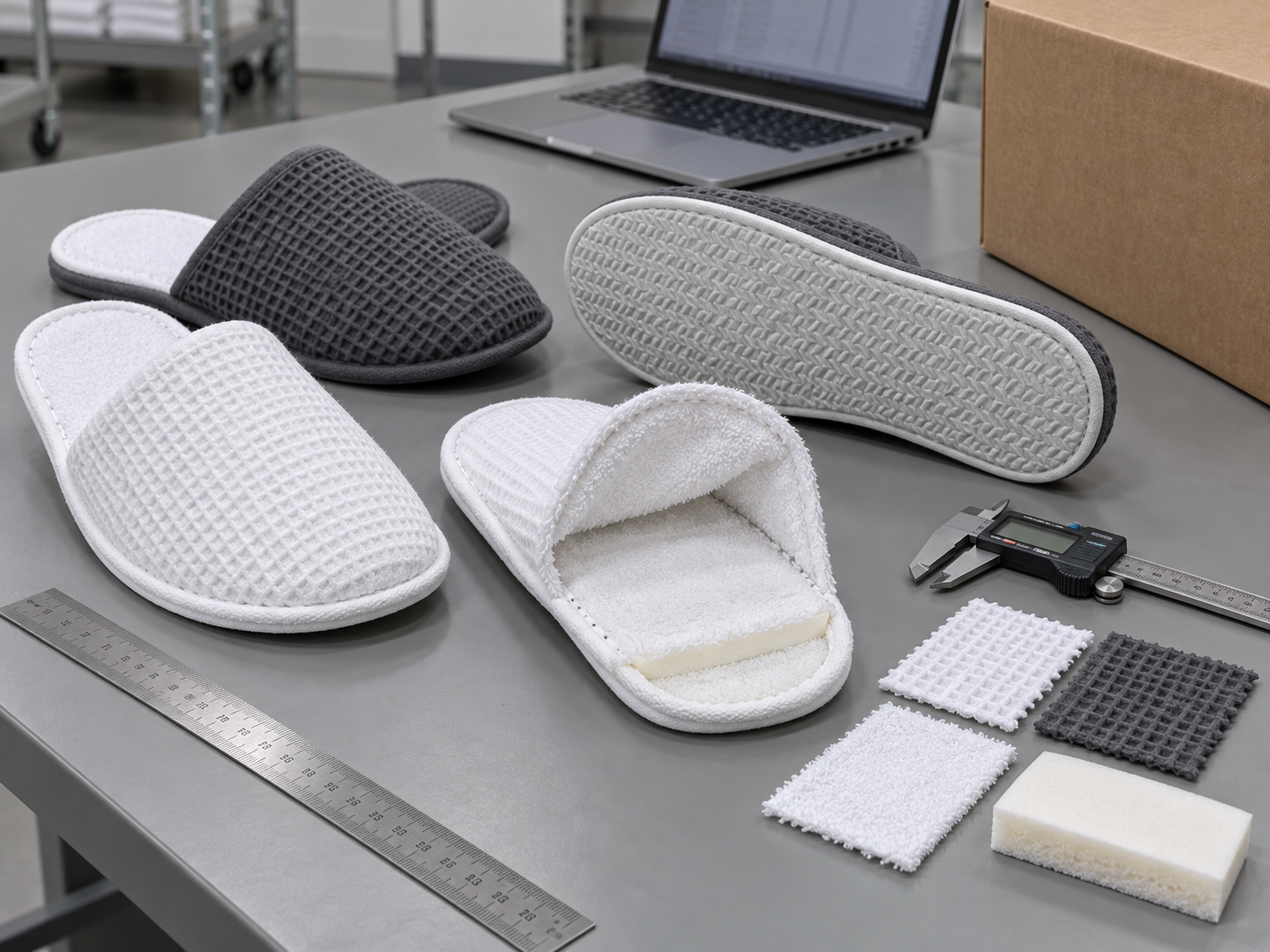
- The Product Layer: Physical construction of the spa slipper—textile upper (terry cloth, waffle weave, or non-woven), border binding, footbed padding, sole material (EVA, TPR, or dot-fabric), and graded sizing. Sourcing literature on Chinese spa-slipper OEM manufacturing notes standard options such as custom materials, logo application, size adjustments, anti-microbial treatments, memory foam padding, non-slip soles, and factory quality control (Yunkai Hotel Amenities). These options represent standard physical configurations; offering them does not prove that design files, production machinery, and QA checklists are digitally aligned.
- The Record Layer: The tracking mechanism assigned to the batch. Whether an OEM utilises an on-sole QR code, carton-level 2D barcode, or alphanumeric lot code, readiness is determined by whether scanning resolves to the exact signed-off revision. Importers must demand a functional test read on the pre-production sample to confirm the linked asset cannot be modified post-approval.
- The System Layer: The software housing the master record—whether an MES, ERP, or version-controlled document repository. The 2026 report attributes cycle-time reductions to plant-level digital systems such as MES, but it does not specify software vendors or API protocols. Inquiring whether an OEM simply "has software" provides no useful procurement signal; buyers must verify which specific purchase-order data fields the OEM system natively locks.
Buyer-side software represents a fourth layer. Sourcing and facility guidance for wellness facilities outlines workflows linking guest bookings, inventory tracking, and API orchestration to synchronise property operations (saunas and bathhouses data-integration guide). However, property-level ERP or inventory tools operate independently of factory tooling. An OEM does not gain manufacturing readiness from an importer's internal booking software, nor does an importer's system define factory stitch tension or sole bonding.
No manufacturing standard cited in referenced literature should be assumed as an active plant-wide accreditation. Compliance documents linked to an identifier must be reviewed individually for legal entity name, scope, test standard, and expiry date. A digital link to a document does not substitute for verified certification of the specific production batch.
New Zealand Buyers: Records That Must Survive Freight and Receiving
For goods destined for Auckland, Tauranga, Lyttelton, or regional New Zealand distribution centres, the primary vulnerability in digital procurement is record drift during international freight and border clearance. International supply chain origins referenced in source material focus on manufacturing plants in China; origin is an operational parameter to verify on quotes, not an expansion of sales-market targeting.
Commercial risk materialises when physical packaging arrives with documentation that diverges from digital customs manifests. This briefing makes no definitive legal declarations regarding New Zealand Customs Service tariffs, biosecurity import health standards, or mandatory consumer labelling laws, as source literature does not establish those statutory frameworks. Importers must verify those requirements directly with licensed New Zealand customs brokers.
Operational control requires absolute data parity: the style SKU, revision number, material declaration, inner pack quantity, and master carton count on the supplier's digital release must identically match the commercial invoice, packing list, and bill of lading. A discrepancy between an electronic record and physical carton markings causes customs inspection holds and receiving delays at local logistics facilities.
Because external research provides no empirical transit durations for maritime or air freight lanes to New Zealand ports, freight intervals must be obtained independently from freight forwarders. Factory cycle times must be isolated from international shipping schedules; an OEM that completes production quickly but holds dispatch due to manual paperwork reconciliation eliminates upstream gains.
Inbound warehouse teams require verification protocols that do not rely on verbal vendor assurances:
- Carton-level pair counts cross-referenced against the commercial packing list.
- Sizing distributions checked against the signed purchase order.
- Sole substrate, pattern, and upper construction physically verified against the golden sample.
- Scannable code validation confirming the link resolves to a frozen, read-only specification sheet.
Logo customisation is standard in contract amenities manufacturing (Yunkai Hotel Amenities). However, digital integration requires embroidery or screen-print vectors, exact Pantone references, and placement coordinates to be locked directly inside the primary manufacturing BOM rather than managed via loose image files.
Measurable Trade-Offs in Cycle Time, MOQ, and File Control
Published metrics from manufacturing reports provide clear benchmarks for evaluating OEM performance claims, provided they are verified against binding quotation terms:
- Product Development Lead Time: The 12 February 2026 report indicates that digital workflows and MES reduced development cycles from 45 days down to 15 days (Unit: days; Scope: new-product prototyping in Chinese slipper manufacturing facilities; As-of date: 12 February 2026; Source: People's Daily English). The 30-day reduction reflects factory-level CAD and tooling alignment. It must not be assumed that bespoke sole molds or custom-woven textiles will automatically prototype within 15 days for a New Zealand importer without written OEM confirmation.
- Minimum Order Quantities (MOQ): The same 12 February 2026 source documents MOQ compression from 3,000 pairs down to 300 pairs under connected manufacturing lines (Unit: pairs; Scope: slipper manufacturing facilities described; As-of date: 12 February 2026; Source: People's Daily English). A 300-pair threshold enables New Zealand hospitality brands to conduct commercial pilots or support boutique lodge footprints. However, because source literature quotes no unit pricing or setup charges, buyers must confirm whether short-run orders incur line-setup surcharges.
- Synchronised Batch Scale: The source details a single procurement scenario where 3,000 pairs were configured and transmitted directly to production (Unit: pairs; Scope: automated manufacturing case study; As-of date: 12 February 2026; Source: People's Daily English). Direct parameter adjustments carry operational risk: unmanaged alterations to colorway or sole density without version freezes can corrupt batch integrity.
- Example Scheduling Calculation (Assumption to verify in supplier quote): If an OEM confirms a 15-day sample development window, and quotes 21 production days post-approval for a 3,000-pair production run, total ex-factory turnaround is calculated at 36 days (15 + 21 = 36 days). These 21-day and 36-day figures represent modeled planning assumptions for contract review. They exclude ocean transit, port processing, biosecurity clearance, and domestic distribution within New Zealand.
- Example Lot Sizing Calculation (Assumption to verify in supplier quote): A 300-pair pilot represents exactly 10 percent of a standard 3,000-pair commercial production volume ((300 / 3,000) * 100 = 10%). This is an arithmetic ratio between reported case metrics, not a guaranteed yield or pricing discount. Importers must establish whether tooling, fabric lots, and QC tolerances on a 300-pair pilot are identical to subsequent replenishment runs.
Compressing production timelines amplifies the risk of undocumented errors. If changes are made rapidly, unversioned artwork or incorrect size curves can enter cutting without detection. A locked, read-only PDF BOM combined with signed physical counter-samples provides greater operational control than an opaque digital portal.
Buyer Decision Table for Spa Slipper OEM Data and Product Approval
New Zealand buyers can use this framework during RFQ evaluation to verify digital readiness across manufacturing phases:
| Procurement Decision | Required Specification | Contract Evidence | Approval Gate | Operational Risk Managed |
|---|---|---|---|---|
| Specification Control | Master SKU, BOM revision number, graded size specs, decoration coordinates | Unified BOM reference across quote, pro-forma, and sample tag | Written approval locking the engineering revision | Prevents unauthorised mid-run fabric or pattern substitutions |
| Prototyping Lead Time | Calendar days from CAD/artwork receipt to dispatch of physical counter-sample | Explicit development schedule with specified trigger date | Validation against OEM contract terms (using 15/45-day benchmarks as context) | Eliminates scheduling slippage before bulk manufacturing |
| Bulk Production Window | Days from sample acceptance to commercial packing and ex-factory readiness | Written production timeline tied to specific order volume | Binding ex-factory milestone tied to confirmed payment terms | Isolates factory floor duration from maritime freight transit |
| MOQ Flexibility | Pilot run vs. replenishment tier volume commitments | Explicit quotation line items for short runs (e.g., 300 pairs vs. 3,000 pairs) | Independent QC sign-off on initial pilot batch prior to full release | Prevents supplier minimums from forcing excess stockholding |
| Lot Identification | Scannable QR code, 2D matrix, or alphanumeric carton stencil | Test scan resolving directly to immutable specification file | Factory sample scan verification prior to mass printing | Prevents landing cartons with untraceable or broken data links |
| Regulatory & Compliance | Relevant material safety declarations or slip-resistance test reports | Valid test certificates specifying product name, date, and accredited lab | Verification of certificate scope against quoted physical materials | Prevents reliance on generic or expired factory certifications |
| Physical Material Lock | Textile GSM, foam thickness, sole compound (EVA/TPR/dots), edge piping | Counter-sample swatch card and technical specification sheet | Physical approval of signed sample over digital render | Prevents material substitution under compressed cycle times |
| Receiving SKU Alignment | Direct cross-reference between factory production code and buyer internal SKU | Integrated mapping table on packing lists and commercial invoices | Operational sign-off from warehouse receiving team | Prevents receiving misallocations and inventory reconciliation errors |
| Master Packaging Spec | Pairs per inner polybag, pairs per carton, gross weight, dimensional data | Master carton packing slip template matching PO specifications | Pre-shipment audit against physical carton dimensions | Stops unexpected freight surcharges and pallet overhang at receipt |
| Revision Governance | Formal workflow for post-approval pattern, colour, or quantity changes | Contract clause stating modifications generate new revision IDs | Stop-shipment protocol if modifications lack written sign-off | Eliminates uncontrolled changes on the production floor |
Separate Reported Factory Systems From Spa-Software Flows
Procurement documentation must maintain a strict technical separation between manufacturing automation and hospitality management systems:
Factory digitalisation, as outlined in the People's Daily report, centers on plant MES networks that compress prototyping from 45 to 15 days, scale MOQs down from 3,000 to 300 pairs, and capture order data directly via identifiers (People's Daily, 12 February 2026). These capabilities reflect specialised industrial automation deployed in Chinese slipper plants. Importers must evaluate whether an individual bidding supplier possesses these systems or simply relies on conventional sub-contracting networks.
Conversely, property management data integration addresses internal wellness facility workflows, linking appointment scheduling, guest preferences, linen inventory, and API management (saunas and bathhouses data-integration guide). While these internal architectures allow New Zealand day spas and luxury lodges to monitor consumption rates, they do not dictate OEM cutting tolerances or adhesive curing. Importers should adopt the discipline of structured data flows—mapping each transition point between internal purchase orders, customs invoices, and stock receipts—without assuming factory connectivity handles domestic stock control.
Supplier marketing literature frequently highlights generic capabilities such as custom designs, logo printing, memory foam insoles, and quality inspections (Yunkai Hotel Amenities). These catalog offerings represent baseline production options rather than automated process integration. Importers must confirm that quality inspections are documented via formal lot-release certificates rather than informal assertions.
Digital 3D renders provide visual layout confirmation, but they do not establish textile hand-feel, foam compression deflection, or sole coefficient of friction. Physical counter-samples remain the sole binding authority for finished product acceptance.
RFQ Checklist
- Ask the supplier to name the exact digital system (MES, ERP, or version-controlled document portal) used to lock style codes, BOM revisions, size curves, and order quantities.
- Require the manufacturer to provide separate, binding day counts for prototype sampling and bulk manufacturing, identifying the exact milestone that initiates each timeline.
- Specify pilot volumes and recurring replenishment volumes on separate quotation lines, requiring confirmed MOQs for specific upper and sole tooling rather than standard catalog estimates.
- Require the manufacturer to provide a functional test scan or digital export of any offered sole QR code or carton barcode to confirm it links to a frozen, read-only specification sheet.
- Specify all upper textiles, foam densities, outsole compounds, and embroidery dimensions in writing, requiring physical counter-sample sign-off before authorizing mass production.
- Ask the supplier to attach complete, unaltered copies of any compliance or test certificates linked via product codes, verifying that the testing entity, date, and product scope match the quoted slipper.
- Verify that commercial invoices, ocean packing lists, and warehouse delivery dockets share identical SKU codes, revision tags, and piece counts prior to port dispatch.
- Compare quoted prototyping lead times and order minimums against reported industry benchmarks (15-day development and 300-pair MOQs) to assess technical plausibility.
- Require the manufacturer to provide a written change-control procedure confirming that any mid-production modification generates an incremented revision ID and halts production pending approval.
- Ask the internal receiving facility in New Zealand to map vendor packaging configurations and barcodes to internal inventory software before issuing the purchase order.
Methodology, Limitations, and What to Verify
Data Sources and Methodology: Operational figures cited in this analysis derive from verified industry source materials. Benchmark lead times (45-day baseline reduced to 15 days), MOQ thresholds (3,000 pairs compressed to 300 pairs), and automated 3,000-pair order routing reflect reporting published by People's Daily English on 12 February 2026. The 30-day timeline delta represents direct arithmetic calculation between reported metrics. The 10 percent pilot ratio and the 36-day cumulative schedule represent illustrative planning models for contract validation. Product customisation categorisations are drawn from published manufacturer documentation (Yunkai Hotel Amenities). Facility data boundaries are referenced from wellness operations systems guidance (AIQ Labs). No commercial search-demand estimates, cost-per-click values, or organic search volume metrics are utilised in this analysis.
Editorial Limitations: The industry case study describes modernised slipper plants in China; it does not represent an exhaustive industry-wide census, nor does it identify proprietary API architectures. Commercial catalog listings outline supplier claims but do not constitute third-party testing data. Operations guides evaluate internal hospitality software rather than manufacturing assembly lines. None of the referenced sources specify New Zealand maritime transit durations, biosecurity import protocols, or customs tariff classifications. Byline credit reflects editorial analysis by Vincent Xi and does not represent an on-site factory audit or proprietary production testing.
Procurement Verification Protocols: Prior to issuing commercial purchase orders, New Zealand buyers must evaluate supplier responses against the decision matrix, execute the structured RFQ checklist, inspect original laboratory test reports, and engage an accredited customs broker to establish import classification. Retain signed physical counter-samples alongside frozen technical BOM files. Digital integration readiness is demonstrated only when physical inventory, shipping documentation, and locked digital records fully align at receipt.
Discuss Your Requirements
Review our manufacturing capabilities, then share your specifications for a supplier-fit review.