Hotel Slipper Wholesale Supplier Communication Workflow Review for Australian Hotels
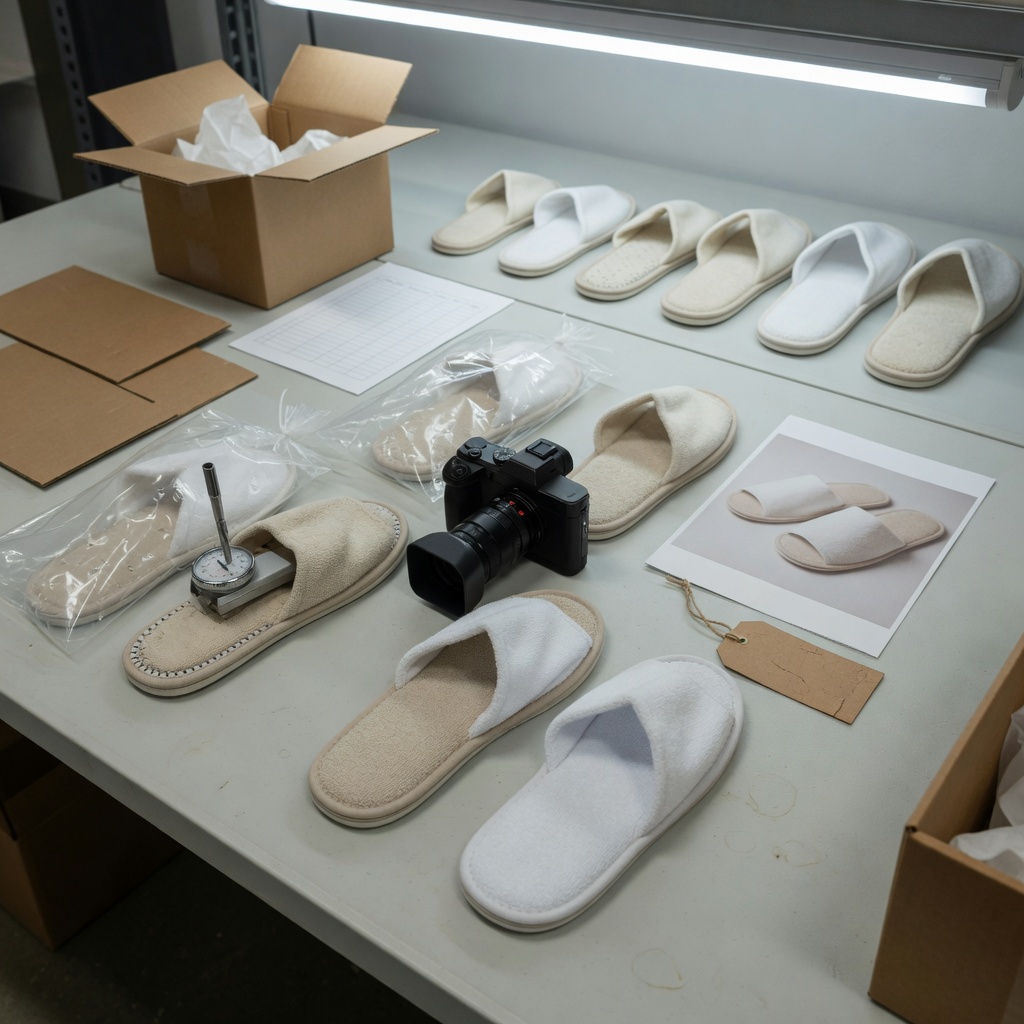
By Vincent Xi, Editorial Author. Profile: https://slipperforge.com/authors/vincent-xi/. Sourcing is limited to the cited manufacturer process pages and hotel-procurement guidance. Client names, awards, certifications, laboratory tests, and factory-visit narratives are omitted because they are not in those sources.
Australian hotel procurement teams should treat a hotel slipper wholesale supplier communication workflow review as a scored RFP gate built from files and dates, not from sales tone. Do not award hotel slipper wholesale supply until the bidder names an owner and backup, states acknowledgement and quotation windows, documents a sample-approval loop with dated photos, commits to a production-status cadence, and routes exception alerts to every receiving site.
Use published OEM process times only as bid tests. One manufacturer states inquiry and quotation in 1–2 days, sample production and approval in 10–15 days, and weekly progress photo updates during mass production, inside a six-step custom hotel slippers process (Hotemax hotel slippers process). Those figures are that manufacturer's stated commercial process. The supplied excerpt does not include a last-updated date. They are not an Australian industry median and are not presented as measured results. Hotel procurement guidance separately frames RFP work as qualification, clarifications, compliance matrices, pricing, samples, risk, submission, and debriefs (InnLead hotel procurement RFP process). Score dates and files from both contexts.
The communication workflow review below covers communication artefacts for hotel slipper wholesale supply. It is not a full product-specification manual and not a country-law handbook.
Communication workflow review: map the hotel slipper loop from inquiry to Australian delivery
Score every message that can delay room-ready stock. Keep sourced manufacturer stages separate from buyer-specified wholesale checkpoints.
Sourced manufacturer stages (bid tests, not universal factory proof). Hotemax publishes a six-step custom hotel slippers process from inquiry through final inspection, with the quotation, sample, and weekly photo timings cited above (Hotemax hotel slippers process). GC Footwear publishes a custom path: send logo and requirements, receive a design proposal, produce after approval, and deliver to the desired address, including multiple locations, with consulting from idea to product and logistics from import to distribution (GC Footwear hotel slippers ordering process).
Buyer-specified wholesale checkpoints (RFQ design, not claimed as either manufacturer's hidden process). For hotel slipper wholesale supply into Australia, specify and score: complete inquiry; quotation covering price, minimum order quantity, lead time, and Incoterms; logo lock; physical sample; any extra pre-production sample the buyer requires; purchase order and deposit; bulk manufacture; packing-list confirmation; inspection window; booking; and arrival at one or more Australian docks or hotels. Incoterms, RACI, and AEST/AEDT clocks are buyer commercial controls. They are not stated as statutory Australian requirements on the cited pages.
Use the GC path as a control list. Do not treat it as proof that every factory can split cartons across Australian properties without extra documents.
Decision rule: a bidder that issues a quotation inside a published 1–2 day window but cannot name a production contact or a weekly evidence method is fast in sales and weak in operations (Hotemax quotation timing). Weight a slower complete quotation with dated photo evidence higher when slippers must arrive before a renovation handover or the hotel group's own brand-standard audit. That audit is a buyer event, not a named external certification in the cited sources.
How Australian procurement teams should score communication in RFP and onboarding
InnLead's hotel supplier materials highlight workflows, catalog data, integrations, onboarding questions, and a 2026 supplier-readiness framing, alongside RFP qualification and clarification rounds (InnLead Insights). Apply those stages only to slipper-specific files: size run, sole build, terry or non-woven upper, embroidery or print, carton marks, and inner-pack counts.
Hard gates (buyer exclusion rules if missing): a RACI covering inquiry, sampling, production, and logistics; email as the buyer's system of record; PDF quotations plus an editable SKU matrix; and a written escalation if the stated window is missed. These gates are procurement controls, not Hotemax, GC Footwear, or InnLead certifications.
Clarification rule: reject unspecified promises such as "updates to follow" unless the reply arrives with a revised quotation, marked tech pack, or counter-photo. Fill the InnLead skeleton of clarifications, samples, risk, and debriefs with those artefacts (InnLead RFP process).
After award: specify a kickoff note that restates SKUs, art-file version IDs, carton marks for each Australian receiving site's own SOP, and photo cadence. If a manufacturer publishes weekly production photos, copy that cadence into the purchase order as a deliverable (Hotemax mass production updates).
Buyer scoring template (not market data): award 2 points when a dated artefact exists, 1 point when the method is promised without a file example, and 0 if missing. Exclude at 0 on any hard gate. Eight checkpoints below give a 16-point sheet that can be filed with the RFP (unit: points; scope: this template only; not a published index).
Trade-off: extra kickoff documentation can add review cycles before deposit (example calculation/assumption: two extra buyer-side review cycles; confirm the calendar in the supplier quote). The cost is days. The benefit is a frozen logo and carton-mark file before bulk. Example lot size such as 1,000 pairs is an assumption to verify in the supplier quote, not a recommended order quantity from this page.
Manufacturer-stated response times are bid tests, not Australian benchmarks
Put only sourced numbers on the scorecard, each with unit, scope, and dating limits:
- Inquiry and quotation turnaround: 1–2 days. Unit: calendar days as published. Scope: one manufacturer's published six-step custom hotel slippers process. As-of: not timestamped in the supplied excerpt; reconfirm as a bid commitment in the live quotation (Hotemax).
- Sample production and approval: 10–15 days. Unit: calendar days as published. Scope and dating caveat: same manufacturer process page; the excerpt does not state whether courier time to Australia or buyer idle time is included (Hotemax).
- Production reporting frequency: weekly progress photo updates during mass production. Unit: one photo set per calendar week. Same source; not a defect-rate statistic (Hotemax).
- Process-stage count: six commercial steps from inquiry through final inspection on that page (count of stages, not days) (Hotemax).
- Guide year: InnLead's 2026 supplier-readiness framing covering workflows, catalog data, integrations, and onboarding questions. Use 2026 as the publication-year context of that checklist, not as demand data (InnLead).
Time-zone offset between an Australian buying office and an offshore plant can consume part of a stated 1–2 day window (example assumption to verify in the quote: one business day lost to calendar-date change; require the bidder's cut-off hour in Australian Eastern Time, AEST/AEDT). Exception emails that arrive after a vessel cut-off still miss the sailing. This article does not have a sourced Australian labelling, biosecurity, GST, or humidity-storage standard, so those topics are not stated as requirements. Instead, require packing method and inner protection to be confirmed in the same thread as production photos.
GC Footwear describes production in Berlin plus partner factories and delivery to multiple locations (GC Footwear). For Australian groups, the communication test is per-site packing lists and advance shipping notices. Origin location is a manufacturing-origin reference, not a sales-market target.
Questions that show whether the workflow will survive sampling and bulk
Ask for artefacts, not adjectives:
- Who acknowledges the RFQ, and within how many business hours measured in Australian Eastern Time (AEST/AEDT)? (Buyer-specified clock; not an OEM SLA on the cited pages.)
- Does the quotation include a calendar: sample ship date, buyer comment-due date, revised sample date?
- Are sample comments accepted as annotated photos, with a stated counter-photo window?
- Is the weekly bulk update a folder of dated process photos or one marketing image?
- If logo or colour fails, what is the hold-and-notify path and who signs restart?
- Can one production order generate multiple packing lists for split hotel deliveries?
- What after-arrival defect window and which channel is contractual?
- Which art-file version ID sits on the quote, the sample photo, and the bulk freeze note?
Published phrases such as "fast and professional communication during production" are testimonials, not SLAs; convert them into a weekly photo method (Hotemax). "Simple and efficient" ordering copy should become file-and-date clauses (GC Footwear).
Trade-off: more questions lengthen the RFP; fewer questions move risk to the loading dock. Treat artwork files, carton marks, and inner-pack counts as high-risk artefacts because they are the items that change between sample and bulk.
Decision table: communication signals that should change the shortlist
| Gate type | Checkpoint | Specify in the RFQ | Evidence to compare | Verify before approval | Order action if failed |
|---|---|---|---|---|---|
| Hard fail | RFQ acknowledgement | Named owner and backup; hours in AEST/AEDT | Timestamped reply to a test inquiry | Repeat on a second weekday | Exclude if silent past the stated cut-off |
| Hard fail | Quotation completeness | Price, MOQ, lead time, Incoterms, sample fee, calendar, art-file version ID | One PDF aligned to the SKU matrix | Test claimed 1–2 day window if the bidder uses it (Hotemax) | Treat incomplete quotes as non-compliant |
| Hard fail | Sample loop | Included revision count; photo annotation method | Dated photos of sample v1 and v2 | Physical pair versus approved photo | Freeze art before deposit; price extra revisions |
| Hard fail | Production cadence | Weekly photo set named by PO | Week-stamped image folder (Hotemax weekly updates) | Request a random week during bulk | Hold remaining payment or delay booking |
| Hard fail | Exception alerts | Same-day notice for material, logo, or schedule slips | Written escalation tree | Run a table-top miss during kickoff | Replacement or delay clause |
| Conditional | Multi-site delivery | Per-hotel packing lists and carton marks | Sample lists for two sites (GC Footwear multiple locations) | Marks match each hotel's receiving SOP | Split-ship only as a priced line |
| Hard fail before balance | Inspection window | Pre-shipment photos; optional third-party inspection if the buyer requires it | Inspection date on the shared calendar | Align with the supplier's final inspection step (Hotemax) | No slot, no balance payment |
| Required before extension | Record file | Thread plus photo archive retention (example assumption: 12 months; confirm in the quote and with contracts) | Shared folder structure | Spot-check one closed sample thread | Required before blanket-order extension |
Score artefacts and dates. Do not score tone. Optional third-party inspection is a buyer-purchased check, not evidence that the factory holds a current certificate.
Shortlist: every hard gate has a date-stamped file. Hold: the quote is complete but the sample loop or weekly method lacks a file-naming convention. Exclude: silent past the acknowledgement cut-off, incomplete quotation, or no named production owner.
Trade-offs Australian buyers should price
Speed versus completeness: a 1–2 day quote that omits carton marks can consume more total calendar time than a slower complete quote (Hotemax).
Sample days versus opening dates: a 10–15 day sample loop does not include courier time to Australia or internal brand review unless the quotation says so (Hotemax sample stage). Do not insert a generic courier-day figure from this page.
Weekly photos versus live video: photos are easier to store in procurement systems that care about catalog data and integrations (InnLead).
Single shipment versus multi-location: more addresses reduce hotel-side redistribution and increase ASN and claim points (GC Footwear).
Deposit versus visibility: a deposit without a written update cadence buys capacity and sells information rights. Put cadence on the PO. Release deposit only after the art-freeze file is in the email of record.
Do not infer Australian statutory labelling, biosecurity, GST, or climate-storage rules from these sources. Attach the hotel group's own compliance pack and require the supplier to acknowledge each file by name.
RFQ checklist for a hotel slipper wholesale supply communication workflow review
Each item is a specify, compare, verify, approve, or order action.
- Name the buying entity, Australian receiving sites, and the single email of record.
- Attach the SKU matrix: size, colour, material, logo method, pairs per inner, inners per carton.
- Require acknowledgement within stated business hours in AEST/AEDT, with a backup person (buyer-specified clock).
- Require a quotation window; if the bidder claims 1–2 days, make it a bid commitment (Hotemax).
- Require a calendar covering sample dispatch, comments, revised sample, and bulk start.
- State whether quoted sample days (including any 10–15 day claim) include or exclude buyer idle time and courier time to Australia (Hotemax).
- State included sample iterations and the unit price of extras (price to be taken from the quote).
- Require photo file naming; example convention PO-YYYYMMDD-stage to confirm in the quote.
- Make weekly production photo sets a PO deliverable (Hotemax).
- Require a written hold path for logo, colour, or workmanship issues, including the named restart signer.
- Require packing-list draft approval before cartons close.
- For multiple hotels, require per-site carton marks and ASNs (GC Footwear).
- Set inspection date and photo set before balance payment (Hotemax final inspection).
- Name Incoterms and who emails exceptions when sailing or air dates move (buyer commercial term; not a cited legal rule).
- Require a close-out pack: quote, art freeze, sample photos, weekly sets, inspection, proof of delivery, consistent with RFP debrief practice (InnLead).
- State record retention (example assumption: 12 months; confirm with the hotel group's contracts team).
- Ask for the post-PO onboarding sequence mapped to hotel procurement onboarding questions (InnLead 2026 supplier readiness).
- List contractual channels (email or PO portal) versus non-contractual chat apps.
- Run one deliberate clarification during RFP and score hours-to-artefact.
- Approve bulk only after art freeze and sample sign-off sit in the email of record.
- Paste the communication calendar into the PO schedule before ordering.
- After first receipt, compare actual versus promised cadence before any extension.
- Put buyer comment blackout dates in the RFQ so sample clocks do not run against silent hotel days.
- Require every quote revision to repeat the current art-file version ID.
- Tie deposit release to the art-freeze artefact, not to a verbal go-ahead.
Methodology, source contexts, and limitations
How the data was derived: process durations, step counts, and RFP stage names were copied from public manufacturer and hotel-procurement pages, then rewritten as buyer tests. The 2/1/0 score sheet is a procurement template, not a measured index. Example pair counts, retention periods, extra review cycles, and time-zone day loss are labelled assumptions to verify in the supplier quote.
Source context A: InnLead Insights hotel supplier procurement guides, including 2026 supplier-readiness topics (workflows, catalog data, integrations, onboarding) and an RFP sequence (qualification, clarifications, compliance matrices, pricing, samples, risk, submission, debriefs) at https://www.innlead.ai/blog/.
Source context B: Hotemax hotel slippers process (six steps; 1–2 day quotation; 10–15 day sample production and approval; weekly production photos; final inspection; testimonial language on production communication) at https://hotemax.com/hotel-slippers/.
Source context C: GC Footwear custom logo hotel slippers path (logo and requirements, design proposal, production after approval, multi-location delivery, import-to-distribution logistics; production in Berlin plus partner factories) at https://www.gcfootwear.com/en/hotel-shoes/.
Limitations / what to verify: excerpts lack last-updated timestamps, enforceable SLAs, and Australian-specific freight, climate, or labelling evidence. Testimonials are not measurements. Named manufacturers are process-page sources for bid tests, not awarded suppliers and not certified by this page. Re-run a timed test inquiry, demand a current process sheet, and do not treat this page as a factory certification. Vincent Xi is listed as Editorial Author on SlipperForge. The public author profile is https://slipperforge.com/authors/vincent-xi/. Statements stay inside the cited sources, labelled bid tests, and labelled example calculations.
Discuss Your Requirements
Review our manufacturing capabilities, then share your specifications for a supplier-fit review.