Hotel Slipper Wholesale Supplier Business Continuity Planning: A United States RFQ Brief
By Vincent Xi — Editorial Author Author profile: https://slipperforge.com/authors/vincent-xi/
United States B2B hospitality buyers evaluating a hotel slipper wholesale supplier should treat business continuity planning as a documented RFQ control, not as an unverified supplier promise. For a hotel-slipper order, the buyer can freeze the approved revision, distinguish another producing site from finished-goods cover and a logistics-only route, define a written switch trigger, and compare path-specific landed cost, delivery milestones, labeling review, and acceptance rules. The Business Continuity in the Hotel Industry source discusses diversified suppliers, safety stock, continuity clauses, and alternate sourcing. The Supply Chain Management in the Hospitality Industry source discusses supplier vetting, inventory visibility, contingency planning, and alternative vendors. Those sources support the control categories; they do not establish hotel-slipper measurements, factory capacity, prices, or delivery performance.
For a United States RFQ, do not count a forwarder change as manufacturing backup. Require the quote to identify whether an alternate path is another producing site, a finished-goods reserve, or a logistics-only route, and require evidence that matches that category. Put the approved revision, United States delivery point, Incoterm, milestone clock, label artwork, and release documents in the quote and purchase order.
This is an editorial buying brief for United States B2B buyers deciding on hotel-slipper wholesale supply. The byline identifies Vincent Xi as Editorial Author at the profile above. It does not claim a factory visit, wear trial, laboratory test, certification audit, named client, customer outcome, or first-person experience.
What United States Buyers Should Lock Into Business Continuity Planning
Use the cited pages for high-level control categories. The exact slipper fields, quantities, dates, thresholds, and acceptance rules below are buyer-defined requirements and must be confirmed in the supplier's written quote. The continuity source addresses diversification, safety stock, and continuity clauses; the hospitality supply-chain source addresses supplier vetting, inventory visibility, contingency planning, and alternative vendors.
- Controlled specification: Freeze the size range, upper material, sole material and thickness, closure, construction, color, pack configuration, and carton fields that affect fit, presentation, receiving, or freight.
- Alternate path: Identify whether the alternate is another producing site, a finished-goods reserve, or only a logistics provider. Do not count a logistics change as production capacity.
- Cover record: State the pair quantity, physical location, ownership, and demand or issuance basis for any reserve stock.
- Switch trigger and authority: Define the missed milestone or inspection event, calendar-day basis, approver, and documents required before release.
- Commercial and receiving rules: Pre-agree landed-cost lines, delivery terms, sample or lot acceptance method, and treatment of any specification or route change.
This control set applies the cited hospitality continuity themes to a hotel-slipper RFQ. The sources do not set a slipper specification, reserve quantity, factory threshold, or delivery promise.
Decision Table for United States Hotel Slipper Wholesale Supply Continuity
The table separates source context from buyer-defined evidence. It does not claim that a cited source sets hotel-slipper specifications, prices, capacity, or delivery thresholds.
| Continuity control | What the buyer compares | Evidence to require before award | Source boundary | Risk if missing |
|---|---|---|---|---|
| Frozen product revision | The same size range, materials, sole thickness, closure, construction, color, and pack configuration on each path | Dated specification sheet and approval sample tied to the revision | Hospitality continuity context supports control discipline; exact slipper fields are buyer-defined | Alternate pairs cannot be accepted against the primary requirements |
| Alternate capability | Producing site, finished-goods reserve, or logistics-only route | Named site or stock location, process scope, capacity evidence, and written release window | Alternate-sourcing and supplier-vetting context; capacity evidence is quote-specific | A route change is mistaken for production backup |
| Cover and ownership | Pair quantity, physical location, ownership, and issuance basis | Dated inventory record and buyer-approved demand or issuance assumption | Safety-stock and inventory-visibility context; quantity and ownership are buyer-defined | Reserve stock cannot be released or counted confidently |
| Switch trigger and authority | Trigger event, calendar-day basis, approver, and required documents | Milestone schedule and written trigger clause | Continuity-clause and response-protocol context; trigger values are buyer-defined | Teams wait informally while demand continues |
| Delivery milestone | Ship-from location, Incoterm, delivery point, clock start, and consequence of delay | Dated milestone schedule and written delivery terms | Hospitality contingency context does not set a delivery promise | Primary and alternate paths cannot be compared on the same clock |
| Landed cost | Unit price, packing, carriage, insurance if applicable, estimated duty and entry charges, brokerage, and United States inland delivery | Path-specific line-item quote with assumptions marked for reconfirmation | Buyer-defined commercial control; no cited source sets price or duty | Finance cannot approve the alternate route confidently |
| Label and carton identity | Unit, inner-pack, and carton fields for size, pair count, order or lot identity, and origin information when applicable | Artwork or blank dieline, packing-list field list, and broker or counsel review status | Buyer-defined receiving and entry control; legal applicability must be verified for the shipment | Receiving cannot reconcile the alternate lot to the open order |
| Incoming acceptance | Measurement list, defect classes, sample or lot method, and rejection authority | Written pass-or-fail method tied to the purchase order | Buyer-defined receiving control; cited sources do not set a slipper test | A disrupted lot enters receiving without a usable decision rule |
| Clause and playbook | Continuity clause, roles, timing, documents, and alternate-sourcing sequence | Draft clause and response playbook | Continuity-clause and response-protocol context; wording is buyer-defined | Staff must invent the response during the disruption |
The Crisis Management: Your Hotel Linen Supplier Backup Plan source is used only for its described sequence: map the chain, qualify alternatives, and assign a response protocol. Its subject is hotel linen, not hotel slippers, so it is not evidence about slipper materials, production capacity, lead times, prices, or delivery performance.
United States Hotel-Slipper RFQ Controls for Specification, Labeling, Landed Cost, and Delivery
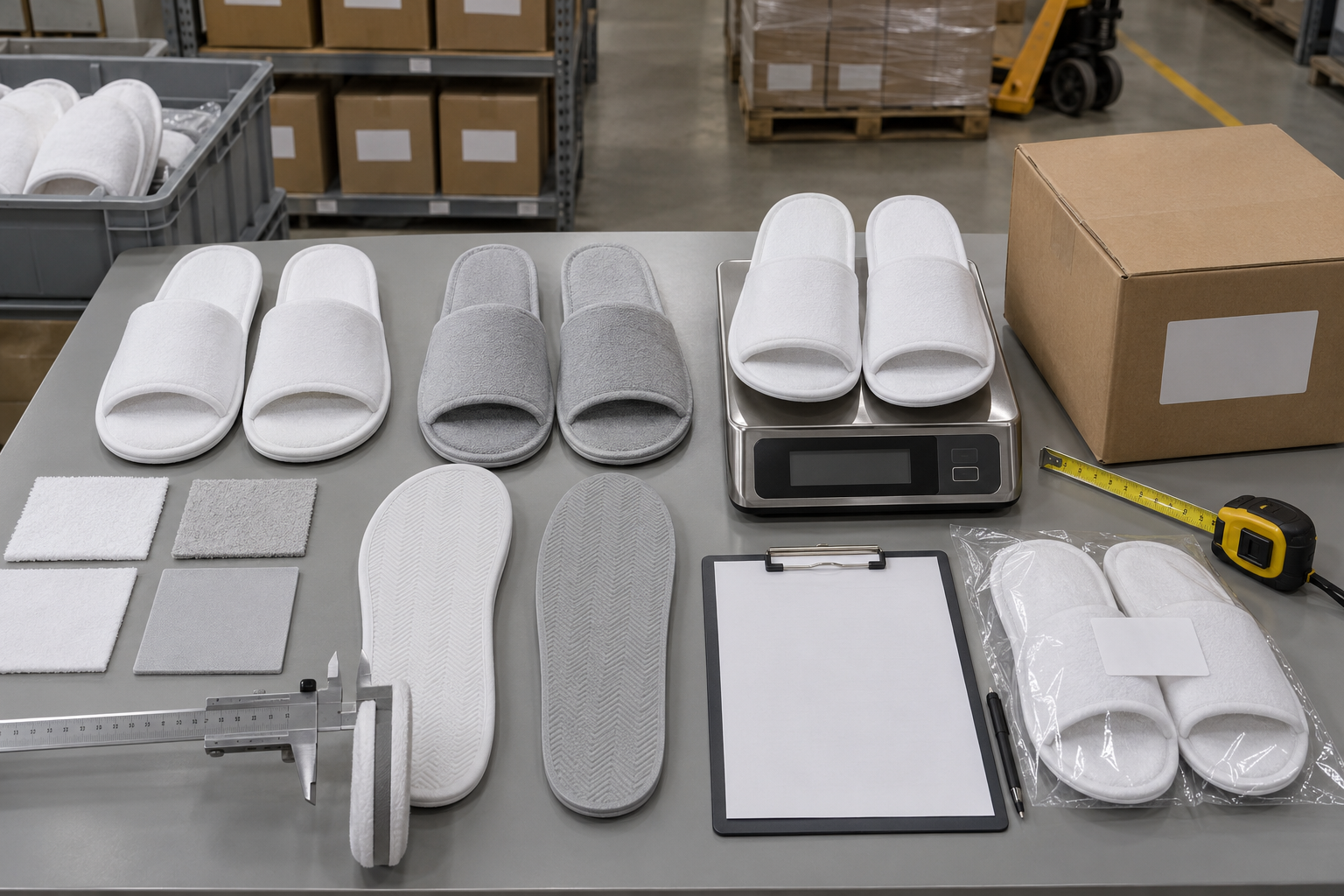
Specification. Require the primary and alternate quotes to repeat the same controlled fields: size range; upper material; sole material and sole thickness in millimeters; closure type; open-heel or closed-heel construction; color; pair weight in grams when used for freight planning; pairs per inner pack; inners per export carton; and carton length, width, and height in centimeters. If a field is out of scope, mark it not applicable rather than allowing an unstated supplier default.
Use the same measurement method for approval samples from each path. The purchase order should identify the approved revision and the sample or lot acceptance method. A supplier description of a similar hotel slipper is not a substitute for a buyer-approved specification.
Labeling. For United States delivery, treat pair, inner-pack, and carton artwork as receiving and entry-review controls. Ask the supplier to show proposed content for size, pair count, purchase-order or lot identity, origin information when applicable, and any material-content field required by the buyer's customs broker or counsel. Ask the broker or counsel to document the current origin-marking, material-content, and other product-specific labeling requirements for the actual article, shipment, and entry date. This article does not decide legal applicability.
Do not accept generic artwork as approved evidence. Require an artwork revision, source file or dieline, approval date, and a way to reconcile the marked goods with the purchase order or lot record. If a supplier proposes a certification mark or compliance statement, hold it for document review before use.
Standards and certifications. If a supplier names a standard or certification, require the current supporting document, issuing body, covered product or process, producing site, validity information, and shipment scope. Treat the document only within its stated scope. A supplier statement that it follows a standard is not, by itself, evidence of certification, and no certification is implied in this brief.
Landed cost. Request delivery to the named United States dock or warehouse as separate lines for unit price and currency, tooling or mold amortization if applicable, export packing, main carriage, insurance if the Incoterm assigns it, estimated duty and entry charges, brokerage, and United States inland delivery. Restate every line for the alternate path. Mark duty and entry figures as estimates for the buyer's broker to confirm. Do not insert an assumed duty rate or exchange rate into the comparison.
Delivery. State the Incoterm, ship-from location, delivery address, acknowledged ship date, production-ready milestone if used, and consequence of missing the agreed date. Use calendar-day units consistently and identify whether the clock starts at purchase-order approval, artwork approval, sample approval, or another named milestone. A ship-from or warehouse address records the route or transaction origin; it does not expand this RFQ beyond the United States sales market.
Acceptance. Put the inspection method in the purchase order. State the measurement list, sample or lot basis, defect classes, authority to reject, and correction or replacement process. If the buyer wants carton-count, size-ratio, or other tolerances, state the percentage, calculation basis, and approval authority instead of accepting a supplier default.
Measurable Trade-offs Buyers Can Recalculate for a United States RFQ
The buyer should compare storage and cash commitments for cover, path-specific comparison and release work for an alternate, and landed-cost changes tied to transport speed. The examples below are assumption-based calculations for RFQ planning. Each states its scope, as-of context, and source to verify. They are not supplier operating data, quoted prices, duty rates, industry averages, or measured outage results.
Example calculation — demand and cover
Assumption-based example calculation for RFQ planning. Scope: one United States property and its hotel-slipper issuance plan. As of: the applicable RFQ date. Source to verify: the buyer's dated occupancy report and written issuance rule; confirm any supplier-held cover quantity in the supplier quote. Assume 150 rooms, 70% occupancy, and one pair issued per occupied room-night. Daily issue = 150 rooms × 70% × one pair = 105 pairs per calendar day. A 14-calendar-day cover target = 1,470 pairs. Replace these assumptions with buyer records before ordering.
Example calculation — cycle and cover
Assumption-based example calculation for RFQ planning. Scope: the same United States property and planning RFQ. As of: the applicable RFQ date. Source to verify: the supplier's dated quote, named Incoterm, United States delivery point, and the buyer's dated issuance rule. Assume 45 calendar days from approved purchase order to the production-ready milestone and 20 calendar days for main carriage plus United States inland delivery. The planning cycle is 65 calendar days. A 21-calendar-day cover target equals 21 ÷ 65, or about 32% of the illustrative cycle; at the illustrative issue rate of 105 pairs per calendar day, it equals 2,205 pairs. Replace every day input with written supplier terms. This is an example calculation, not an industry average.
Example calculation — split allocation
Assumption-based example calculation for RFQ planning. Scope: a quarterly United States program. As of: the applicable RFQ date. Source to verify: the buyer's approved quarter quantity and the supplier's written release capacity. Assume 10,000 pairs for the quarter. A 70% primary and 30% alternate plan assigns 7,000 and 3,000 pairs. If the buyer requires alternate release within 15 calendar days of a written trigger, that response window must be quoted and approved; it is not a published standard. Replace the assumed allocation and response window with the buyer's decision and dated supplier evidence.
Use these calculations to compare choices, not to create a generic demand forecast. Price cover as a pair quantity and storage obligation, alternate running as a path-specific allocation, and speed as a landed-cost change tied to the delivery milestone.
Source Context and Method
The Business Continuity in the Hotel Industry page is used for general hospitality continuity context, including diversified suppliers, safety stock, continuity clauses, and alternate-sourcing preparation. It is not used as evidence of hotel-slipper capacity, materials, prices, or delivery performance.
The Supply Chain Management in the Hospitality Industry article is used for its discussion of supplier vetting, inventory visibility, contingency planning, and alternative vendors. It is not used to set slipper specifications, reserve quantities, or operating thresholds.
The Crisis Management: Your Hotel Linen Supplier Backup Plan article is used only for the sequence of mapping the supply chain, qualifying alternatives, and assigning a response protocol. Its linen subject limits its use as evidence.
Method. The cited source themes were translated into buyer-controlled hotel-slipper RFQ fields: frozen specification, alternate capability, cover ownership, trigger authority, landed-cost comparison, labeling review, delivery milestones, and acceptance. The numerical illustrations were calculated arithmetically from the assumptions printed beside them. The source set and author profile are not used as proof of supplier production records, audits, factory visits, tests, prices, certifications, or customer outcomes.
Limitations and What to Verify Before Award
The cited material does not establish hotel-slipper demand, factory outage frequency, supplier lead time, reserve quantity, price, or delivery performance for a particular United States property. The calculated pair counts and day counts are illustrations, not forecasts. Replace them with dated property data, the buyer's issuance rule, and a written supplier quote.
The linen source has a different product scope. Its planning sequence can inform an RFQ structure, but it does not show that slipper and linen supply fail for the same reasons or on the same timeline.
Confirm current United States entry, origin-marking, material-content, and other product-specific labeling requirements with the buyer's customs broker or counsel. If a supplier cites a standard, require the supporting document and verify its scope, producing site, validity, and shipment applicability. This page does not certify any factory or product.
Before the award, verify that the procurement file contains:
- The approved specification revision and approval sample.
- The alternate site's production or finished-goods capacity and release window.
- The location and ownership of any cover stock.
- Path-specific landed-cost lines with assumptions identified.
- The delivery milestone, switch trigger, and incoming inspection rule.
RFQ Checklist
- Ask the supplier to attach the dated hotel-slipper specification revision and approval sample, and to state the size range, upper and sole materials, sole thickness in millimeters, closure, construction, color, pair weight in grams when used, pack configuration, and carton dimensions in centimeters.
- Require the manufacturer to identify each alternate path as a producing site, finished-goods reserve, or logistics-only provider, and to state capacity in pairs per calendar week, finished-goods location, ownership, and release window in calendar days.
- Specify the United States delivery point, Incoterm, ship-from location, acknowledged milestone, delivery clock, and written trigger that authorizes a path change.
- Ask the supplier to itemize landed cost for each path into unit price, packing, main carriage, insurance if applicable, estimated duty and entry charges, brokerage, and United States inland delivery, with estimates marked for broker confirmation.
- Require the supplier to provide pair, inner-pack, and carton artwork showing size, pair count, purchase-order or lot identity, and origin information when applicable, and to attach current supporting documents for any certification or standard claim.
- Specify the cover target as a pair count derived from dated occupancy and issuance data, and state whether the pairs are held at the property, supplier, or named United States warehouse, including ownership.
- Ask the supplier to include a continuity clause and alternate-sourcing playbook that name the approver, release documents, response window, sample method, and accept-or-reject authority.
- Require the supplier to submit an alternate-path approval sample and compare it with the primary sample using the same measurement list before the alternate is listed as qualified.
Release the wholesale supply award only when the alternate sample, capacity evidence, landed-cost lines, delivery trigger, labeling review, and acceptance rule are in the procurement file. Replace assumption-based day counts, allocation percentages, and occupancy inputs with property data and a dated supplier quote before they enter the purchase order.
Discuss Your Requirements
Review our manufacturing capabilities, then share your specifications for a supplier-fit review.