Hotel Slipper OEM Payment Terms Review for Europe Buyers
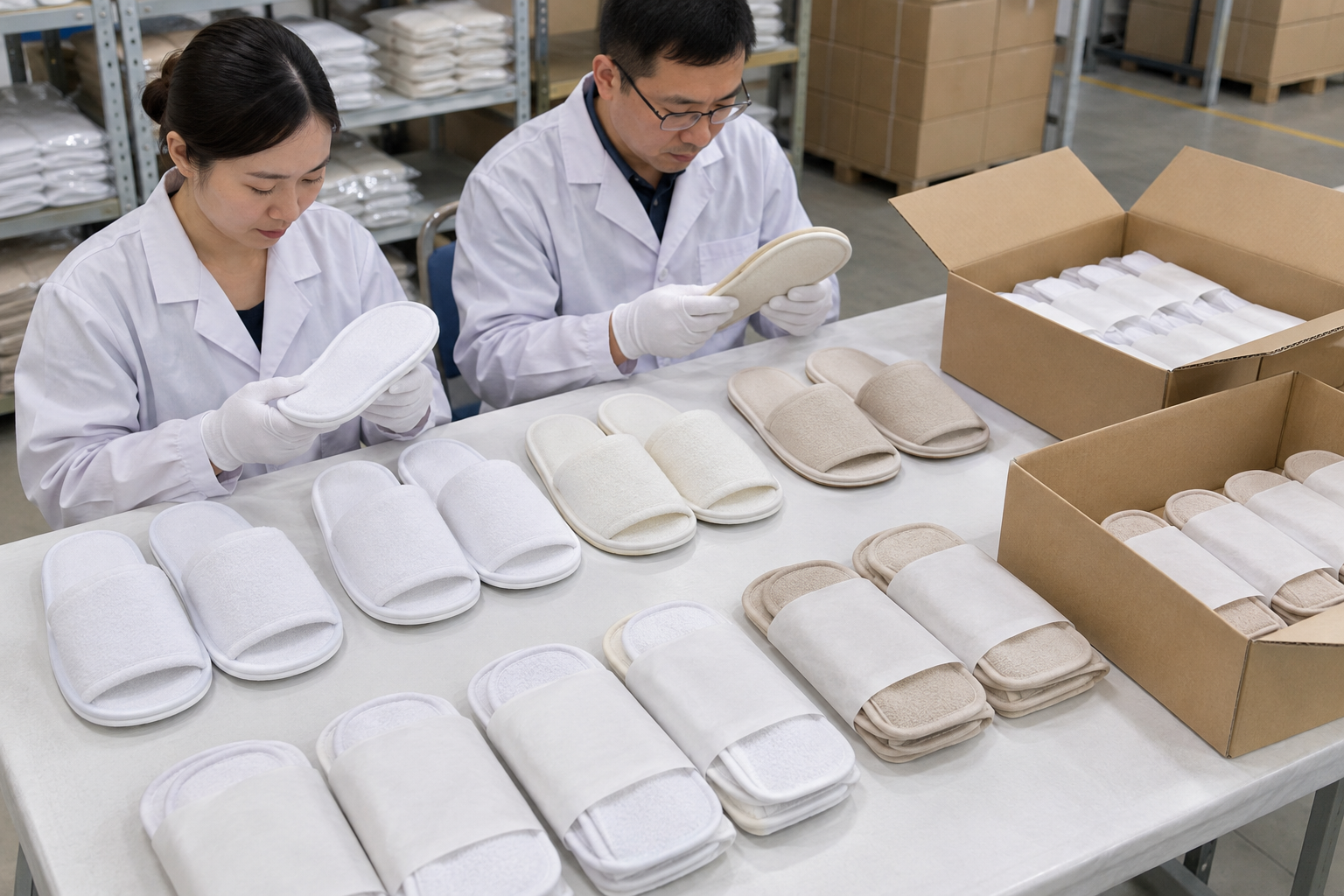
A hotel slipper oem payment terms review is the structured check a Europe buyer completes before confirming an OEM order, so that when payment is made, what is being paid for, and what must happen before the next payment are all agreed in writing. For hotel slipper manufacturing, payment terms are not only about timing. They link the order specification, sample approval, production release, inspection, packing, and delivery acceptance into one commercial sequence. If that sequence is unclear, a buyer can pay for work that has not yet been approved or face a dispute about whether a balance is due before goods are ready.
This page focuses only on the payment terms review for hotel slipper OEM orders for the Europe market. It does not replace a contract, and it does not set out country-specific law. Europe includes different jurisdictions, including EU, EEA, and UK arrangements, and requirements can vary by country of delivery, contracting entity, and agreed terms. Buyers should confirm any country-specific point with the supplier in writing and, where needed, with their own adviser, rather than assuming one rule applies across all of Europe.
Why a Hotel Slipper OEM Payment Terms Review Matters for Manufacturing Orders in Europe
In hotel slipper manufacturing, the buyer is usually agreeing a repeatable product for guest use, not a one-off retail purchase. That means the specification may include size range, upper material, sole type, logo application method, individual wrapping, inner packing, carton packing, and labelling details defined by the buyer. Payment terms should follow that specification. When a deposit, milestone payment, or balance is linked to a vague stage such as production or shipment without a defined completion check, both sides may interpret the trigger differently.
A clear review helps the buyer connect each payment to an observable step. For example, the buyer and supplier should agree what counts as sample approval, what documents confirm production readiness, how inspection will be handled, and what acceptance means for the delivered cartons. The review also creates a record for internal approval inside the buying organisation, so finance, procurement, and operations are working from the same agreed terms instead of separate email threads.
For Europe buyers sourcing for multiple properties or distribution points, consistency matters as well. If deliveries go to different countries, the buyer should confirm whether payment terms, invoicing details, delivery responsibilities, and acceptance procedures are the same for each destination or need to be recorded separately. Keeping those points in the payment terms review avoids treating Europe as a single uniform delivery condition when the actual order may involve different addresses and receiving processes.
Hotel Slipper Manufacturing Payment Terms Review: What to Clarify Before Agreeing
Start the payment terms review by listing every payment stage the supplier proposes and the exact event that triggers it. Each stage should have a plain description that a buyer, supplier, and finance team can all recognise. Avoid stages defined only by a date if the work itself has not been checked. Where a stage is time-based, also record what deliverable or confirmation should exist by that point.
Next, clarify what is included in the agreed order value for that stage. Confirm whether the amount covers only the slippers as specified or also includes items the buyer has requested such as individual wrapping, printed inserts, carton marks, pallet handling, or delivery to a named location, as agreed. If any item is charged separately, record it separately so the buyer can compare proposals on the same basis. Do not assume that two suppliers quoting a similar unit price are offering the same payment structure or the same inclusions.
Currency, invoicing, and payment method should also be agreed as part of the review. Specify the currency to be used, the legal name and details to appear on invoices as provided by each party, when an invoice will be issued for each stage, and what supporting documents will accompany it, such as the order reference, packing list, or inspection confirmation agreed between the parties. Ask the supplier to confirm what happens if an invoice detail does not match the agreed order, and how a corrected invoice will be handled, so a paperwork mismatch does not become a payment dispute.
Finally, record how changes are handled. If the buyer changes size mix, quantity, material, logo method, or packing after the order is confirmed, agree how that change affects the order value and future payment stages before the changed work proceeds. A simple change record signed or confirmed in writing by both sides protects the original payment terms review from being undermined by informal adjustments.
Buyer Decision Table for Hotel Slipper Manufacturing Payment Terms
Use the table below as a working review tool. Complete it with the supplier proposal in front of you, and keep only decisions that both sides have agreed in writing. Where a point is not yet agreed, mark it as open rather than filling it with an assumption.
| Decision Area | What to Agree | Why It Matters for the Buyer | What to Request in Writing |
|---|---|---|---|
| Payment stage triggers | The exact event that makes each payment due, such as order confirmation, sample approval, or delivery acceptance as defined by the parties | Prevents payment being requested before the agreed step is complete | A stage-by-stage schedule linked to the order reference |
| Deposit purpose | What work or commitment the initial payment covers and how it is treated if the order changes or is cancelled by agreement | Clarifies what the buyer has committed to before production proceeds | A written statement of how the deposit is applied to the order |
| Sample and specification approval | Which sample version and specification version must be approved before a production-related payment is due | Links payment to the product the buyer actually approved | Approved specification sheet and sample confirmation |
| Inspection and acceptance | How goods will be checked, who confirms acceptance, and what happens if cartons or products do not match the agreed specification | Ensures the balance is tied to conforming delivery, not only to dispatch | Inspection and acceptance procedure agreed before production |
| Inclusions and separate charges | Which packing, labelling, handling, and delivery items are included and which are charged separately | Allows a fair comparison between supplier proposals | Itemised order confirmation showing included and separate items |
| Invoicing and currency | Currency, invoice timing, invoice details, and supporting documents for each stage | Helps finance verify each request against the agreed order | Invoice format and document list for each payment stage |
| Changes after confirmation | How specification, quantity, or packing changes affect value and payment stages | Stops informal changes from creating payment disagreements | Written change approval process and updated order confirmation |
| Delays and non-conforming goods | How the parties will record a delay, a short delivery, or a non-conforming delivery and how it affects outstanding payments | Gives the buyer a clear process if delivery does not match the agreement | Agreed remedy and communication process in the order terms |
| Final balance release | The documents and acceptance confirmation required before the final payment is released | Protects the buyer from closing payment before the order is complete | Final document checklist tied to the last payment stage |
The table is a decision aid, not a substitute for the final order documents. Once the review is complete, transfer the agreed points into the purchase order, proforma, or supply agreement that the parties will actually use, and check that the wording matches.
How to Compare Supplier Payment Proposals for Hotel Slipper OEM Orders
When comparing proposals, do not compare only the size of the first payment. Compare the whole sequence. One proposal may request a smaller initial payment but require a large payment before inspection, while another may link more of the value to acceptance. The buyer should map each proposal onto the same stages: order confirmation, specification and sample approval, production readiness, inspection, dispatch or delivery, and final acceptance. That mapping shows where the buyer's financial exposure sits at each point.
Also compare what each supplier needs from the buyer to keep the sequence moving. For example, delays in sample approval, artwork confirmation, or packing approval can shift later stages. Ask each supplier to state what buyer approvals they depend on and how they will notify the buyer when a stage is ready for checking. A proposal that looks simple may become difficult if approval responsibilities are not named.
Check consistency between the payment proposal and the rest of the quotation. The product description, packing description, delivery location, and order quantity in the payment schedule should match the main quotation exactly. If names, sizes, or packing terms differ between documents, ask the supplier to reissue a consistent version before any payment is agreed. Inconsistent documents are a common source of avoidable disputes, even when both sides intend the same product.
For repeat orders, compare the proposed terms with the terms used previously, if any. If the supplier proposes a change to stage triggers, invoicing, or acceptance for a repeat order, ask for the reason to be recorded and agree the new terms explicitly. Do not assume repeat orders automatically continue on earlier payment terms unless that continuation is confirmed in writing for the new order.
RFQ Checklist
Use this checklist when sending a request for quotation and when reviewing the reply. Keep the replies in writing and attach the agreed version to the order file.
- Ask the supplier to provide a stage-by-stage payment schedule that names the trigger event for each payment.
- Require the supplier to state what the initial payment covers and how it will be applied to the total order value.
- Specify the exact hotel slipper specification, size range, materials, logo method, and packing version that payment stages will be linked to.
- Ask the supplier to confirm the currency, invoice timing, and supporting documents required for each payment stage.
- Require the supplier to list which packing, labelling, handling, and delivery items are included and which are charged separately.
- Specify how sample approval will be recorded and which approved version authorises production to proceed.
- Ask the supplier to describe the inspection and acceptance process and what confirmation will be provided before the final balance is requested.
- Require the supplier to confirm how changes to quantity, specification, or packing after order confirmation will be priced and approved.
- Specify the delivery destination or destinations in Europe for this order and confirm whether terms differ by destination.
- Ask the supplier to confirm how delays, short deliveries, or non-conforming goods will be notified and recorded in relation to outstanding payments.
- Require the supplier to reissue the quotation and payment schedule as one consistent document set before order confirmation.
Final Checks Before Placing the Order in Europe
Before placing the order, read the payment terms review, the specification, and the quotation together as one set. Check that product names, size ranges, packing descriptions, delivery addresses, and order references match across all documents. Confirm that every payment stage in the schedule appears in the final order confirmation and that no extra stage or separate charge has been added without agreement.
Confirm the internal approval route as well. The person who approves the specification may not be the person who releases payment, so share the agreed stage triggers and document checklist with finance before the first payment is due. That step helps avoid a situation where goods are ready for a checking stage but payment is delayed because finance has not seen the supporting documents list.
For deliveries within Europe, confirm the receiving process for each destination named in the order. Record who will check the delivery, how acceptance or a discrepancy will be reported, and how quickly that report will be shared with the supplier, as agreed between the parties. If more than one country is involved, keep a separate receiving note for each address rather than relying on a single generic instruction.
Keep the completed review with the order file. For future hotel slipper manufacturing orders, it provides a clear starting point for comparison, while still requiring a fresh agreement for each new order. A disciplined hotel slipper oem payment terms review does not remove commercial risk, but it makes each payment decision traceable to an agreed specification, an agreed stage, and an agreed document, which is the practical basis for a fair OEM relationship.
Discuss Your Requirements
Review our manufacturing capabilities, then share your specifications for a supplier-fit review.