Hotel Slipper OEM Minimum Order Quantity for Buyers in Canada
By Vincent Xi, Editorial Author
For hotel buyers in Canada, the useful OEM question is not simply, "What is your MOQ?" It is, "What minimum order quantity applies to this exact hotel slipper specification, and how does every applicable constraint convert into finished pairs?"
The supplied sources identify materials, sole types, branding methods, packaging options, and operating considerations that can affect an RFQ. They do not provide a project-specific manufacturer quotation, a numeric SlipperForge MOQ, or a Canada-specific threshold. This article therefore does not state an actual supplier minimum.
Decision first: compare prices only after every bidder has quoted the same construction, material, dimensions, size allocation, color, artwork, branding process, packaging, and pack-out. Require each bidder to identify the constraint or combination of constraints that determines the smallest feasible order.
How Buyers in Canada Should Read a Minimum Order Quantity Quote
Use this buyer-side procurement rule:
Required finished-pair order = the smallest supplier-confirmed allocation that satisfies every applicable product, variant, component, branding, packaging, and packing constraint for the quoted specification.
This is a quote-normalization method, not an industry formula or published manufacturer threshold. A headline MOQ is insufficient unless the quote explains what it covers.
| Quote element | Supplier response required | Reason for review |
|---|---|---|
| Controlled scope | Product specification and revision covered by the quote | Prevents comparison with a stock item, substitute, or earlier sample |
| Finished-product minimum | Minimum finished pairs for the exact construction | Establishes the base production constraint |
| Variant allocation | Minimum and permitted allocation by size, color, artwork, branding placement, and packaging version | Shows whether the total can be allocated to the required variants |
| Component minimum | Native purchasing unit, gross and usable quantity, usage per pair, process allowance, rounding rule, and finished-pair equivalent | Reveals material commitments hidden behind the finished-product MOQ |
| Branding and packaging | Minimum by artwork, application method, placement, pouch, label, insert, or other separately purchased item | Identifies constraints that may exceed the base production minimum |
| Outer packing | Pairs per carton, carton configuration, and required production multiple | Shows whether the order must be rounded for the approved pack-out |
| Commercial treatment | Setup charges, surplus ownership, storage terms, quantity tolerance, quote validity, and release obligations | Defines the commitment attached to the stated minimum |
Do not automatically select the largest number in the quote. The largest line may control when all minima apply to one shared specification, but separately produced colors, artworks, sizes, or packages may require additive allocations. Component lots and carton multiples may also require rounding. The supplier should provide the completed allocation and conversion worksheet.
Lock the Hotel Slipper Specification Before Comparing MOQ
The cited sources provide option categories for an RFQ, not proof that a particular supplier currently offers every option. The buyer should select the required configuration, and each bidder should confirm it in writing.
| Specification field | RFQ entry to control | Minimum order quantity relevance |
|---|---|---|
| Materials and sole | Candidate terms in the supplied guides include terry cloth, velour, non-woven fabric, waffle fabric, EVA, and PVC. State the selected composition, surface, color reference, thickness or mass unit, and measurement method | Different materials or sole components may have separate purchasing lots |
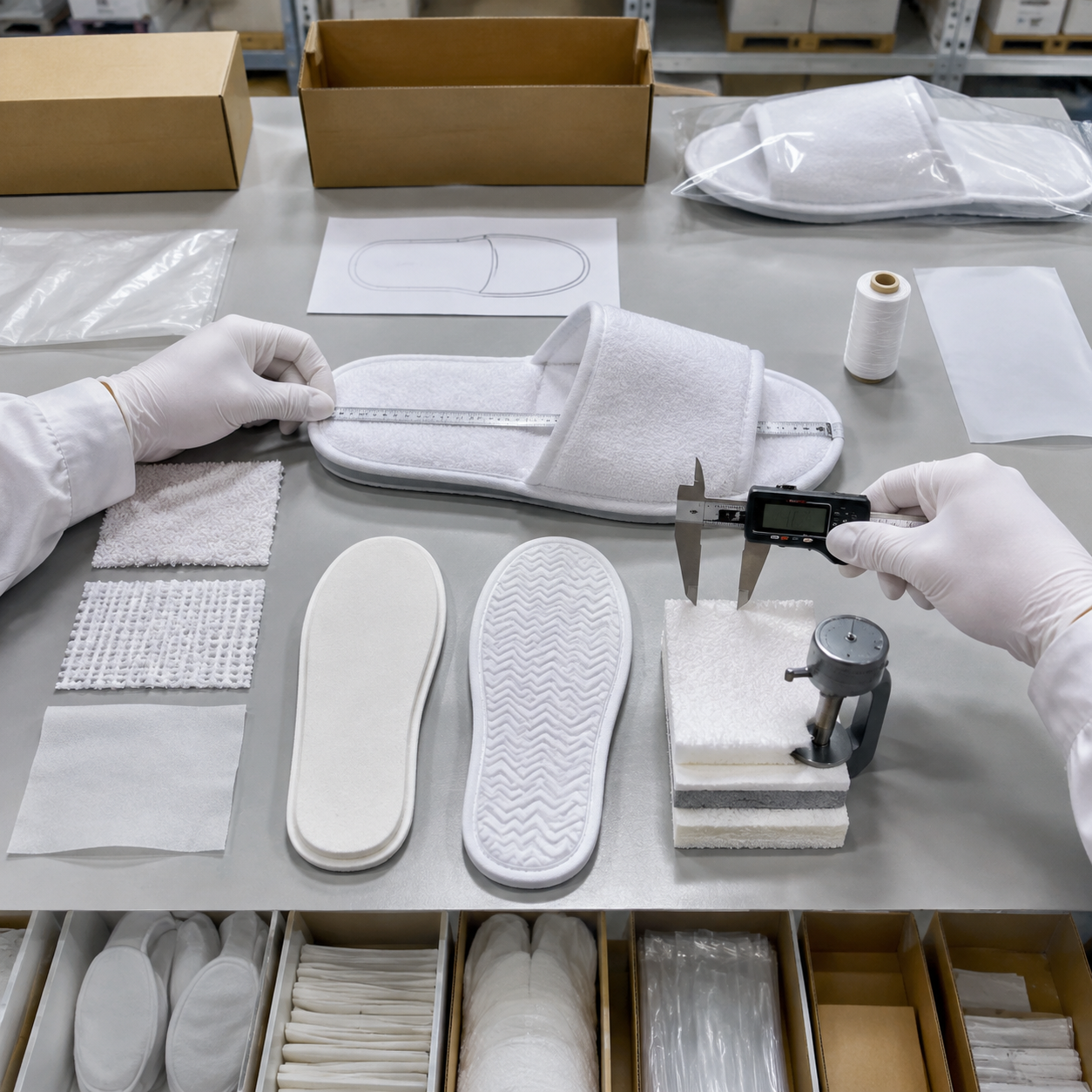
| Construction and dimensions | Define the assembled format and require measured outsole length, forefoot width, upper opening, and sole thickness at stated locations, each with a unit and tolerance | Prevents a lower MOQ based on a smaller or materially different product |
| Size allocation | State each size identifier, dimensional table, required pair quantity, and permitted pooling rule | Tests whether the quoted total can be divided into the required sizes |
| Branding | Candidate methods in the supplied evidence include embroidery, screen printing, heat transfer, labels, insole branding, and outsole branding. State the controlled artwork, method, dimensions, placement, orientation, and color reference | Artwork, process, or placement changes can create separate setup and production minima |
| Individual packaging | Define pouch or package material, dimensions, closure, inserts, buyer-supplied content, and pairs per pack | Packaging components may impose a minimum above the slipper production requirement |
| Outer carton | Define pack-out, arrangement, carton limits, and receiving requirements in declared units | Carton multiples can change the final order quantity |
| Service model | State the buyer-selected disposable or reusable program and the demand period covered by the RFQ | Keeps the demand forecast tied to the quoted product rather than mixing different operating models |
| Performance requirements | State the buyer-approved test method, sample condition, test location, acceptance threshold, and required report | Prevents general performance wording from changing the specification without measurable evidence |
The Mapper Shoe wholesale slippers guide identifies terry cloth, EVA, PVC, colors, logos, and packaging as sourcing variables. The Mayam Textile hotel-slipper buying guide distinguishes terry cloth, velour, non-woven, and waffle materials and discusses disposable and reusable programs. Those references support RFQ field selection, not a project MOQ or current supplier capability.
Worked Minimum Order Quantity Example for a Canada RFQ
Numerical status: Every figure below is a hypothetical buyer or supplier assumption for one example Canadian RFQ as of that RFQ's issue date. The figures are not market benchmarks or current supplier terms. Verify every value and calculation in the final written quotation.
| Planning line | Example value and scope | Status and source |
|---|---|---|
| Buyer demand | 24,000 finished pairs for the specified 90-calendar-day Canadian demand window | Example buyer assumption as of the RFQ issue date; verify against the buyer's approved forecast |
| Finished-product minimum | 20,000 finished pairs per production order for the exact shared construction | Example supplier assumption as of the RFQ issue date; verify in the supplier quote |
| Outsole purchasing lot | 25,000 matched outsole sets per purchase lot for the specified sole, converted in the example to 25,000 finished pairs | Example supplier assumption and conversion as of the RFQ issue date; verify the usable quantity, usage rate, allowance, and conversion |
| Branding run | 30,000 branding applications per artwork and placement per production run, converted in the example to 30,000 finished pairs | Example supplier assumption as of the RFQ issue date; verify the method, artwork, placement, and conversion |
| Carton multiple | 200 finished pairs per outer carton for the exact example pack-out | Example supplier assumption as of the RFQ issue date; verify the approved carton configuration |
| Required example order | 30,000 finished pairs, equal to 150 outer cartons at the stated example pack-out | Example calculation derived from the stated assumptions as of the RFQ issue date; verify the allocation and arithmetic |
| Demand variance | 6,000 finished pairs above the example demand, equal to 25% of the 24,000-pair demand forecast | Example calculation derived from the stated assumptions as of the RFQ issue date; verify the demand and controlling minimum |
In this example, the branding run controls because every constraint applies to the same undivided construction, artwork, and package, and the resulting order also satisfies the carton multiple. That result cannot be generalized. If colors or artworks have independent minima, the supplier may need to add their allocations rather than select a single maximum.
Request MOQ Alternatives Without Changing the Quote Unintentionally
A lower minimum is useful only if the supplier explains what changes. Ask bidders to quote each alternative as a separate controlled option, including:
- The revised finished-pair minimum and allocation by size, color, artwork, and package.
- The construction, material, branding, or packaging change that enables the reduction.
- The recurring pair price and every separate sample, artwork, setup, packaging, storage, or release charge.
- The native-unit quantity and finished-pair equivalent of any surplus material or packaging.
- Ownership, permitted reuse, storage duration, storage charge, and disposal authority for surplus items.
- The sample or proof that must be approved before production.
- Any total commitment, minimum release, payment trigger, or risk-transfer condition attached to scheduled releases.
Potential RFQ options include pooling demand across Canadian properties that use an unchanged specification, reducing color or artwork fragmentation, using a supplier-quoted stock package, or scheduling releases against a documented total commitment. None should be treated as available or economical until it appears in the written quote with its allocation, charges, and obligations.
Sample Approval at the Quoted Minimum Order Quantity
The UTOP Slippers branding guide identifies branding methods and supports evaluating branding on the assembled slipper rather than relying only on a flat swatch. Apply that point through an approval file tied to the quoted specification.
The approval file should record:
- The quotation, specification revision, artwork revision, and sample identifier.
- Material identity, declared composition, surface, and controlled color reference.
- Finished dimensions and tolerances for every ordered size.
- Branding method, finished dimensions, placement, orientation, and permitted variation.
- Individual packaging, sealing, pack-out, and outer-carton arrangement.
- The method, sample condition, acceptance threshold, and report identity for every requested performance claim.
- Production inspection method, defect definitions, acceptance rule, reporting format, and rejected-lot remedy.
- Written prohibition on unapproved material, construction, branding, packaging, or process substitutions.
No technical standard is named because the supplied evidence does not identify one required for the quoted product. If a buyer adds a standard, the RFQ should quote the applicable product requirement separately from the supplier's own manufacturing or inspection practice. Do not infer certification from a logo, supplier statement, or general product description; request a current product-scoped document where certification affects approval.
Source Context and Claim Boundaries
| Supplied source | Evidence used for this RFQ method | Boundary |
|---|---|---|
| Mapper Shoe wholesale slippers guide | Material, sole, color, logo, and packaging terminology | Does not establish a project MOQ, current supplier availability, or tested slip performance for the quoted product |
| UTOP Slippers branding guide | Embroidery, screen printing, heat transfer, label, insole, outsole, packaging, and assembled-sample context | Does not establish method availability, performance, or a numeric minimum for a particular RFQ |
| Mayam Textile hotel-slipper buying guide | Material categories, disposable and reusable program context, and flexibility, durability, and anti-slip considerations | Does not provide a buyer-approved test method, acceptance threshold, or project-specific result |
| SJC hotel and spa sourcing guide | Washing, disinfecting, drying, sorting, storage, and replacement as reusable-program operating categories | Does not quantify savings or establish whether a reusable program is suitable for a particular Canadian property |
No publication or evidence-access dates were included in the supplied package. Recheck each page before relying on it for a live RFQ.
Canada Minimum Order Quantity RFQ Checklist
- [ ] Identify the Canadian buying entity, delivery destination, controlled specification, and RFQ revision.
- [ ] State forecast demand by construction, size, color, artwork, packaging version, and demand period.
- [ ] Request separate minima for the finished product, variants, materials, components, branding, packaging, and carton multiples.
- [ ] Require native units, usable quantities, usage per pair, allowances, rounding rules, and finished-pair equivalents.
- [ ] Require a feasible allocation worksheet and written identification of the controlling constraints.
- [ ] Confirm whether properties, sizes, colors, artworks, or releases may be pooled without changing the approved specification.
- [ ] Record surplus quantities, ownership, storage terms, reuse restrictions, charges, and disposal authority.
- [ ] Separate recurring pair price from samples, artwork, setup, packaging, inspection, and other charges.
- [ ] State the quote currency, validity period, delivery basis, included charges, excluded charges, and permitted quantity tolerance.
- [ ] Require an assembled approval sample tied to the final quotation and specification revision.
- [ ] Define the event that starts production lead time and any dependency that can pause or reset it.
- [ ] Require current product-scoped evidence for every performance or certification claim affecting approval.
- [ ] Prohibit substitutions without written buyer approval and a revised quote or sample where scope changes.
- [ ] Require the final quote to list all assumptions, exclusions, minima, allocation rules, price breaks, remainders, and release obligations.
Methodology
The evidence method was to extract only product variables and operating categories attributed to the supplied sources, then translate those inputs into specification controls, minimum-disclosure fields, conversion questions, sample controls, and quote-comparison gates.
Mapper Shoe was used for material, sole, color, logo, and packaging context. UTOP Slippers was used for branding-method and assembled-sample context. Mayam Textile was used for material, service-model, and performance-consideration context. SJC was used only for reusable-program operating categories.
The decision rule, allocation worksheet, RFQ tables, and checklist are buyer-side procurement methods derived from those variables. They are not supplier quotations, industry benchmarks, guarantees, or evidence that a particular commercial arrangement is available. The worked example is separately labeled as hypothetical and is not derived from the cited pages.
Limitations and Items to Verify
The supplied pages are commercial sourcing guides, not project quotations, independent laboratory reports, Canadian legal advice, customs rulings, or current certification records. They do not establish a numeric supplier MOQ, price, production capacity, lead time, quantity tolerance, customer outcome, or current manufacturer capability.
The evidence also does not establish Canadian bilingual-labeling, product-compliance, customs, duty, tax, or landed-cost requirements for the finished item. Verify destination requirements from current authoritative Canadian sources after the product, packaging, manufacturing origin, and delivery destination are fixed.
Before award, verify every minimum, allocation, component conversion, process allowance, rounding rule, surplus quantity, performance claim, document, charge, sample, production tolerance, release obligation, and delivery term in the supplier's final written quotation.
Author note: Vincent Xi is identified by the supplied first-party profile as an Editorial Author. That profile is the source for the visible byline and role.
Discuss Your Requirements
Review our manufacturing capabilities, then share your specifications for a supplier-fit review.