Hospitality Slipper Wholesale Supplier Communication Workflow Review for United States Buyers
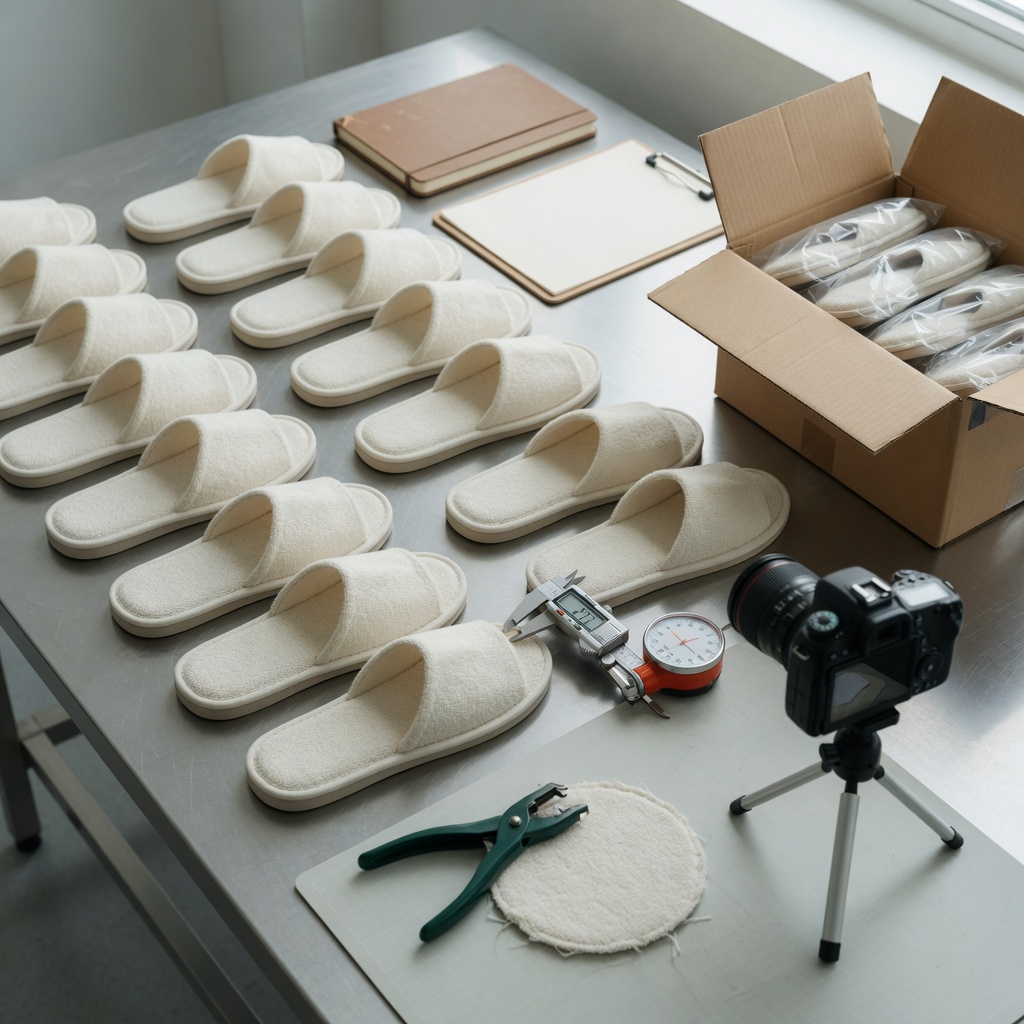
When a United States hotel, franchise, or group-purchasing organization sources a hospitality slipper program, the first controllable risk is the message path. A hospitality slipper wholesale supplier communication workflow review should decide award: how a complete quote is built, how sample comments become a dual-retained golden sample, how mass-production photos and defect data are filed, and how delays are disclosed before a promised date.
A photogenic sample does not qualify a factory for wholesale supply if that path cannot support labeling, landed-cost, and accounts-payable files used in the United States. Do not award on unit price. If the first reply omits carton cube, Incoterms, document owners, or named backup contacts, record the workflow as incomplete and restart the RFQ clock.
This page reviews communication only—for hospitality-slipper wholesale-supply programs that ship to United States receiving nodes. It is not a complete product guide and not a country catalog.
Editorial Author: Vincent Xi, Editorial Author. The visible byline and the BlogPosting author are that named person and role. Factory visits, laboratory tests, awards, certifications, named customers, and personal production stories are not claimed. Figures below are either attributed to a cited public page or labeled as example calculations to verify in the live supplier quote.
Award rule for hospitality slipper wholesale supply communication
Score every bidder against four pass/fail gates. A miss is a no-award until the missing field is restated in email or the procurement portal. A pass is a dated, complete restatement in that record channel—not a faster chat ping.
- Complete-quote gate. The clock starts only when the RFQ lists construction, size mix, logo method, packing, Incoterms, and the United States ship-to or bill-to node. A price-only note does not start a valid clock.
- Golden-sample gate. Written approval must lock sample ID, artwork file name, BOM, and packing.
- Evidence-cadence gate. Production drops must show mix, defects, and carton marks—not beauty shots only.
- Exception-honesty gate. Holds, substitutions, and missed cuts must be disclosed with a recovery plan before the original promise date.
Public manufacturer pages sometimes publish their own clocks. One hotel-slippers manufacturer process page describes a custom path that includes inquiry and quotation in 1-2 days, sample production in 10-15 days, order confirmation, mass production with weekly photo updates, and final inspection (Hotemax hotel slippers process). Those numbers are supplier-stated intervals on that public process page (units: calendar days as written there; scope: that company's described custom hotel-slipper path; as-of: the cited page, not stopwatch-timed for this article). They are not industry medians and not production commitments of SlipperForge.
Use them as comparison prompts. Require every bidder to restate clocks with time zone and day-type (working days vs. calendar days; whose holiday calendar). Wholesale-slippers buying guidance separately tells purchasers to test communication reliability before an order by asking about factory audits, average production lead time, the quality-control process, and how delays or errors are handled (JNP wholesale slippers buying guide). Those questions belong in the RFQ for hospitality slipper wholesale supply, not in a post-deposit chat.
Measurable trade-off: a 1-2 day price-only note can look as fast as that published inquiry-to-quotation interval and still fail completeness. A 3-5 working-day complete quote (example control to verify in the live RFQ, not a measured average; unit: working days in the supplier's stated time zone; scope: first complete hospitality slipper quote after RFQ send; as-of: the live RFQ date) that includes pack-out, carton weight, and a named QC contact is slower on the clock and faster at purchase order. Prefer completeness unless the hotel opening date is inside a documented expedite path.
United States RFQ packet: the first reply as a communication artifact
For United States wholesale supply, the first complete quotation is the first audit object. It should contain:
- Style code and construction (example: terry upper, EVA sole; disposable vs. reusable).
- Size run and pairs-per-inner / inners-per-export-carton.
- Export carton outer dimensions and gross weight (needed for United States distribution-center slotting and LTL planning).
- Artwork method, color standard, file format, and color-approval path.
- Incoterms rule, named place, and which party books United States inland.
- Production calendar plus the update cadence during that calendar.
- Document owners: commercial invoice, packing list, and pair/inner labels the importer's broker or counsel will require for United States entry and brand receiving.
- Named merchandising, production, QC, and logistics contacts, with backup coverage and an after-hours path for United States receiving exceptions.
If the supplier returns unit price only, keep the workflow incomplete and restart the clock. MOQ belongs in the same artifact because it changes packing, carton counts, and whether a United States pilot quantity is even possible. Treat MOQ as a field beside lead time and the communication SLA, not as a separate merchandising essay.
Example landed-cost calculation (assumption to verify in the supplier quote, not a market price): if a bidder states USD 0.85 per pair FOB origin and the importer's worksheet estimates USD 0.22 per pair for ocean or air allocation, United States inland, estimated duty, and brokerage, the working landed cost is USD 1.07 per pair. Units: United States dollars per pair; scope: one pair of a hospitality slipper SKU on one quote; date/as-of: live quote date only. Replace every line with the broker's HTS treatment, the carrier rate, and the supplier's restated Incoterms.
FOB quotes move faster in email and shift classification, importer security filing, and United States inland risk onto the buyer's communication path. DDP-style quotes reduce handoffs and hide component costs unless the supplier still opens the same cost file. Choose the Incoterms rule the United States team can actually document, not the one that sounds simpler in a chat window. Incoterms allocation is a commercial rule set; it is not a factory certification.
Sampling timeline, revision loops, and what approved must mean
Sampling is where hospitality programs lose weeks. The published 10-15 day sample-production window on the same manufacturer process page (Hotemax hotel slippers process) describes one pass (units: calendar days as written there; scope: that company's described custom hotel-slipper sample production; as-of: the cited page). It does not include United States reviewer time, logo-file correction, or a second physical courier after a fail.
Specify the loop, not only the first clock:
- United States comment SLA after sample receipt (example control to verify: 3 working days; unit: working days on the buyer's calendar; scope: one hospitality slipper sample lot; as-of: the RFQ or quality agreement).
- Supplier rework clock in working days, material-dependent (terry dye vs. print vs. embroidery).
- When a photo pass is allowed vs. when a physical pair must move by courier.
- Dual-retained golden sample: one sealed at origin, one in the United States buyer's file, both photo-indexed to a sample ID.
- Silence rule: escalation if production confirmation does not follow written approval within a named number of hours.
Approved means a dated portal or email record that lists golden-sample ID, artwork file name, BOM, and packing. A chat sticker is not an approval record for United States brand or accounts-payable trails.
Photo-only revisions save courier time of several calendar days (example assumption to verify against the sample-ship method on the quote, not a measured courier median) and raise the risk that GSM, EVA hardness, or stitch density will not match the pair that later arrives at a United States distribution center. Require a physical golden sample before the first house-wide purchase order; allow photo loops only for logo placement after that golden sample exists.
Communication workflow review: production updates, QC evidence, and delay handling
The same public process describes mass production with weekly photo updates and a final inspection (Hotemax hotel slippers process). Read weekly as one evidence drop per 7 calendar days during mass production, as that manufacturer states it (unit: calendar days; scope: that company's described mass-production path; as-of: the cited page)—not as proof that every factory will do so under a United States purchase order.
Contract the contents of each drop:
- Date, purchase order, and line.
- Color, logo, and size mix vs. the order.
- In-line defects, not only finished-goods beauty shots.
- Carton count vs. plan, including carton marks that will face United States receiving.
- Any substitution (terry, EVA, glue, polybag, carton board) flagged before use.
Turn the pre-order questions from wholesale buying guidance—what is the quality-control process, and how are delays or errors handled (JNP wholesale slippers buying guide)—into named RFQ answers: hold authority, notification hours, disposition (sort, rework, replace, credit), and who pays air recovery if a United States hotel opening is at risk.
Example SLA to verify in the quote, not a measured industry average: written hold notice within 24 hours of a confirmed line hold. Unit: hours from confirmed hold to record-channel email/portal notice; scope: the awarded hospitality slipper purchase order; as-of: the quality agreement date.
Do not confuse a marketing sequence (inquiry, quotation, sample, confirmation, mass production, final inspection) with a certified quality system. That sequence is a narrative on a manufacturer page (Hotemax hotel slippers process). If the United States buyer needs an AQL plan, the buyer names the plan in the purchase order. Naming AQL is a purchase-control choice; it is not evidence that a factory is certified. This article does not assert that any factory is certified, audited, or approved for any hotel group.
Weekly beauty photos are cheap to send and weak for mix control. Daily defect tallies cost merchandising time and catch a size-run error before an entire United States container is wrong. For first-time vendors, require the tighter pack on a paid pilot; relax only after two consecutive complete cycles (buyer-specified gate, not a measured industry average).
United States labeling, landed-cost, and delivery communication
Communication quality becomes visible when freight meets a United States port or airport and then a hotel distribution center.
Labeling (buyer-controlled instruction, not a certification claim). Confirm in the purchase-order thread how each pair and inner pack will show the fiber, origin, and responsible-party information the United States importer of record's counsel or customs broker specifies. Distinguish that statutory or broker instruction from any factory's own hangtag habit. A woven logo on the vamp is not a labeling pack. Ask for a photo of the actual pair-level label on the golden sample and carton marks that match the packing list.
Landed cost and delivery. Assign an owner for commercial-invoice accuracy, packing-list transmission, and (for ocean) importer security filing data. A weekly production photo that never includes carton marks will not prevent a receiving exception in a United States warehouse management system. Restate cargo-ready date, document-issue date, and advance-ship-notice timing in the same thread as production updates.
Cut-off honesty. Restate remaining production weeks against the United States hotel opening or seasonal reset. A delay notice after the vessel missed cut-off is a communication fail even if the line was busy.
Holding cartons for a complete document pack can add 1-3 calendar days at origin (example assumption to verify on the booking file, not a carrier tariff; unit: calendar days at origin; scope: one hospitality slipper export lot; as-of: the booking file date) and can remove days to weeks of United States distribution-center exception time. Specify which errors are ship-blockers (invoice quantity vs. carton quantity; missing origin mark) vs. which can move with a same-day correction file.
Hotel procurement software onboarding as a communication test
United States hotel groups often route hospitality slippers through buyer platforms rather than standalone email. InnLead hotel-procurement blog coverage includes a 2026 guide to hotel procurement software covering workflows, catalog data, integrations, onboarding questions, and platform selection, and it discusses supplier registration versus approval, RFP processes, and buyer-led networks such as BirchStreet for onboarding and payment workflows (InnLead Insights). Year 2026 is the guide year named in that publisher context on the cited blog page; it is not proof that any slipper factory is live on a named platform.
Translate that buyer-side coverage into communication tests for hospitality slipper wholesale supply:
- Registration is not approval. Time how long vendor-master data (tax forms as applicable, banking, insurance the hotel requires) takes after the first complete RFQ.
- Catalog data. Item number, unit of measure (pair), pack quantity, image rights, and the price-file format the platform requires.
- SKU mapping. Who creates the new hosted or punchout line when a logo colorway is added.
- Status visibility. How a QC hold in the factory thread becomes a status United States accounts payable and receiving can see.
- Ticket owner. A coordinator who answers platform tickets, not only a merchandiser on a chat app.
Email-only suppliers can still win a pilot if catalog onboarding is scheduled. They should not win a house-wide United States rollout until the SKU is testable in the hotel's sandbox. Onboarding labor is part of total cost of ownership even when the pair price does not change.
Buyer decision table: communication controls for United States wholesale supply
The table converts the award gates into compare-and-verify rows for hospitality slipper wholesale supply. The checklist that follows is the attachable RFQ exhibit.
| Control | Specify in the RFQ | Compare across bidders | Verify before award | Approve / order gate |
|---|---|---|---|---|
| Complete-quote clock | Working days, time zone, and the field list that makes a quote complete | One manufacturer publishes inquiry-to-quotation in 1-2 days on its process page (Hotemax); others must state their own complete-quote clock | Timestamp of first complete quote vs. RFQ send time | No award if price arrives without pack-out, Incoterms, and contacts |
| Sample production clock | Working days for first physical sample including logo | 10-15 days is one supplier's published sample-production window (Hotemax) | Courier ship date vs. promise; sample ID photos | Golden sample dual-retained before mass purchase order |
| Revision loop | Max rounds, United States comment SLA, rework days | Count silent days after comments | Artwork file name and BOM locked | Chat-only OK is not approval |
| Production evidence cadence | Contents list per drop (mix, defects, carton marks, date) | Weekly photo updates appear in that same published mass-production narrative (Hotemax) | File dates and contents on a paid pilot | House-wide purchase order only after two consecutive complete drops |
| QC and delay handling | Hold-notice hours, disposition, expedite cost owner | Pre-order questions on QC process and delay/error handling are recommended in wholesale buying guidance (JNP) | Written procedure attached to the quality agreement | Vague recovery slogans fail the control |
| United States document pack | Invoice, packing list, label photos, carton marks, ASN timing | Completeness and match to purchase-order quantity and SKU | Broker or 3PL dry-run on a sample pack | Booking blocked until the pack is complete |
| Platform onboarding | Catalog fields, registration vs. approval owner, ticket SLA | Hotel procurement software coverage separates registration from approval and stresses catalog and integration work (InnLead) | Test SKU in the hotel sandbox | No chain-wide rollout until the catalog line is live |
| Coverage matrix | Primary + backup for merchandising, QC, logistics | Holiday and after-hours path for United States receiving exceptions | Live contact test during RFQ | Escalation tree attached to the purchase order |
RFQ checklist: communication workflow review for United States orders
Attach this list to the RFQ. Score it as pass/fail. Promote passing lines into purchase-order schedules. Every item is for specifying, comparing, verifying, approving, or ordering hospitality slippers—not for general reading.
- Complete-quote definition. Construction, size mix, artwork method, inner/outer pack, carton cube and gross weight, Incoterms, lead time, update cadence, MOQ. Incomplete quotes restart the clock.
- Clock units. Working days vs. calendar days; whose holidays; which time zone. Require bidders to restate any published 1-2 day quote or 10-15 day sample claim in those units (Hotemax).
- Channel of record. Email or procurement portal is the audit trail. Chat is unofficial. Approvals, holds, and artwork must exist in the record channel in English for the United States file.
- Contact matrix. Merchandising, production, QC, logistics, plus backup and a hold-notice path aimed at United States opening-date risk.
- Sample protocol. First-sample contents, revision rounds, courier account, dual golden-sample retention, and the written meaning of approved.
- Production evidence pack. Weekly or tighter drops: date, purchase order, line, size mix, defects, carton marks. Beauty-only photos fail.
- QC process. Incoming, in-line, and finished-goods points; the sampling method the buyer names; hold authority; disposition options (JNP).
- Delay and error handling. Notice timing, recovery (rework, replace, air, credit), and cost ownership. Score narrative slogans as fail.
- Substitution control. How terry, sole, glue, or carton changes are proposed, sampled, and approved in writing before use.
- United States labeling proof. Photo of pair-level and inner-pack labels as the importer's counsel/broker specifies; carton marks matching the packing list.
- Landed-cost file. Open breakdown (origin price, freight, insurance, estimated duty, brokerage, United States inland). Mark estimates as to-verify.
- Shipment communication. Cargo-ready date vs. document-issue date; importer security filing data owner if ocean; ASN timing to the United States distribution center.
- Pilot-before-rollout. Paid pilot on the same SLAs as the annual program; two consecutive complete update cycles before house-wide purchase order.
- Procurement-platform onboarding. Registration vs. approval, catalog owner, image/spec fields, ticket SLA, logo-colorway mapping (InnLead).
- Close-out pack. Final inspection report, shipment photos, documents, and a single folder indexed to the purchase order for United States accounts payable and brand audit.
Methodology, source context, and limitations
Source contexts. This article uses three public contexts: a manufacturer-published custom hotel-slippers sequence that states 1-2 day quotation, 10-15 day sampling, weekly production photos, and final inspection (Hotemax); a wholesale-slippers buying guide that tells purchasers to evaluate communication through audit access, lead time, QC process, and delay/error handling before ordering (JNP); and hotel procurement editorial coverage of a 2026 software guide on workflows, catalog data, integrations, onboarding questions, supplier registration versus approval, RFP process, and buyer-led onboarding/payment workflows (InnLead).
How the data were derived. Day counts and the weekly cadence are transcribed as vendor- or publisher-stated figures. They were not independently timed and not averaged across a supplier panel. Example money and SLA figures are labeled as quote-side assumptions. The decision table and RFQ checklist turn those statements into buyer controls for United States hospitality slipper wholesale supply.
What to verify. Published intervals can change, may exclude artwork or material waits, and do not include United States transit. Weekly photos may be marketing language until they are purchase-order exhibits. Platform topics describe buyer systems; they do not mean a given factory is integrated. United States duties, HTS classification, textile labeling, and broker filings must be confirmed with the importer of record's advisors. No certification, award, test result, factory capability, or customer outcome is claimed for SlipperForge or for any named manufacturer. Treat every money and day figure in a live quote as an assumption until restated on dated documents.
Discuss Your Requirements
Review our manufacturing capabilities, then share your specifications for a supplier-fit review.