Hospitality Slipper Sourcing Digital Integration Readiness for Canada Procurement
Hospitality Slipper Sourcing Digital Integration Readiness: A Canadian RFQ Brief
Hotel, resort, and management-company buyers in Canada should treat hospitality slipper sourcing digital integration readiness as a production-PO gate, not a brochure slide. Before the first production order, require three proofs: a machine-readable product master the buyer’s ERP can load; one contractual order channel (portal, email, punchout, EDI, or API); and a tested catalog–order–acknowledgement–invoice–error path, including a reject for an obsolete SKU or an invalid Canadian ship-to. Score the supplier on those proofs, then copy the RFQ clauses into the award file.
Author: Vincent Xi, Editorial Author, SlipperForge. Attribution follows the public author profile at that URL. The article does not add factory visits, mill tests, certifications, client names, awards, or operating anecdotes beyond that profile.
Methodology, source contexts, and how numbers are used
Two public source contexts drive the buyer task. First, Innlead’s hotel procurement software guidance published for 2026 describes a dependable product master with SKUs, units, lead times and documents; purchase orders that transmit via portal, email, punchout, EDI or API; a realistic integration map of the catalog-order-acknowledgement-invoice-error exchange; and a 30-day readiness plan that maps workflows, repairs data and tests transactions (unit: calendar days; scope: hotel procurement software supplier-readiness discussion published for 2026; source: Innlead) (Innlead). Second, People's Daily Online English coverage dated 12 February 2026 on industrial-chain upgrading in slipper manufacturing reports QR-on-sole access to specifications, 3D diagrams and certificates; real-time color and pattern customization; a 30-second factory order sync (unit: seconds; scope: the reported slipper-manufacturing innovation example in that article; as-of: 12 February 2026; source: People's Daily Online); a development-cycle cut from 45 days to 15 days (unit: days; same scope and date); and an MOQ cut from 3,000 pairs to 300 pairs (unit: pairs; same scope and date) (People's Daily Online). Those manufacturing figures are published examples to pressure-test a quote. They are not a live SLA for any Canadian receiving dock.
A third context, KW Hospitality’s hospitality-supplies note, states that procurement is transforming through digitalization (e-procurement platforms, vendor portals, AI analytics and blockchain), that KW Hospitality uses digital tools that integrate with clients’ PMS or ERP for transparent real-time order and delivery control, and that custom-designed slippers form part of guest-room essentials and consumables (KW Hospitality). KW’s PMS/ERP sentence is that company’s stated practice, not a market-wide rule and not a capability claimed here for any mill.
How the data was derived: exact figures and channel lists are quoted from those pages with their published dates; they were not independently timed, counted, or audited for this brief. Manufacturing-origin reporting in the 12 February 2026 article is evidence about a published factory-digitalization example, not a Canadian sales-market target. Figures that are only planning assumptions (pilot SKU counts, example pair volumes) are labeled as example calculations to verify in the supplier quote.
What digital integration readiness means for a Canadian hospitality slipper program
For a multi-property operator in Canada, readiness means the hospitality slipper supplier can sit inside the existing purchase-to-pay stack without a shadow spreadsheet. Failed SKU loads, carton-to-ASN mismatches, and invoice exceptions can move amenity-program cost even when the unit price looks competitive. Operator-facing supply writing describes digitalization of hospitality purchasing as e-procurement platforms and vendor portals (KW Hospitality). The procurement job is to convert that description into a testable interface for a consumable guest-room SKU.
Score the supplier on four questions, in this order:
- Can the product master export SKU, pack unit, inner/outer carton, lead time, document links, and substitution rules in a file the buyer’s ERP can load?
- Which order channel is contractual: supplier portal, email, punchout, EDI, or API (Innlead)?
- What happens when a SKU is obsolete, a Canadian ship-to is invalid, or a carton label does not match the ASN?
- Will factory-side tools (QR, 3D spec, MES status) post into the buyer’s commercial messages, or only into a factory dashboard the AP team cannot audit?
A factory MES is not a hotel PMS. Do not accept an unnamed PMS-integration claim unless the objects, protocol, and security review are named. KW Hospitality’s remark that it uses digital tools integrating with clients’ PMS or ERP is evidence that some operators want that visibility; it is not evidence that a slipper plant can write into a property-management system (KW Hospitality).
Award, conditional award, or withhold
The table below is a buyer risk-control, not a certification scheme. It applies Innlead’s catalog–order–acknowledgement–invoice–error framing to a hospitality slipper PO and adds a receiving match the cited sources do not score (Innlead).
| Decision | When it applies |
|---|---|
| Award | Product master loads; the named channel is contractual; catalog–order–acknowledgement–invoice–error UAT includes at least one reject path; carton identity matches the ASN in a receiving trial |
| Conditional award | Channel and master-data files exist, but UAT is incomplete; bind a dated readiness plan in the SOW and gate the production PO on sign-off |
| Withhold | PDF-only catalog; email as the only path for a centralized Canadian AP stack; untested QR/MES claims offered as a substitute for ASN and invoice match |
Catalog, punchout, EDI, and API trade-offs buyers can measure
Transmission path is the first measurable trade-off. Innlead lists portal, email, punchout, EDI or API as transmission paths in its 2026 hotel procurement software supplier discussion (Innlead).
Email and portal. Least supplier IT burden; highest buyer re-keying and version-control risk. Acceptable for a single-property trial. Weak for a Canadian chain with centralized AP and three-way match.
Punchout. The buyer stays in e-procurement, opens a live catalog, and returns a cart. Requires customer-specific price lists, current images, and a stable unit of measure (pairs versus dozens versus cartons). UAT collision to inject: a wrapped logo slipper and an unwrapped house slipper sharing one SKU, so the cart cannot distinguish amenity presentation.
EDI. Fits high-volume, stable hospitality slipper SKUs (for example a chain-standard closed-toe construction in two sizes). Onboarding needs a documented transaction set—confirm the actual messages with the buyer’s EDI team rather than assuming a document number. UAT collision to inject: size, color, or Canadian ship-to code lists that do not match.
API. Fits made-to-order colorways or near-real-time inventory. Buyer IT should specify authentication, versioning, idempotent order posts, and a downtime SLA. These controls are RFQ requirements, not claims from the cited pages. UAT collision to inject: a nightly CSV drop labeled “API.”
Trade that channel against factory digitalization. A 30-second MES post, as reported in the 12 February 2026 manufacturing example cited above, does not help Canadian AP if the commercial invoice is still an uncoded PDF (People's Daily Online). Buy the integration that updates the system of record.
Use Innlead’s 30-day readiness plan length as a planning assumption to confirm in the statement of work: map workflows, repair data, and test transactions across 30 calendar days (Innlead). A Canadian hotel-group IT queue may be longer. Gate the first production PO on UAT sign-off, not on a demo recording.
Product master, QR, MES, and SKU control for hospitality slippers
Hospitality slippers are guest-room consumables and, in operator-facing supply writing, sit with custom-designed guest-room essentials (KW Hospitality). Custom color and logo work can multiply SKUs. That is why the product master is the integration backbone. Innlead’s minimum set is SKUs, units, lead times and documents (Innlead). For this commodity, extend it with fields the buyer must name in the RFQ—not as unsourced product claims about any mill:
| Master-data field | Why a hospitality slipper buyer needs it |
|---|---|
| Size run | Adult, one-size, or split sizes; drives carton cube and guest complaints |
| Upper material and mass | Locks the buyer’s brand-standard specification |
| Sole material | Locks the buyer’s durability and wet-area specification |
| Wrapped vs. unwrapped | Housekeeping presentation |
| Logo vs. house | Prevents punchout and EDI collisions on one SKU |
| Pairs per inner; inners per carton | EDI unit of measure and DC receiving |
| Lead time split | Production versus ex-works versus named Canadian 3PL—obtain days in the quote |
| Document links | Composition and any lab reports the buyer’s standard requires |
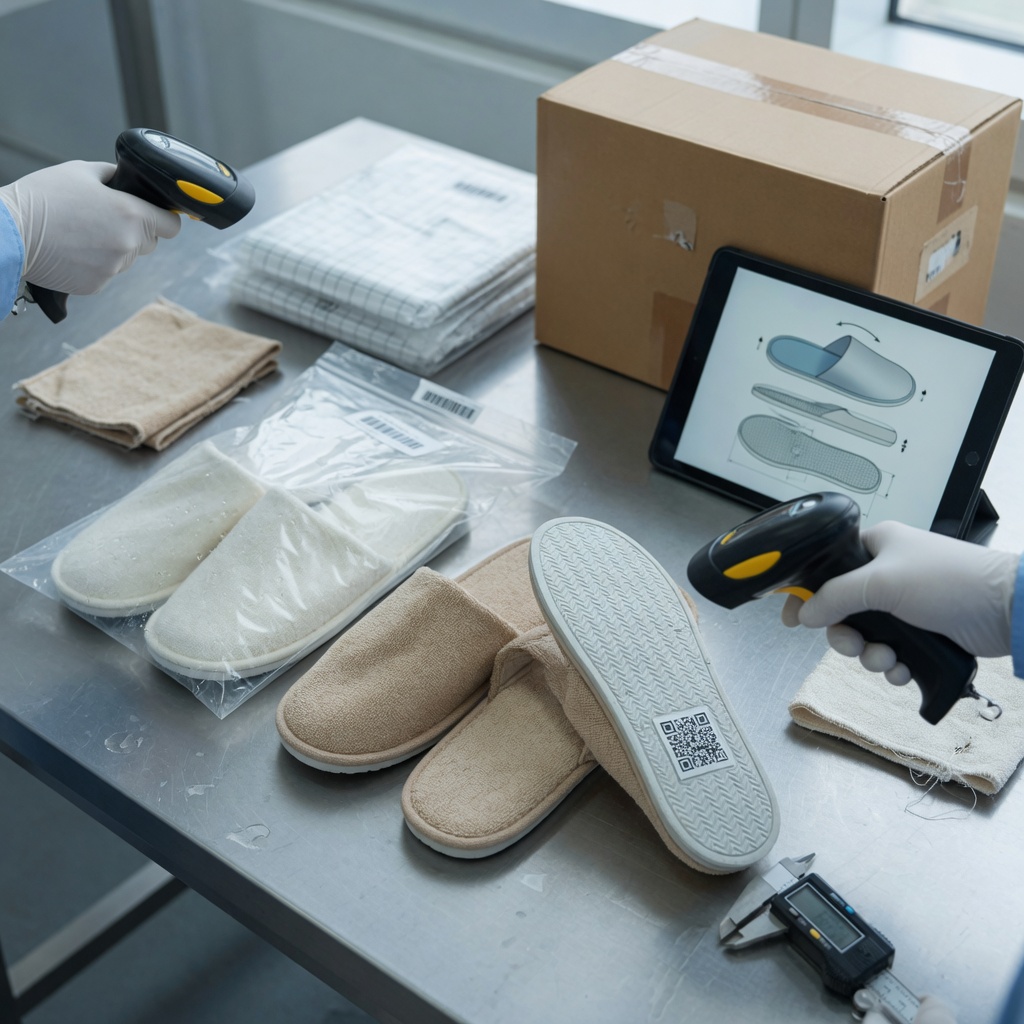
The February 2026 manufacturing article describes QR codes on the slipper sole that open specifications, 3D diagrams and certificates, plus real-time color and pattern customization (People's Daily Online). Treat QR-on-sole as optional traceability: useful in QC if access is controlled and the payload matches the PO line. It is not a substitute for an ASN and scannable carton identity.
MES-linked development in that same article is reported as shortening development cycles from 45 days to 15 days and cutting MOQ from 3,000 pairs to 300 pairs (People's Daily Online). For a Canadian brand-standard refresh, a 15-day development cycle is a supplier claim to verify with dated proto logs. A 300-pair MOQ may help a boutique test order; a large urban hotel may still replenish by the carton layer. Label both numbers as example figures from the cited article, to verify in the supplier quote.
This brief does not name a product standard as a requirement. None of the supplied sources set a slipper-specific certification obligation for hotels in Canada. If the brand standard needs a test method, put the method and a current laboratory document in the RFQ. A standard’s name is not proof of certification. Distinguish any named test method (buyer requirement) from a mill’s own practice; do not treat a method name as a current certificate.
Canada delivery, receiving match, and systems without invented compliance figures
The sole primary sales market for this page is Canada. Buyers in Canada still need a digital path that survives import, 3PL, and property receiving. The supplied sources do not publish CBSA data elements, duty rates, GST/HST treatment, or bilingual packaging statutes, so this brief does not state those figures.
What procurement teams in Canada can still require, using the 2026 software guidance plus process control:
- A ship-to master that distinguishes national 3PL, city cluster, and individual hotel.
- Commercial invoice and packing-list fields that match the PO (SKU, pairs, cartons, net and gross weight).
- A stated Incoterm and a named delivery point in Canada, with lead time split into production days, international transit, and domestic transfer—values to obtain in the quote, not invented here.
- An exception workflow when a carton fails receiving: credit, replacement, or consume-and-claim.
Landed program cost is a procurement KPI. No freight, duty, or fuel number is offered here. Ask suppliers to price a reference scenario to verify in the quote (example assumption, not a demand forecast: 10,000 pairs of a named construction, named carton spec, named Canadian delivery point) and to show how those SKUs appear in punchout or EDI. Bilingual carton or guest-wrap copy should be specified only if the buyer’s own brand standard requires it; this article does not assert a statutory rule.
Buyer decision table: score digital integration readiness
Each row is a control a buyer in Canada can specify, compare, verify, approve, or use to withhold the order.
| Control | Minimum evidence | Strong signal | Fail or weak signal | Verification before production PO |
|---|---|---|---|---|
| Product master | Machine-readable SKU file: pairs UOM, carton pack, lead time, document URLs | File loads to ERP/PIM without manual remap | PDF catalog; sizes as free text | Load an example set of 20 live SKUs (assumption to size UAT) into sandbox |
| Order channel | Named portal, email, punchout, EDI, or API (Innlead) | Contractual support for the buyer’s system of record | Factory routing limited to email | Round-trip PO → acknowledgement → invoice |
| Full message loop | Written catalog–order–ack–invoice–error map (Innlead) | Tested rejects for obsolete SKU and bad Canadian ship-to | Happy-path demo only | Inject one invalid SKU in UAT |
| Readiness window | Dated plan covering workflows, data repair, transaction tests | Shared RACI and sample files in week 1 of a 30-calendar-day plan (2026 software-guidance length to confirm in SOW) (Innlead) | Go-live promised on the first order | Production PO gated on UAT sign-off |
| Custom color/logo SKU | New SKU issued before cutting | Proto image tied to SKU, not a chat thread | Custom work with no SKU | Match proto, PO line, and carton mark |
| Factory sync claim | If offered: MES objects and latency | Timestamped test log; 30-second class sync exists only as a cited 12 February 2026 manufacturing example to verify (People's Daily Online) | QR sticker with empty or public payload | Time a test order on the buyer’s channel |
| Development cycle | Dated proto calendar | 15-day class cycle only with artifacts; article reports 45→15 days in that example (People's Daily Online) | Open-ended sampling | Count calendar days on the last three customs |
| MOQ | MOQ in pairs and in full cartons, quote-dated | Ask against the reported 3,000→300 pair example; do not import that MOQ as a promise (People's Daily Online) | MOQ restated after award | Pilot at the quoted MOQ to a Canadian 3PL |
| PMS/ERP visibility | Named messages: PO status, ASN, invoice | Buyer ERP updates; hotel PMS only if buyer IT owns middleware (KW Hospitality describes one operator’s own tool use) | Open-ended PMS integration claim with no named messages | Security review plus one test message |
| Canadian receiving | Carton identity matches ASN | 3PL scan success at the buyer’s threshold | Inner packs unlabeled | Receiving trial on first inbound |
Practical RFQ checklist for hospitality slipper digital integration
Copy these clauses into the RFQ. Each one supports specify, compare, verify, approve, or withhold.
System of record and channel
- Name the system of record that must receive the hospitality slipper PO, acknowledgement, ASN, and invoice.
- Mandate one transmission path—portal, email, punchout, EDI, or API—with email only as disaster-recovery fallback (Innlead).
- Issue sandbox punchout, EDI identifiers, or API keys before any production catalog goes live.
- Require the full exchange map: catalog sync, order, acknowledgement, ASN, invoice, and error codes, matching Innlead’s catalog-order-acknowledgement-invoice-error framing.
Product master and SKU control
- Require a product-master extract: SKU, size, color, upper/sole, wrapped/unwrapped, logo/no-logo, pairs per inner, inners per carton, net/gross kilograms, cubic metres, production lead time, document links. Mass and cube values are supplier-quoted fields, not measurements stated in this brief.
- Publish the hospitality slipper SKU schema before custom rooms are ordered, so color and logo variants do not break punchout or EDI.
- Require a new SKU to be issued before cutting any custom color or logo; proto image must tie to that SKU.
- Request a data-repair log from UAT (count of SKUs corrected), consistent with Innlead’s “repairs data” step.
UAT, readiness, and award gate
- Calendar a readiness plan that maps workflows, repairs data, and tests transactions; treat 30 calendar days as the 2026 software-guidance planning figure and confirm duration in the SOW (Innlead).
- Require a round-trip test: PO → acknowledgement → ASN → invoice on the contractual channel.
- Inject one obsolete SKU and one invalid Canadian ship-to during UAT; withhold award if the error path is demo-only.
- Gate the first production PO on UAT sign-off, not on a recorded demo.
- Add an exit clause if UAT fails the error-path test, so the buyer is not left with dead custom SKUs.
Factory digital claims (optional; verify, do not substitute)
- If QR-on-sole is offered, specify payload fields and access control. The 12 February 2026 article describes QR access to specifications, 3D diagrams and certificates (People's Daily Online); require that the QR matches the PO SKU.
- If MES sync is claimed, specify objects and latency. Ask for timestamped logs of a test order against the reported 30-second example; do not accept a marketing video as proof of the buyer’s channel.
- Verify development-cycle claims with artifacts from the last three custom color or logo jobs (brief date, proto date, approval date). Compare with the reported 45-to-15-day MES example as a benchmark only.
- Lock MOQ in pairs and in cartons, as-of quote date. Use the reported 3,000-to-300-pair cut only as a question, not as the specification.
- Separate factory status from PMS. Do not require hotel PMS integration unless buyer IT will own middleware (KW Hospitality).
Canada delivery, match, and exceptions
- Name the Canadian delivery scenario: 3PL or city, Incoterm, and who transmits the ASN to the receiving location—supplier to fill values.
- Define three-way match on SKU, pairs, and price; weight tolerance only if the buyer explicitly allows it.
- Set exception rules: time to acknowledge a short-ship or quality reject; replacement versus credit; no silent SKU substitution.
- Pilot the quoted MOQ or one mixed carton set to the Canadian 3PL before rolling out to all properties.
- List only laboratory documents the buyer actually needs; require current reports; do not accept a standard name as certification.
- Stamp every numeric claim in the quote with unit, scope, and as-of date, including any “30-second” or “15-day” language copied from manufacturing marketing.
- Price the 10,000-pair reference scenario (example assumption to verify in the quote: named construction, named carton spec, named Canadian delivery point) and show those SKUs in the proposed punchout or EDI catalog.
Limitations and what to verify before the production order
This article does not audit a factory, does not certify a supplier, and does not publish Canadian duty, GST/HST, bilingual-label, or freight numbers. The 30-second sync, 45-to-15-day development cycle, and 3,000-to-300-pair MOQ figures are as reported on 12 February 2026 in People's Daily Online English coverage of slipper manufacturing innovation; they may not apply to a given mill, construction, or season (People's Daily Online). The 30-day readiness-plan length is taken from Innlead’s 2026 hotel procurement software discussion; actual Canadian operator IT queues may be longer (Innlead). KW Hospitality’s PMS/ERP integration remark is that company’s stated practice (KW Hospitality). Award, punchout/EDI collision tests, and receiving-match rules in this brief are buyer controls, not measurements published by those sources.
Verify before award: a current product-master file, a live test transaction on the buyer’s chosen channel, carton-to-ASN match at a Canadian receiving point, and any laboratory documents the brand standard requires. Treat every exact number in a sales deck as a supplier claim or example calculation to confirm in the dated quote.
Discuss Your Requirements
Review our manufacturing capabilities, then share your specifications for a supplier-fit review.