Hospitality Slipper OEM Digital Integration Readiness for United States Buyers
By Vincent Xi, Editorial Author. Profile: https://slipperforge.com/authors/vincent-xi/
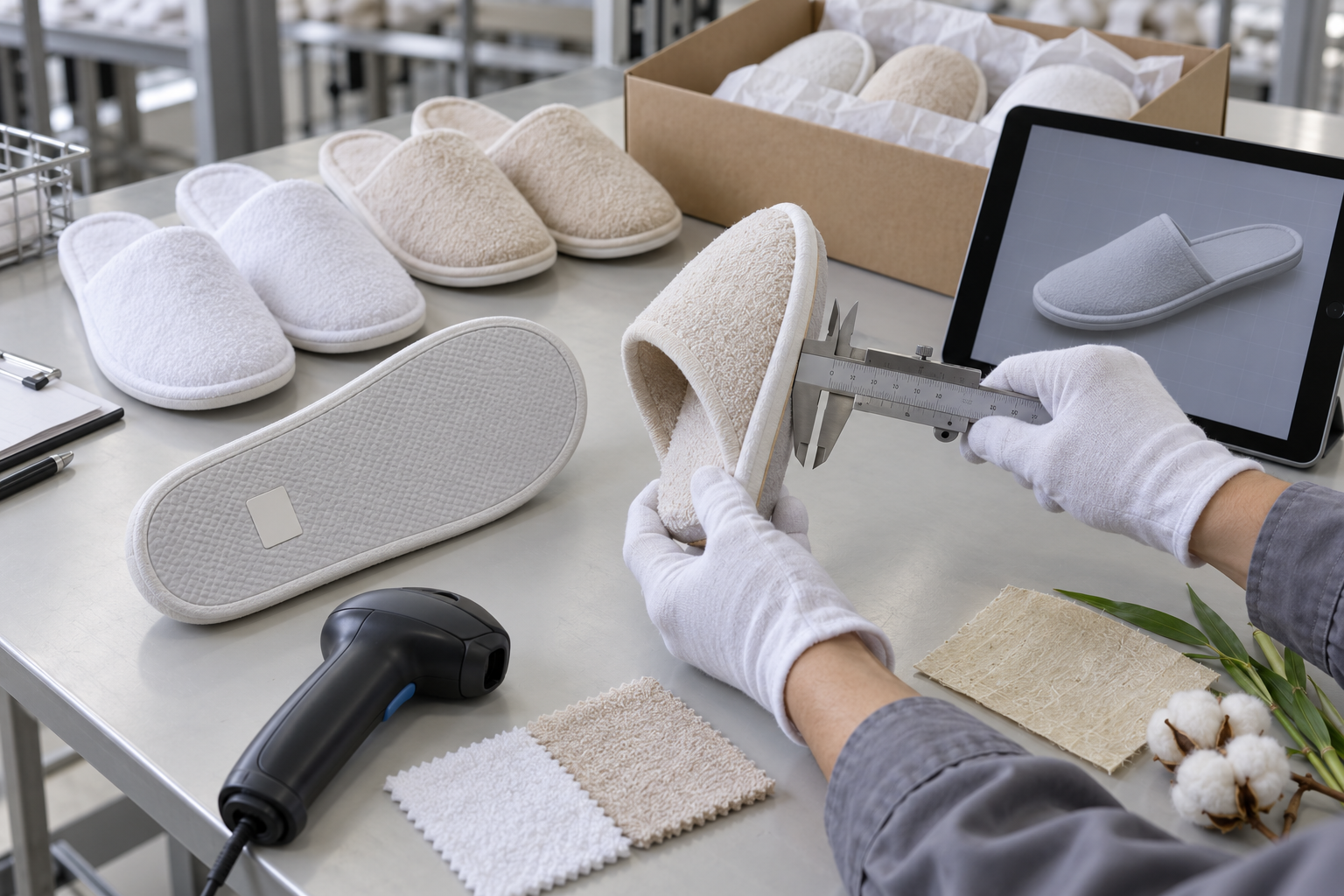
United States hospitality buyers should treat hospitality slipper OEM digital integration readiness as a procurement control, not as a slogan. The working test is whether a manufacturer can accept an approved specification—color, pattern, size run, material, logo placement, and pair count—and return a traceable mock-up plus an order acknowledgement without retyping the order into an isolated spreadsheet. Published examples describe pieces of that path: QR codes on soles, tablet color changes, digital mock-ups, and manufacturing execution system (MES) order handling. Those examples come from a 2026 industry report and from other suppliers' pages. They are not SlipperForge production measurements, and they do not show that a mill can sync a hotel property-management system.
This briefing compares manufacturing evidence for United States RFQs. Every exact figure below is tied to a cited page or marked as an example calculation to verify in the supplier quote. It reports no site visit, wear test, named hotel result, or SlipperForge certification.
Digital integration readiness signals United States buyers can specify
For this manufacturing buy, digital integration readiness is four handoffs a United States team can specify and later audit.
The first is visual approval. One European hospitality page states that hotels adjust logos, text, and finishes online and receive free digital mock-ups for orders of 100 pairs or more, with delivery stated at 5-10 days (Caussün Hospitality). Another wholesale page states that buyers submit requirements online, receive personalized digital mock-ups for approval, and are offered a 24-hour response, with production stated at 3-4 weeks and a minimum of 500 pairs from a European factory (SneakerBranding). A mock-up that is not tied to a pair count and a file version is only a picture.
The second is a machine-readable spec. A People's Daily report published on 12 February 2026, covering slipper-industry upgrading in China, describes procurement specialists scanning QR codes on slipper soles for specs, 3D diagrams, and certificates, then changing colors and patterns on tablets (People's Daily, 12 February 2026). That pattern supports factory-to-buyer traceability. The report does not define guest tracking, RFID, or a property-management interface.
The third is order sync. The same 12 February 2026 report says 3,000-pair orders were synced to smart factories in 30 seconds, and that MES tools processed orders, calculated materials, and scheduled production with automated guided vehicles. A 30-second move of a 3,000-pair record shows transmission speed in that account. It does not show yarn or outsole availability, quality release, or a ship date.
The fourth is a replenishment quantity the buyer can actually release. The report describes minimums moving from 3,000 pairs to 300 pairs and development cycles moving from 45 days to 15 days inside that digital setup. Those clocks are not the 5-10 day delivery statement and not the 3-4 week production statement on the other pages. United States buyers should write all four handoffs into the RFQ as pass/fail fields. If the file, the acknowledgement, or the certificate is missing, the readiness claim stays unverified.
What published OEM examples measure
The 12 February 2026 People's Daily account is a news feature, not a lab report and not a United States customs ruling. Use its figures as interview prompts: show a timestamped sync of a stated pair count; show a QR code that opens the current spec rather than a brochure. Do not treat 15-day development or a 300-pair minimum as a SlipperForge result or as a national average.
The Caussün page, in the excerpt used here, does not display a revision date. Its ISO 16620-2 line is that supplier's product claim about bio-based content. ISO 16620-2 specifies a method for determining biobased carbon content. It does not require MES software, AGVs, or QR codes, and a webpage sentence is not a test report. A buyer who wants the claim repeated on a United States hangtag should collect the report: product identity, laboratory, method version, result, and date. Nothing on that page certifies SlipperForge.
The SneakerBranding page states complimentary digital designs, free quotes, OEKO-TEX certified slippers, and dedicated project management, along with the response, production, and MOQ figures already noted. The excerpt shows no certificate number, class, or expiry. OEKO-TEX is a product-certificate program; the certificate, not the sentence, is the evidence. The page also does not document an API, a PLC list, or a hotel-system connector.
None of the three sources documents RFID read range, a property-management field map, or an amenity internet-of-things workflow. Those questions can still be asked. The evidence-bound answer is a sample payload or the written words not provided. Silence is not compatibility.
Buyer decision table for hospitality slipper manufacturing
Reference points are published claims. They are not SlipperForge specifications. Use each row to specify, compare, verify, approve, or release an order.
| Decision point | Published reference point | Specification to issue | Check before award | Effect on the order |
|---|---|---|---|---|
| Mock-up gate | Free digital mock-ups stated at 100 pairs or more; a second page offers mock-ups after online submission and states a 24-hour response | File version, view angles, logo scale, size run, and an approved-for-production line | Match filename or version to the pre-production pair | Block cutting until that version is approved |
| Order sync | 3,000-pair sync reported in 30 seconds (12 February 2026); MES described as material calculation and AGV scheduling | Mandatory acknowledgement fields: SKU, color, size curve, pair count, ship-to | One redacted sample export with a timestamp | Reject pair counts that exist only in email |
| Trace code | QR on soles reported to open specs, 3D diagrams, and certificates | Declare QC code, carton code, guest code, or none | Scan a sample and record the record it opens | Fail the lot if the code opens the wrong revision |
| Minimum order | Reported move from 3,000 pairs to 300 pairs; other pages state a 100-pair mock-up threshold and a 500-pair MOQ | Release quantity, allowed multiple, and whether a pilot is separate from bulk | Quote MOQ equals a legal purchase-order quantity | Avoid paying for leftover pairs from a bad multiple |
| Time clocks | Development reported from 45 days to 15 days; production stated as 3-4 weeks; delivery stated as 5-10 days | Separate dates for artwork, material booking, production, and delivery to the United States | Ask which clock the date uses and what starts it | Do not stack clocks that the quote already overlaps |
| Claim documents | ISO 16620-2 claim on one page; OEKO-TEX claim on another | List allowed on-pack claims, or ban eco-label printing | Certificate or test report number, scope, and expiry in hand | Hold artwork if the document is missing or expired |
| United States packet | Not quantified in the three sources | Commercial invoice, packing list, origin, material content, Incoterms edition and named place | Broker review of a draft packet before first shipment | Refuse pickup if origin or content conflicts with the spec |
Trade-offs in mock-ups, sync speed, MOQ, and lead time
Pair-count fit is the clearest numeric trade-off. Example calculation to verify in the quote, not a program SlipperForge has priced: an illustrative United States opening order of 1,200 pairs. Against the 300-pair MOQ in the 12 February 2026 report, 1,200 divided by 300 equals 4, so the multiple fits exactly. Against the 500-pair MOQ stated by SneakerBranding, 2 times 500 pairs equals 1,000 pairs, leaving a 200-pair remainder. The buyer either moves the order to 1,500 pairs (3 times 500) or gets written acceptance of the remainder. Against the 100-pair mock-up threshold stated by Caussün, a 100-pair pilot meets that page's free-mock-up minimum. That threshold does not prove the same minimum, or the same 5-10 day delivery, applies to bulk.
Calendar fit is the second trade-off. Within the 12 February 2026 report, 15 days of development is 30 days shorter than the 45-day baseline the article itself cites. That delta belongs to the reported example only. The SneakerBranding production window of 3-4 weeks is about 21-28 days and may already include or exclude artwork time; the buyer has to ask. The Caussün 5-10 day delivery statement may reflect a different origin, batch size, and mode. Example assumption for a United States inbound worksheet, to be replaced by the forwarder and the quote: 15 days of production after artwork approval, plus 20 days of ocean transit, plus 5 days of customs release and drayage, equals 40 days to a United States dock. If production is instead the stated 3-4 weeks, the same unverified 20-day ocean leg and 5-day drayage leg produce about 46-53 days. Do not write either total into a contract unless the quote uses the same inputs.
Sync speed is a weak proxy for readiness. Thirty seconds for 3,000 pairs, as reported, beats a slow inbox only if the acknowledgement carries the fields in the decision table. A fast sync of the wrong logo file is a defect with a short clock. Score field completeness above stopwatch time.
Traceability scope is a third trade-off. A sole QR code that opens a 3D diagram and a certificate helps a United States reviewer match the received pair to the approved spec. On the evidence in these sources, it does not update a hotel inventory ledger. If the group wants inventory visibility, the specification must name the data carrier and the system of record. Until a sample record exists, guest tracking and PMS compatibility stay not demonstrated.
Standard documents and factory software solve different risks. A biobased-content result under ISO 16620-2 does not prove digital order control. An OEKO-TEX certificate, when current and in scope, does not prove software uptime. Keep certificates in a compliance file and integration samples in a systems file. A lower MOQ, such as the reported move from 3,000 pairs to 300 pairs, can let a United States group pilot more than one property. It can also multiply logo variants. Set a limit on how many artwork versions ride in one sync, and name the default if a file is late.
United States labeling, landed cost, and delivery checks
Manufacturing origin may sit outside the United States. Origin is a declaration on the invoice and the product, not a reason to aim this RFQ at other sales markets. Landed cost is the approved sum of product, packaging, international freight, duty and fees as a broker calculates them, and inland delivery under a named Incoterm. None of the three sources states a United States duty rate, a freight tariff, or a port pair. Do not invent those rates in the purchase order.
Require the quote to name the Incoterm, the named place, and the Incoterms edition year. If the offer is DDP to a United States warehouse, require the supplier to name the importer of record. If the offer is FOB at an origin port, the United States buyer should treat freight, insurance, duty, and brokerage as lines outside the unit price. Example assumption, not a selling price: a worksheet that starts from a placeholder of USD 1.00 per pair is unfinished until each of those lines is marked included or buyer-paid. Replace USD 1.00 with the quoted unit before any approval.
Require the supplier to propose the country-of-origin marking, the material-content line, and the pair count per carton that will be printed for United States receipt. Hotel slippers are often packed for back-of-house stock rather than retail display. Printed text still has to match the invoice. If the factory wants a bio-based or OEKO-TEX-style claim on a hangtag, the supporting document must be in hand first. Do not copy a claim from another supplier's website onto this order.
Delivery control is part of digital readiness when ship-to and pair count share one record. Ask whether a change of United States distribution center after sync is an amendment, and how many hours or days that amendment takes. The 30-second sync account does not mention address changes. For an unproven link, split the purchase: a pilot at the supplier's stated mock-up or MOQ threshold, then bulk only after acknowledgement fields match the purchase order. At the United States dock, compare carton counts to that acknowledgement, scan any code the specification required, and check one pair per size against the approved mock-up version. Record discrepancies against the order file.
RFQ Checklist
- Ask the supplier to provide a sample digital mock-up tied to a named pair count, logo file version, and size run, and to state the minimum pairs required before that mock-up is issued.
- Require the manufacturer to return an order acknowledgement listing SKU, color, size curve, total pairs, and United States ship-to, and to state whether an MES export or manual entry produced it.
- Specify whether the slipper or carton carries a QR code, a barcode, RFID, or no trace code, and require a sample scan that opens the approved specification.
- Ask the supplier to quote development days, production days, and delivery days to a United States destination as separate figures, and to define the event that starts each clock.
- Require the manufacturer to state the MOQ in pairs, the allowed order multiple, and whether a remainder below one multiple is allowed to ship.
- Specify the Incoterm, named place, Incoterms edition year, importer of record, and which landed-cost lines are included in the unit price for the United States shipment.
- Require the manufacturer to attach a current test report or certificate for every on-pack material claim, including method, product scope, and expiry, or to confirm that no such claim will be printed.
- Ask the supplier to state whether any hotel PMS, API, or guest-inventory connection is offered and, if it is not offered, to print not provided on the quote.
- Require the manufacturer to name the country of origin and the material-content line that will appear on the commercial invoice and on the marking used for United States entry.
- Ask the supplier to define how many pairs per size will be inspected at delivery and what remedy applies if the scanned specification revision does not match the approved mock-up.
Methodology, source context, and limits
Vincent Xi, Editorial Author (https://slipperforge.com/authors/vincent-xi/), is the byline for this SlipperForge briefing. The page does not report a factory visit, a production trial, or a wearer test.
How the figures were derived. Three public sources were used for facts, and small arithmetic was applied only where noted. The People's Daily article dated 12 February 2026 supplied the sole QR description, the 3,000-pair sync in 30 seconds, the MES and AGV description, development figures of 45 days and 15 days, and MOQ figures of 3,000 pairs and 300 pairs. The Caussün Hospitality page supplied the 100-pair free mock-up threshold, the 5-10 day delivery statement, online logo, text, and finish customization, a European-made description, and the ISO 16620-2 claim. The SneakerBranding page supplied the 24-hour response statement, 3-4 week production, the 500-pair MOQ, a European factory description, the mock-up approval step, and the OEKO-TEX claim. The 1,200-pair example, the exact fit at 4 times 300 pairs, the 200-pair remainder against 500-pair multiples, the 30-day gap between 45 and 15 days, and the illustrative 15 plus 20 plus 5 day stack were calculated here and are not new measurements from those publishers. The USD 1.00 per pair line is a placeholder unit, not a price.
Source context. The news feature describes industrial upgrading reported in China. The other two sources are commercial pages for those named suppliers. Neither commercial excerpt included a visible last-updated date. Standard text was kept apart from any company's practice.
Limits, and what to verify on the quote. There is no SlipperForge cycle time, MOQ, defect rate, freight rate, or software log in this briefing. RFID performance, PMS maps, API uptime, PLC brands, and United States duty rates are outside the sources. AGVs, a 30-second sync, and a 300-pair minimum are not established beyond the reported example. Before award, verify the live acknowledgement export, file-version workflow, certificate expiry, origin marking, and Incoterm with a customs broker for the actual product classification and United States port. If the quote conflicts with this briefing, the quote and the underlying document control.
Discuss Your Requirements
Review our manufacturing capabilities, then share your specifications for a supplier-fit review.