Disposable Slipper Wholesale Supplier Sustainability Sourcing Criteria for United States Buyers
By Vincent Xi, Editorial Author
United States B2B buyers evaluating a disposable slipper wholesale supplier should use sustainability sourcing criteria as an award gate. First establish one quoted product revision: materials, dimensions, tolerances, packaging, sample identity, manufacturing site, quantity, delivery boundary, and destination. Then require every sustainability claim to identify the component or package it covers, its calculation or test basis, the evidence owner, validity status, and its connection to that revision.
A lower unit price does not cure unsupported environmental wording, an unidentified production site, incomplete labeling inputs, or uncontrolled substitutions. Compare bids only after suppliers quote the same construction, packaging, quantity, currency, delivery term, named place, and landed-cost boundary.
Author note: The linked profile identifies Vincent Xi as an Editorial Author. This document-based analysis does not present factory visits, product tests, certifications, client work, purchasing outcomes, or supplier performance as personal experience.
United States sustainability sourcing criteria for supplier award
Apply the following gates in sequence. These are buyer-created procurement controls, not legal requirements, certification requirements, or provisions of a named standard.
| Award gate | Required supplier submission | Release condition | Hold or reject condition |
|---|---|---|---|
| Product identity | Legal seller, manufacturing site, relevant subcontractors, product code, specification revision, bill of materials, and packing revision | Quote, sample, reports, artwork, and production proposal identify the same revision | Generic descriptions, conflicting revisions, or an undisclosed site |
| Sustainability evidence | Exact claim wording, covered component, calculation or test basis, evidence owner, source records, and validity status | Evidence matches the quoted material, component, site, and proposed wording | Whole-product wording supported only by raw-material documents, marketing copy, or unrelated certificates |
| Product acceptance | Identified pre-production sample, dimensions, tolerances, test methods, acceptance criteria, and report index | Sample and reports match the proposed production materials and approved specification | Sample identity, finished-product performance, or report scope remains unresolved |
| United States review | Proposed environmental wording and symbols, manufacturing-origin information, tariff inputs, material disclosures, artwork, and shipping-document inputs | Buyer-designated quality, customs, logistics, and legal reviewers close their assigned checks | Printing or shipment is scheduled before required reviews close |
| Landed cost | Itemized quote, quantity basis, currency, validity, delivery term, named place, packing data, freight assumptions, and buyer-side charges | Competing totals use the same product, quantity, destination, and delivery boundary | Unit prices rely on different constructions, packaging, quantities, or delivery scopes |
| Delivery and change control | Milestones, start events, dependencies, production-site capacity basis, inspection window, and substitution procedure | Dates have named owners, and controlled changes require advance written approval | The bid states only an unqualified lead time or permits unapproved changes |
Source boundaries for sustainability claims
The retained commercial sources can generate RFQ questions, but they do not prove that a current bidder, factory, component, or finished disposable slipper meets a claim.
| Retained source context | Supported use | Boundary that must remain explicit |
|---|---|---|
| The undated material article recommends recycled EVA containing at least 20% recycled material | Ask a bidder to state the claimed percentage, covered component, input type, calculation basis, exclusions, and supporting records | The percentage is scoped to the article's recycled-EVA screening recommendation. It does not establish content in a quoted component or finished pair, traceability, performance, certification, or environmental outcome (eco-friendly slipper materials) |
| The same undated article reports factory minimum order quantities of 500 to 1,000 pairs per offer | Ask whether each quoted minimum applies to the order, material, size, color, artwork, carton, or production run | The source-reported range is not a current supplier quote, market benchmark, capacity commitment, price level, or delivery promise (eco-friendly slipper materials) |
| The undated sourcing article recommends requesting material specifications, test reports, factory audits, physical samples, origin data, and compliance documents | Convert each document category into an RFQ field with a named owner, scope check, and release hold | The article does not establish that a bidder has supplied valid documents or that a document proves United States compliance (wholesale slippers sourcing guide) |
| The bulk disposable-slippers article is retained as a commercial source context | Use it only as a prompt to request claim-specific support | No environmental comparison or product-performance assertion from the page is used as an award fact because the retained context lacks a dated method, defined comparison boundary, and underlying study (bulk disposable slippers article) |
Lock the disposable-slipper specification first
A material name is not a complete specification. Require each bidder to complete the same schedule and mark unresolved fields as subject to buyer approval.
| Specification area | RFQ fields | Evidence to request |
|---|---|---|
| Product identity and use | Product code, revision, intended setting, expected wear conditions, indoor surface, moisture exposure, size designation, and packing format | Buyer-approved use statement linked to the quoted revision |
| Upper and lining | Material identity, blend by mass where applicable, construction, color, basis mass in grams per square meter, supplier, and tolerance | Bill of materials, technical data, and identified swatches |
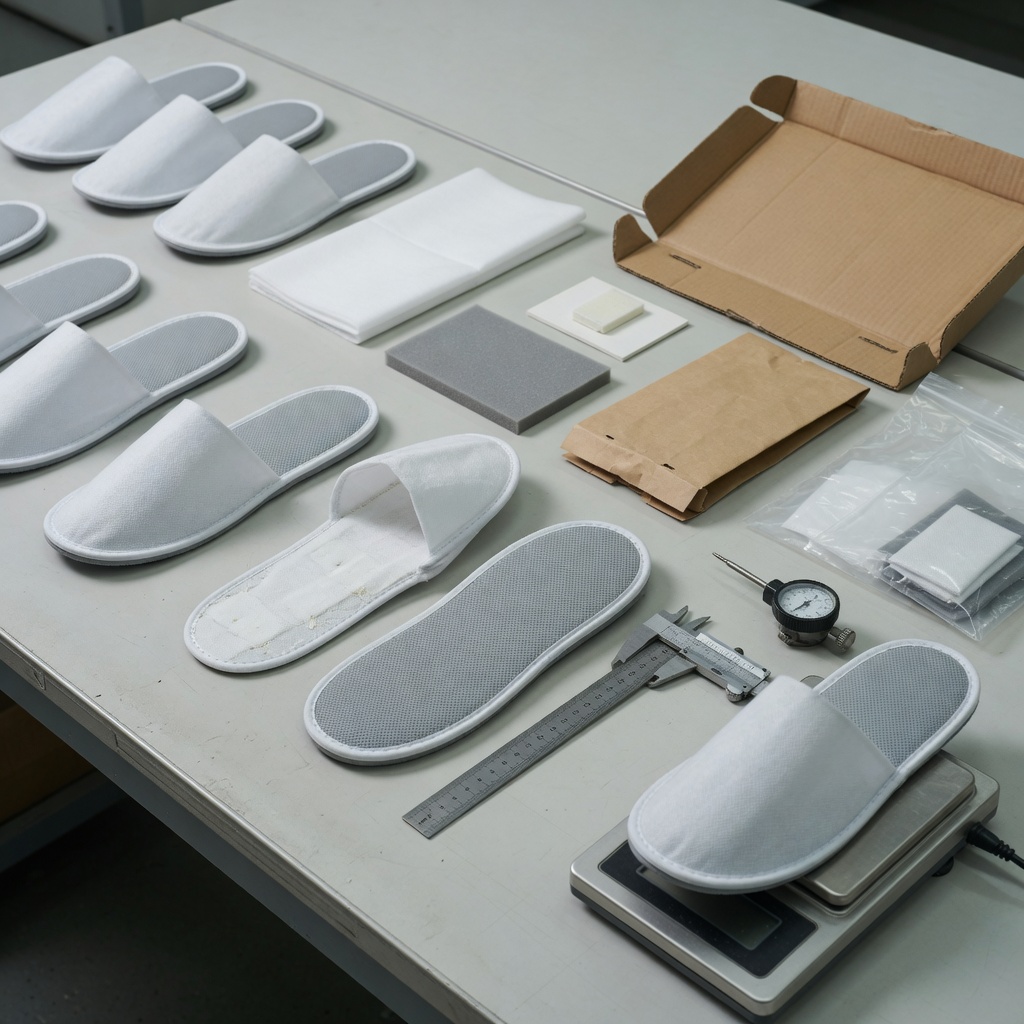
| Insole and sole | Material identity, formulation description, color, thickness in millimeters at defined locations, density or hardness where relevant, component mass in grams, and tolerances | Technical data, identified sample measurements, and reports scoped to the quoted component |
| Adhesive, binding, thread, ink, and coating | Material or chemistry description, supplier, color, application location, and component mass where relevant to a claim | Bill of materials and declarations or reports matched to the quoted inputs |
| Dimensions and performance | Overall length, forefoot width, pair mass, measurement locations, tolerances, construction checks, bond integrity, sole behavior, odor, appearance, and fit | Dimensioned specification, buyer-approved test plan, identified sample, and scoped reports |
| Packaging | Individual-pack and carton materials, coatings, inks, adhesives, dimensions, packed mass, closure, pairs per carton, net mass, gross mass, and loading assumptions | Approved packing specification, claim evidence, artwork, and freight-quotation inputs |
The values below are article-created example assumptions, not sourced product facts, recommended specifications, or acceptance limits. Every value must be replaced or verified in the dated supplier quote, approved specification, and identified sample for the actual order.
| Example measurement | Assumption to verify | Measurement definition to confirm |
|---|---|---|
| Overall length | 280 millimeters per illustrative adult-size slipper | Rearmost heel point to foremost toe point with the sample flat and uncompressed |
| Forefoot width | 105 millimeters per illustrative adult-size slipper | Widest forefoot location, recorded on the dimensioned drawing |
| Sole thickness | 4 millimeters per illustrative adult-size slipper | Defined sole location excluding the textile upper, with the instrument and compression method recorded |
The purpose of these assumptions is to show what a measurable RFQ field needs: a value, unit, location, method, tolerance, sample identity, and specification revision.
Sustainability sourcing criteria for claim approval
Create a separate evidence record for each statement proposed on the slipper, individual package, carton, quotation, or buyer-facing material.
| Claim category | Supplier must define | Evidence request | Buyer hold condition |
|---|---|---|---|
| Recycled content | Covered component, claimed percentage, calculation basis, input type, and exclusions | Material specifications, supplier declarations, input records, invoices, applicable chain-of-custody records, and order-linked records where relevant | Records do not match the quoted material, site, calculation boundary, or product revision |
| Plant-derived or organic input | Exact material identity, blend, processing description, percentage basis, and covered component | Supplier records, applicable certificate scope, and material-identification evidence | A raw-material statement is extended to the complete packed pair |
| Recyclability | Exact product or packaging boundary, separation steps, collection route, and exclusions | Construction data and route-specific evidence relevant to the proposed wording | Blends, adhesives, coatings, separation needs, or collection assumptions remain unresolved |
| Compostability or biodegradability | Covered item, intended environment, method, test conditions, claimed outcome, time boundary, and exclusions | Complete report identifying the tested item, method edition, result, date, and report owner | Input-material evidence is used to support a claim covering a finished slipper or package |
| Packaging reduction | Baseline package, proposed package, mass basis, functional requirements, and comparison boundary | Current and proposed packing specifications plus calculation inputs | Baseline and proposal use different product quantities, functions, or shipping boundaries |
For each submitted certificate or report, record its title, identifier, holder, issuer or laboratory, manufacturing site, covered product or material, method and edition where applicable, issue date, expiry or validity status, sample identity, and connection to the proposed order.
No specific standard is mandatory under this framework. If a supplier names a standard or certification program, distinguish that program's current requirements from the buyer's procurement controls. Do not describe a product, site, material, or supplier as certified without checking a current document for holder, scope, site, validity, and product connection.
United States labeling and import inputs before release
The supplier should submit complete inputs, while the United States buyer's qualified reviewers determine the treatment required for the actual product and transaction. These hold points are procurement recommendations, not legal or customs conclusions.
| Review subject | Supplier submission | Buyer control |
|---|---|---|
| Environmental wording | Exact claims and symbols proposed for the slipper, package, carton, and commercial material, including component boundaries and evidence references | Legal or claims reviewer closes the evidence-to-wording check before artwork release |
| Evidence ownership | Document holder, issuer, site, scope, issue date, validity, product connection, and source-verification path | Quality or responsible-sourcing owner resolves identity, scope, and validity mismatches |
| Manufacturing origin | Proposed origin, supplier's stated basis, production-flow records, proposed marking, and placement | Qualified customs or legal reviewer determines the treatment for the actual construction and supply chain |
| Tariff and invoice inputs | Supplier's proposed classification, product description, composition, use, value inputs, and commercial-invoice description | Qualified United States customs reviewer evaluates the entry treatment; the supplier proposal remains an input rather than a buyer determination |
| Material information | Complete material list, colors, coatings, adhesives, available reports, sample identity, and report scope | Buyer assigns any applicable federal, state, customer, or destination-specific review |
| Shipping records | Commercial-invoice inputs, packing-list inputs, carton data, lot references, and document owner | Logistics and customs owners check consistency with the purchase order, origin review, approved artwork, and broker instructions before shipment |
Do not authorize printing or shipment merely because a document has a familiar title. Close the connection among the document, its holder, the manufacturing site, the covered material or product, the proposed claim, and the order revision.
Normalize minimum quantities and landed cost
Treat the source-reported minimum-order range above only as an RFQ prompt. Require each bidder to state every minimum by total order, material, size, color, artwork, carton, and production run, together with the quote date, validity, and consequences of falling below the stated threshold.
Use one landed-cost worksheet for every qualifying bid:
| Cost boundary | Required input |
|---|---|
| Product | Unit price, currency, quantity break, included packaging, payment terms, quote date, and validity |
| Delivery | Delivery term, applicable edition where used, named place or port, transfer boundary, and excluded services |
| Supplier and third-party charges | Sampling, tooling, testing, documentation, inspection, reinspection, export handling, and other itemized charges |
| Packing and freight | Carton dimensions, pairs per carton, net mass, gross mass, pallet assumptions, loading data, freight, and insurance |
| United States destination costs | Brokerage, applicable entry charges, handling, storage assumptions, and inland delivery to the named destination |
| Buyer assumptions | Defect, replacement, financing, storage, or disposal allowances, each separately identified and approved |
Use the same denominator and scope for every bid:
landed cost per accepted pair = total applicable product, service, logistics, entry, and inland costs / expected accepted pairs
The comparison is decision-useful only after competing bids pass the same specification, evidence, labeling, quality, packaging, and delivery gates. Record the source, date, currency, scope, owner, and validity of each cost input instead of combining undocumented allowances into the unit price.
Control delivery assumptions and substitutions
A lead-time statement is comparable only when the quote identifies its start event, dependencies, milestones, and delivery boundary.
| Milestone | Required supplier response | RFQ control |
|---|---|---|
| Material readiness | Source, availability, reservation requirement, and dependencies | State whether timing assumes stock, a new material run, or buyer-funded reservation |
| Sample submission | Start event, sample revision, material and artwork status, dispatch date, and assumed approval period | Do not release production against an unidentified or unapproved sample |
| Production | Planned start and completion dates, site, capacity basis, and subcontracted processes | Tie production to the approved specification, evidence set, and manufacturing site |
| Testing and evidence closure | Sample identity, laboratory booking, expected report date, and responsible party | State whether production or shipment stops after a failed, incomplete, or late result |
| Pre-shipment inspection | Lot-readiness condition, inspection window, sampling plan, acceptance rule, and reinspection allowance | Define how nonconformity affects release and schedule |
| Booking and origin movement | Booking owner, cut-off assumptions, route, and document deadline | Use the same delivery boundary as the landed-cost comparison |
| United States entry and final delivery | Broker handoff, document deadline, clearance assumption, named destination, and delivery owner | Separate planning estimates from contractual commitments |
Require advance written notice and buyer approval before changing a material, supplier, formulation, recycled-content claim, colorant, adhesive, coating, production site, subcontractor, evidence status, artwork, packaging, or product revision. The purchase order should identify the approved specification, bill of materials, sample, artwork, packing revision, and evidence index, along with lot identification, inspection, containment, corrective action, reinspection, replacement, rejection, retained-sample, and record-retention responsibilities.
RFQ release checklist for a disposable slipper wholesale supplier
- [ ] Identify the legal seller, manufacturing site, relevant subcontractors, product code, specification revision, and quotation owner.
- [ ] Complete the bill of materials, measurable specification, tolerances, packaging schedule, and intended-use statement.
- [ ] Submit identified pre-production samples made from the proposed materials and packaging.
- [ ] Create a separate evidence record for every environmental statement proposed for the product or packaging.
- [ ] State the boundary, calculation or test basis, evidence owner, validity, and order connection for every claim.
- [ ] Identify whether each report covers a raw material, component, package, or finished pair and list anything not covered.
- [ ] Submit proposed environmental wording, symbols, origin information, artwork, and print locations for United States review.
- [ ] Quote minimum quantities, quantity breaks, currency, validity, delivery term, named place, and excluded charges.
- [ ] Provide carton, loading, freight, inspection, testing, customs-input, and inland-delivery data for landed-cost normalization.
- [ ] Submit milestone dates, start events, dependencies, capacity assumptions, inspection windows, and failure consequences.
- [ ] Accept written approval controls for material, source, formulation, site, subcontractor, evidence, artwork, and packaging changes.
- [ ] Make purchase-order release conditional on closing product, evidence, sample, labeling, import, cost, delivery, and change-control reviews.
Mark each mandatory gate as Pass, Hold, or Reject and cite the document used for the decision. Unsupported sustainability wording should remain a mandatory hold or rejection issue rather than being offset by a lower price.
Methodology, source contexts, and limitations
Source contexts: In the retained context, the commercial pages are undated. The eco-friendly slipper materials article is used only for its attributed recycled-EVA screening recommendation and reported minimum-order range. The wholesale slippers sourcing guide is used only for its document-request categories. The bulk disposable slippers article is retained as a commercial source context, but its environmental assertions are not used as award evidence. The author role is attributed only to the Vincent Xi author profile.
Method: Attributed source statements were separated from buyer-created RFQ controls and unsupported assertions. A source statement was retained only within its stated material, product, and date boundary. Procurement controls are presented as recommendations rather than laws, standards, certifications, or demonstrated supplier practices. Illustrative dimensions are labeled as assumptions and are not used as product facts.
Limitations: The cited pages do not validate a current supplier capability, manufacturing-site status, bill of materials, recycled-content calculation, certificate scope, product test, factory audit, legal conclusion, customs treatment, quotation, freight rate, capacity, lead time, lifecycle result, or destination-specific collection route. No current certificate, transaction record, laboratory report, supplier quotation, freight bid, customs decision, or lifecycle assessment has been validated here.
Verify before award: Confirm the seller and production site, bill of materials, dimensions and tolerances, component masses, claim calculation, certificate and transaction scope, laboratory sample identity, test method and result, approved sample, environmental wording, manufacturing origin and tariff treatment, applicable United States reviews, artwork, quote validity, minimum-order structure, carton data, freight assumptions, delivery schedule, inspection plan, corrective-action terms, and substitution controls for the exact product and purchase order.
Discuss Your Requirements
Review our manufacturing capabilities, then share your specifications for a supplier-fit review.