Disposable Slipper Wholesale Supplier Quality Control Inspection
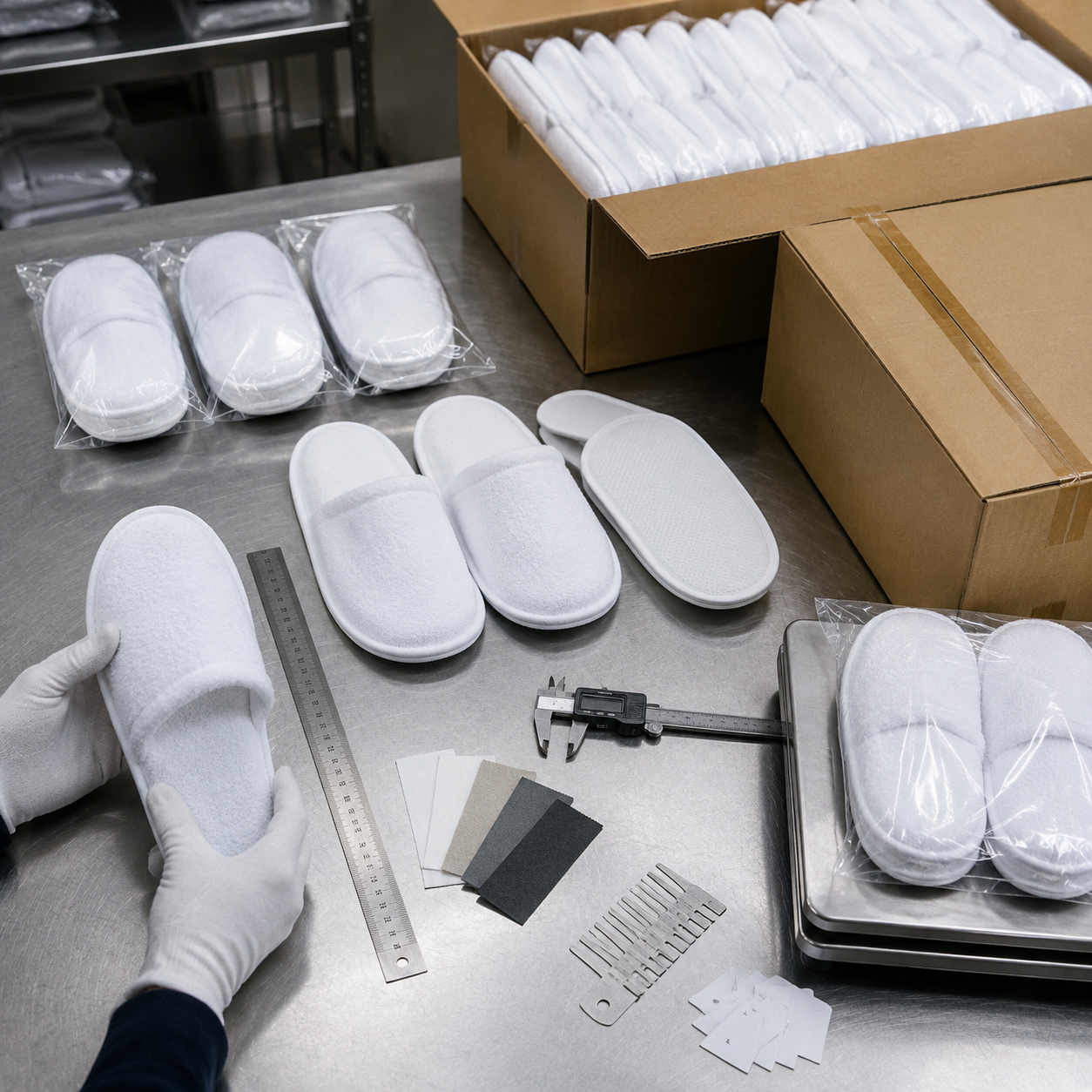
Disposable Slipper Wholesale Supplier Quality Control Inspection for United States Buyers
By Vincent Xi, Editorial Author
For a United States business buyer, a disposable slipper wholesale supplier quality control inspection should answer a narrow question: may an identified production lot be released under the signed purchase terms? The decision should compare the packed goods with the SKU specification, approved complete sample, controlled artwork and packaging, purchase order, and contractual sampling rule. It should not rest on a showroom sample, a general quality statement, or a report that cannot be traced to the offered construction and lot.
Set these controls in the RFQ before comparing prices. A comparable bid should return a defined commercial unit, measurable product and packaging requirements, declared exceptions, an inspection plan, United States labeling files for buyer review, an itemized quote, and a milestone schedule. This keeps quality, landed cost, and delivery tied to the same SKU and accepted-pair quantity.
United States Quality Control Inspection Release Gates
Use the same gates for every bid. An unanswered field remains an exception; it is not evidence that a capability or specification is included.
| Gate | Buyer-controlled evidence | Hold condition |
|---|---|---|
| Bid comparison | Completed SKU schedule, quote, assumptions, exclusions, and deviation register | Hold comparison when the commercial unit, construction, packaging, quantity basis, or excluded charges are unclear |
| Pre-production approval | Signed specification, approved complete slipper, bill of materials, artwork version, packaging sample, and approval record | Do not authorize production while documents conflict or approvals are provisional |
| Print approval | Controlled artwork tied to the exact SKU, packaging level, claims, and buyer-reviewed labeling decision | Do not authorize mass printing while wording, applicability, or supporting evidence is unresolved |
| Inspection readiness | Defined lot, completed and packed status, carton map, random access, and agreed inspection instruction | Postpone inspection when the lot is incomplete under the contract or access is restricted |
| Shipment release | Traceable inspection results, defect totals, measurements, packaging and label checks, and written disposition | Keep the lot on hold until the signed acceptance rule is met or the buyer approves a documented concession |
The RFQ should identify who may approve samples, classify disputed defects, accept deviations, order reinspection, and release a held lot. Verbal approval should not replace a controlled decision record.
JSH Slippers' supplier page presents product development, quality control, inventory, and distribution as supplier functions (source). These categories can be converted into due-diligence questions, but the page does not establish that a bidder controls the proposed production site, holds suitable inventory, has available capacity, or can meet the requested delivery date.
Lock the Disposable Slipper Specification Before Inspection
Mappershoe's supplier-published category overview discusses terry cloth, EVA, PVC, and related constructions as possible slipper materials (source). Use that context to frame material questions. It does not establish a bidder's material composition, product performance, conformity, or manufacturing capability.
The RFQ should state which document controls if the purchase order, signed specification, approved sample, artwork, packaging file, or supplier response conflicts.
| RFQ field | Requirement to define | Evidence to retain |
|---|---|---|
| Commercial unit | Single slipper, pair, individual pack, inner pack, or export carton | Quote and SKU schedule using the same unit |
| Construction | Open-toe or closed-toe form, left-right configuration, upper, lining, padding, binding, insole, outsole, thread, adhesive, and finishing method | Signed bill of materials and controlled complete sample |
| Measurable attributes | Measurement points, nominal values, tolerances, sample condition, instrument type, and recording precision | Signed specification and sample-level inspection results |
| Workmanship | Seam, bonding, edge finishing, pair matching, outsole texture, and permitted appearance variation | Defect catalogue with controlled photographs or diagrams |
| Branding | Application method, artwork version, dimensions, color reference, placement, orientation, and tolerance | Approved branded slipper and artwork record |
| Packaging | Pair orientation, bag and closure, assortment, pack quantity, carton construction, labels, and carton marks | Approved packaged-pair sample and packing specification |
| Claims | Exact wording, applicable construction, test method, acceptance threshold, and scope-matched evidence | Claim register linked to the current SKU and artwork |
| Change control | Changes requiring notice or reapproval, including site, component source, material, process, construction, artwork, and packaging | Written change-control commitment and approval history |
The following values are not product findings or market norms. Each is a buyer-created example assumption for an illustrative SKU as of the buyer's RFQ issue date. Each value must be confirmed or replaced in the supplier quote and signed sample before it becomes an order requirement.
| Attribute | Buyer-created example assumption | Inspection method | Source, scope, and as-of context |
|---|---|---|---|
| Finished outsole length | 28.0 cm nominal per finished slipper, with +/- 0.5 cm per finished slipper permitted | Place the finished slipper flat without stretching and measure the buyer-marked heel-to-toe centerline | Buyer-created example assumption for the illustrative SKU as of the buyer's RFQ issue date; verify in the supplier quote and signed sample |
| Outsole thickness | 3.0 mm nominal per finished outsole, with +/- 0.3 mm per finished outsole permitted at buyer-marked locations | Measure each specified location with the identified gauge and record every sampled result | Buyer-created example assumption for the illustrative SKU as of the buyer's RFQ issue date; verify in the supplier quote and signed sample |
| Packaged-pair mass | 42 g nominal per sealed finished pair, with +/- 4 g per sealed finished pair permitted | Weigh the complete sealed pair with the identified scale and record every sampled result | Buyer-created example assumption for the illustrative SKU and pack configuration as of the buyer's RFQ issue date; verify in the supplier quote and signed sample |
| Export-carton quantity | 100 pairs per export carton for the specified SKU and assortment | Count the packed pairs and reconcile the result with the packing list and carton record | Buyer-created example assumption for the illustrative order as of the buyer's RFQ issue date; verify in the supplier quote and signed packaging sample |
These examples do not imply a standard size, construction, tolerance, mass, or pack quantity. Inspection reports should preserve individual readings rather than only an average or overall pass statement. An out-of-tolerance result establishes a mismatch with the signed requirement; it does not establish the root cause. Keep the affected lot on hold until its scope, investigation, proposed correction, and disposition are documented.
Treat traction, recycled-content, biodegradability, antimicrobial, and similar claims as unresolved until the exact wording is supported for the offered construction. Request the test method and version, specimen construction, conditioning, test environment, acceptance threshold, test date, laboratory identity, report scope, and traceability to the offered material and SKU. A report for another construction or an unidentified specimen should remain an exception unless applicability is documented and accepted by the buyer.
Define the Production Lot, Sampling Rule, and Defects
Inductus describes material checks, in-process inspection, and final pre-shipment review as separate footwear quality-control stages (source). This supplier-published sequence can organize RFQ controls. It does not prove that a bidder performs those controls at the proposed site or for the offered order.
| Stage | Contract control | Order-specific evidence |
|---|---|---|
| Material approval | Compare components with the signed bill of materials and controlled references before assembly | Material records, component photographs, lot references, and approved-substitute status |
| In-process control | Apply buyer-defined checks for cutting, symmetry, seam placement, bonding, edge finishing, and branding | Dated records, inspected scope, affected quantities, defect evidence, and corrective-action entries |
| Final lot inspection | Select samples from completed and packed goods across the contract-defined lot | Carton and unit selection records, measurements, defects, packaging checks, label checks, photographs, and disposition |
Define each lot by SKU, color, size, production batch, and carton boundaries. The inspection instruction should also state the required completed and packed status, carton-selection method, unit-selection method, sample size, defect classes, acceptance and rejection values, treatment of unavailable cartons, and required report format. State whether rework, replacement sampling, expanded screening, or reinspection is permitted after failure.
If the contract uses AQL terminology or invokes a sampling standard, identify the standard title, edition, applicable clauses or tables, lot-size treatment, inspection level, switching rules where applicable, and acceptance values for each defect class. Only the provisions incorporated into the signed order become contractual standard requirements. A supplier's internal sampling frequency, defect catalogue, calibration procedure, and corrective-action workflow remain company practices unless the contract incorporates them.
Do not infer certification from a logo or general statement. Any certification claim should be matched to a current document identifying the holder, site, scope, status, and validity.
Buyer-defined defect classes may include:
- Critical: an observation meeting the buyer's agreed safety or regulatory-risk definition, such as a sharp foreign object, prohibited contamination, or a material-label mismatch with compliance consequences.
- Major: an observation meeting the buyer's agreed intended-use, saleability, or specification-failure definition, such as an open seam, detached sole, wrong material, failed measurement, incorrect artwork, or wrong assortment.
- Minor: a cosmetic departure outside the approved appearance range that does not meet the agreed critical or major definition.
These are contractual examples, not universal legal classifications. Attach controlled photographs or diagrams for boundary cases and state how repeated defects, uncertain classifications, and multiple defects on the same sampled slipper are counted.
Approve Branding, Packaging, and United States Labeling Evidence
UTOP's supplier-published branding discussion identifies upper material, application method, artwork size, color reference, placement, construction, and tolerances as variables that can affect logo presentation (source). Use those variables to structure approval; the page does not demonstrate that a bidder can reproduce the requested artwork on the offered construction.
Approve a complete branded slipper and packaged-pair sample, not only a digital artwork file or flat material swatch. The approval record should connect the physical sample identifier to the SKU, artwork version, application method, placement points, color reference, upper construction, packaging version, approver, approval date, and any exceptions. A sample should not silently override conflicting purchase-order or specification terms.
Packaging controls should cover bag material, closure, pair orientation, assortment, carton construction, sealing, labels, and marks. Inspection evidence should connect selected cartons to the defined lot and record wet, crushed, open, contaminated, relabeled, or otherwise nonconforming cartons under the buyer's defect catalogue.
No official United States regulatory or customs source is included in the supplied source set. The following is therefore an order-level verification workflow, not a statement that every field is legally required for every disposable slipper.
| Review question | Supplier submission | Buyer-controlled release evidence |
|---|---|---|
| Origin marking applicability | Proposed wording, location, application method, and production sample | Written determination and approval for the exact SKU and packaging configuration |
| Material or fiber statements | Exact component descriptions, proposed placement, and supporting material records | Documented applicability decision and approved wording |
| Importer or distributor information | Proposed entity details, format, and placement | Confirmation that the displayed entity matches the commercial arrangement |
| Environmental or performance claims | Exact wording and evidence tied to the offered construction | Claim approval linked to the current evidence register and artwork version |
| Barcode and customer data | Data owner, symbology request, print location, and verification method | Approved data file, scan result, and production-inspection evidence |
| Destination or customer instructions | Requirement response for the identified United States order | Written determination of applicable wording and placement |
Route proposed artwork through the buyer's customs broker, qualified compliance counsel, retailer review, or other responsible process before mass printing. Supplier approval alone should not be recorded as the buyer's legal determination. Any post-approval change should return through change control.
Control Landed Cost and Delivery in the RFQ
Compare bids on accepted pairs using a consistent buyer-created structure:
comparison cost per accepted pair = (product and packaging cost + tooling and sample cost + inspection and reinspection cost + origin handling + international transport + insurance + brokerage + applicable duty and fees + inland delivery + documented rework, replacement, and shortage allowance) / accepted-pair quantity
This is an editorial sourcing comparison method, not a customs, tax, legal, or accounting rule. Every monetary input should identify its currency, unit, SKU or order scope, quote or as-of date, and source. Duty and fee inputs should identify the classification, origin, customs-value assumptions, calculation date, and source used by the buyer.
Require each quote to state:
- Whether the price unit is a slipper, pair, pack, or carton.
- Included construction, materials, branding, packaging, labels, samples, tooling, testing, and inspection access.
- Currency, quotation date, validity period, payment milestones, and deposit treatment.
- Delivery rule and edition when used, named place, transfer point, and excluded charges.
- Freight, insurance, origin charges, and destination charges included in the supplier figure.
- Reinspection responsibility, correction cost, replacement terms, shortage remedy, and treatment of rejected goods.
- Quantity used as the denominator and the treatment of rejected, missing, replacement, or concession-accepted pairs.
Record missing cost inputs as unknown rather than zero. Do not compare a quoted pair price with a carton price or with a landed estimate containing different cost buckets. Recalculate after inspection if the accepted-pair quantity differs from the ordered or shipped quantity.
The delivery schedule should separate sample submission, approval, material readiness, production start, production completion, inspection access, corrective action, reinspection, cargo-ready status, booking, departure estimate, arrival estimate, customs clearance, and warehouse receipt. For each milestone, identify the responsible party, proposed date, dependency, completion evidence, status route, and contractual remedy for delay. Keep supplier-controlled production commitments distinct from carrier, border, and inland-delivery estimates.
Practical United States RFQ Checklist for Quality Control Inspection
Send every bidder the same checklist and SKU schedule. Require a response of comply, deviate, or not offered plus an attachment reference for every line item. Treat blank fields, unsupported claims, and unpriced inclusions as unresolved exceptions.
- [ ] Supplier identity: State the contracting legal entity, proposed production site, subcontracted processes, order contact, and the entity responsible for corrective action.
- [ ] Commercial unit: Confirm whether every price, quantity, inspection result, shortage remedy, and delivery figure applies to one slipper, one pair, one pack, or one carton.
- [ ] SKU specification: Return the construction, bill of materials, measurement points, nominal values, tolerances, workmanship limits, branding method, packaging, assortment, and order quantity basis.
- [ ] Deviation register: Mark every requirement comply, deviate, or not offered and explain substitutions, exclusions, conditional statements, and conflicts between returned documents.
- [ ] Approval samples: Identify the complete slipper, branded sample, packaged-pair sample, artwork version, packaging version, approver, and approval status that will control production.
- [ ] Claims evidence: Link each proposed material, environmental, safety, or performance claim to evidence for the exact offered construction, test method, specimen, date, and scope.
- [ ] United States labeling: Submit proposed origin, material, importer or distributor, customer-data, barcode, and claim files for buyer-side applicability review before mass printing.
- [ ] Lot and inspection plan: Define lot boundaries, completed and packed status, random-access terms, carton and unit selection, sample size, defect classes, acceptance values, report format, and reinspection rule.
- [ ] Inspection evidence: Commit to a report identifying selected cartons and slippers, individual measurements, defects by class, packaging and label checks, photographs, restrictions, and written disposition.
- [ ] Itemized price: State currency, quotation date, validity period, payment terms, price unit, included materials and services, tooling, samples, testing, inspection access, exclusions, and deposit treatment.
- [ ] Landed-cost inputs: Identify origin handling, transport, insurance, brokerage, duty and fee assumptions, inland delivery, shortage treatment, rework, replacement, and reinspection responsibility without entering unknown amounts as zero.
- [ ] Delivery milestones: State proposed dates, dependencies, responsible parties, completion evidence, status route, and delay remedies for sampling, approval, production, inspection, correction, cargo readiness, transport, clearance, and warehouse receipt.
- [ ] Nonconformity remedies: State segregation, investigation, rework, replacement, expanded screening, renewed testing, reinspection, concession, shortage, rejected-goods, and delay terms.
- [ ] Change control: Commit to written notice and buyer approval before changing the production site, subcontractor, component source, material, process, construction, artwork, or packaging.
- [ ] Authorized release: Name the parties allowed to approve samples, classify disputed defects, accept deviations, authorize reinspection, grant concessions, and release a held lot.
Do not close the RFQ comparison until every exception has an owner and written disposition. Do not release production, printing, or shipment merely because a bidder checked a box; use the referenced documents and order-specific evidence to verify each response.
The final inspection report should identify the purchase order, SKU, lot definition, completed and packed quantities, available and selected cartons, selection method, sampled slippers, individual measurements, defects by class, packaging checks, label checks, photographs, unavailable goods, access restrictions, and disposition.
After a failed result, require segregation of affected goods, an affected-quantity statement, cause investigation, corrective action, and proposed disposition. Rework, replacement, expanded screening, renewed testing, reinspection, or concession should proceed only under the contract and written buyer authorization. A concession should identify the affected lot, requirement, quantity, and commercial treatment without changing future-order specifications by implication.
Evidence Methodology and Limitations
Methodology. The cited supplier-published pages were used only to identify RFQ question categories: possible material variables, staged inspection controls, branding variables, and supplier-function claims requiring due diligence. Those contexts were converted into buyer-controlled specifications, evidence requests, hold points, and release decisions. No bidder-specific capability or production-lot result was inferred. The measurable values are expressly labeled buyer-created example assumptions as of the buyer's RFQ issue date; they were not derived from a supplier quote, physical measurement, test report, shipment record, or market average.
Limitations and what to verify. The supplied source package does not include official United States regulatory or customs sources, independent factory audits, product test reports, current certificates, bidder quotations, production records, inspection reports, source-access dates, or archive snapshots. Before ordering, verify the legal entity, production site, subcontracting, bill of materials, signed sample, material lots, production status, inspection access, laboratory-report scope, current certification status where relevant, United States labeling determination, tariff classification, duty treatment, quote inclusions, capacity, milestone dates, logistics plan, and contractual remedies. Signed order documents and current advice from qualified customs, compliance, tax, accounting, and legal professionals should control where they differ from this editorial framework.
Author note. Vincent Xi is identified by SlipperForge as an Editorial Author. The approved profile does not document first-hand factory inspection, product testing, shipment handling, or customer outcomes, so this article makes none of those claims.
Discuss Your Requirements
Review our manufacturing capabilities, then share your specifications for a supplier-fit review.