Disposable Slipper Wholesale Supplier Minimum Order Quantity for Europe: RFQ Decision Sheet
By Vincent Xi, Editorial Author
For a Europe-bound RFQ, approve a disposable slipper wholesale supplier minimum order quantity only when a dated quotation ties it to the locked product specification, permitted SKU allocation, packaging configuration, price basis, quality controls, delivery terms, and actual destination.
A headline quantity in pairs is not enough. The supplier should separate any minimum that applies to the construction, material, component, style, size, color, artwork, individual package, carton, or release schedule. The RFQ should also identify the destination as an EU member state, non-EU EEA country, UK jurisdiction, or other European country. These route labels organize procurement review; they do not establish which requirements apply.
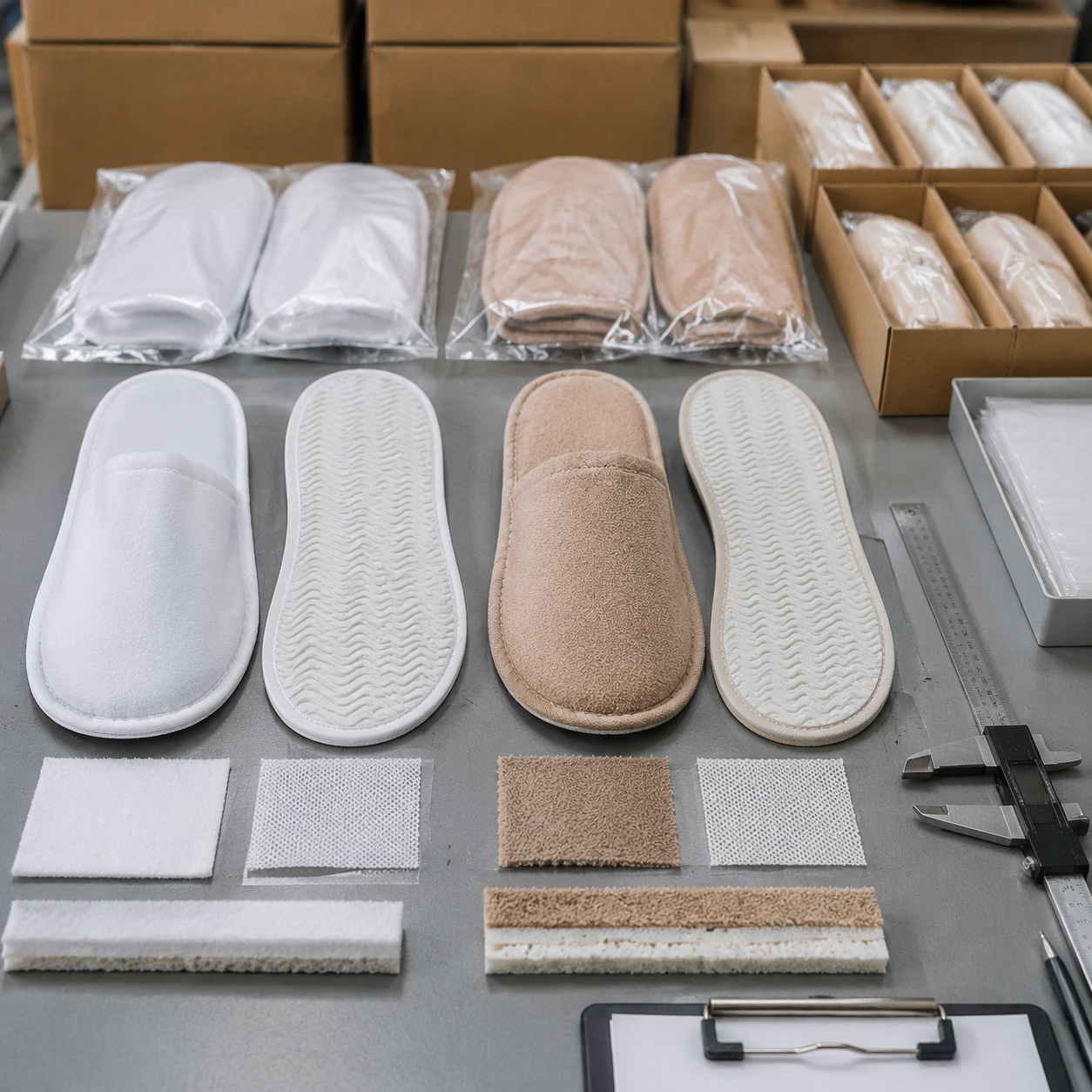
A published MOQ is evidence only for the model, terms, source, and date displayed. It is neither a Europe-wide benchmark nor a current SlipperForge offer. The cited DM Import listing illustrates why the specification must remain attached to the quantity: it displays the same finished-pair minimum for constructions with different material layers, sole thicknesses, and EXW prices (DM Import).
Minimum order quantity approval gates for Europe
Treat these as buyer-defined controls. Each answer should appear in the dated quotation or an attached, revision-controlled specification.
| Decision gate | Complete supplier response | Buyer action if incomplete |
|---|---|---|
| Product revision | Construction, material stack, dimensions, size designation, color, sole, artwork, and packaging are identified | Request a specification-linked revision |
| MOQ structure | Finished-product MOQ and every applicable material, component, SKU, artwork, packaging, carton, and release minimum are separated | Do not approve the headline quantity |
| Allocation and rounding | Permitted quantity by style, size, color, and package is confirmed together with carton multiples and rounding rules | Ask for the nearest permitted allocation and revised price |
| Price connection | Unit price and mandatory charges apply to the proposed specification, allocation, and packaging | Requote the requested configuration |
| Sample and quality | The approved sample or production reference, measurements, tolerances, inspection conditions, and remedies are identified | Complete objective acceptance terms before release |
| Commercial basis | Currency, quote validity, payment triggers, delivery term, named place, inclusions, and exclusions are stated | Normalize the quote before comparison |
| European destination | Actual country, delivery address, buyer role, and required evidence are recorded | Route the order for destination-specific review |
| Replenishment | Repeat MOQ, production trigger, material-continuity conditions, storage terms, and lead-time basis are disclosed | Test the proposed commitment against documented demand |
Approve the quote basis only when these answers match the buyer's approved requirement. Negotiate when the minimum exceeds documented demand, changes the requested SKU mix, or depends on unapproved materials or packaging. Do not prepare a purchase order when the supplier will not bind quantity and price to a defined product revision.
Ask for every minimum behind the headline MOQ
Ask the supplier to complete each applicable line and mark unused lines as Not applicable. This makes component and packaging thresholds visible before commercial approval.
| MOQ layer | Supplier disclosure required | Decision question |
|---|---|---|
| Finished product | Minimum pairs for the specified construction, dimensions, material stack, sole, and package | Does the quoted minimum cover the approved product? |
| Material or component | Purchasing threshold, surplus quantity, cost, ownership, storage, reuse, and disposal terms | Who pays for and controls unused material? |
| Style or SKU | Minimum allocation by style, size, color, and package | Is the requested demand mix allowed at the quoted price? |
| Artwork | Minimum for the buyer-approved print, embroidery, weave, embossing, or other method | Is an unbranded option quoted separately? |
| Individual package | Minimum for the specified bag, sleeve, insert, barcode, label, or artwork | Does packaging create a higher commitment than production? |
| Master carton | Pack count, carton multiple, rounding rule, dimensions, net mass, and gross mass | What quantity will be produced, invoiced, and shipped? |
| Release or call-off | Quantity per release plus payment, ownership, storage, and unused-stock terms | Does staged delivery reduce stock exposure or only defer shipment? |
| Repeat order | Replenishment MOQ, production trigger, material continuity, and price-review basis | Can the repeat cycle support documented demand? |
Any lower-MOQ alternative that changes material, dimensions, allocation, color, artwork, packaging, carton configuration, or delivery schedule should receive its own specification and quotation. It is not a like-for-like revision of the original quote.
Lock the disposable slipper specification before comparing MOQ
The UTOP wholesale checklist discusses intended use, material, sizing or fit, sole selection, customization, packaging, sample approval, and bulk quality checks. It is used here as a commercial sourcing context, not as independent testing or destination-specific legal guidance.
Convert those considerations into measurable RFQ fields:
| Specification area | RFQ entry | Procurement risk controlled |
|---|---|---|
| Intended use and construction | Buyer-approved use statement, open-toe or closed-toe form, component stack, edge construction, and assembly method | Bids based on different products or unsupported claims |
| Dimensions and sizing | Finished length and width, measurement points, measurement condition, size designation, and buyer-set tolerances | Incomparable sizing descriptions |
| Material stack | Material name and composition for each applicable upper, lining, backing, fill, binding, sole, thread, adhesive, and trim | Undisclosed substitution |
| Thickness or mass | Nominal or finished value, unit, test location, method, conditioning, and buyer-set tolerance | Values measured at different stages or positions |
| Sole and workmanship | Sole material, tread description, flexibility criterion, stitching, bonding, edge finish, symmetry, cleanliness, and visible-defect criteria | Subjective quality decisions |
| Artwork | Approved file revision, method, placement, dimensions, color reference, and permitted variation | MOQ or price changes after artwork approval |
| Individual package and carton | Materials, dimensions, closure, contents, pack count, artwork revision, carton construction, and shipment data | Packaging thresholds and freight assumptions discovered late |
| Reference sample | Sample identifier, specification revision, approval status, recorded deviations, and retention location | A sample being applied to a different product revision |
Every bidder should quote the same locked fields. A price based on another material, thickness, size allocation, package, or artwork method is an alternative offer, not a directly comparable MOQ quote.
The cited evidence does not establish a universal product or test standard for every European destination and specification. If the buyer's destination review identifies a relevant standard, record its exact title, edition, scope, test conditions, and acceptance criterion. A supplier's internal inspection remains that company's practice unless the purchase documents adopt it. Do not describe a product or supplier as certified without a current document that matches the ordered scope.
Source-backed disposable slipper minimum order quantity example
The following figures are transcribed from the DM Import commercial page bearing the stated date of February 19, 2026. Every value is scoped to the listed model and that source date. The figures are listing claims, not independent measurements, current quotations, European averages, or SlipperForge capabilities.
| Listed model | Displayed construction and dimensions | Displayed packaging and MOQ | Displayed price | Source and date context |
|---|---|---|---|---|
| Nap model | Closed toe; finished length 29.8 cm; finished width 11.8 cm; nap layer 0.3 mm; non-woven layer; sole 4 mm | Individual OPP packaging; minimum 5,000 pairs for the listed model | USD 0.1420 per pair, EXW, for the listed model | DM Import, page bearing the stated date of February 19, 2026 |
| Coral-fleece model | Finished length 29.8 cm; finished width 11.8 cm; coral-fleece layer 0.3 mm; nap layer 0.3 mm; sole 6 mm | Individual OPP packaging; minimum 5,000 pairs for the listed model | USD 0.2480 per pair, EXW, for the listed model | DM Import, page bearing the stated date of February 19, 2026 |
Example calculations to verify in the supplier quote:
- For the nap model displayed on the cited DM Import page bearing the stated date of February 19, 2026, 5,000 pairs x USD 0.1420 per pair = USD 710.00 EXW goods value. Verify the quoted quantity, unit price, named handover point, included services, and arithmetic in the actual supplier quotation (DM Import).
- For the coral-fleece model displayed on the cited DM Import page bearing the stated date of February 19, 2026, 5,000 pairs x USD 0.2480 per pair = USD 1,240.00 EXW goods value. Verify the quoted quantity, unit price, named handover point, included services, and arithmetic in the actual supplier quotation (DM Import).
The commercial lesson is narrow: the same displayed pair minimum does not make different constructions equivalent. Select the required construction first, then obtain a dated quotation tied to that specification.
Compare commercial exposure at the quoted minimum order quantity
The Chantomoo bulk-buying article discusses product configuration, destination, timing, replenishment, and whether shipping, taxes, and duties are included. It is used here as a source of commercial questions to verify, not as evidence of actual rates, supplier performance, or destination-specific law.
Normalize each bid with buyer-controlled calculations:
Goods commitment at MOQ = quoted pairs x quoted unit price + mandatory setup, artwork, packaging, testing, and other quoted charges
Delivered commercial exposure = goods commitment + verified buyer-paid logistics, border, inspection, storage, and handling amounts
Cost per accepted pair = verified commercial and remediation cost / accepted pairs
Inventory remaining at reorder point = approved order quantity - documented consumption before the next feasible replenishment
Label every input as a supplier quotation, buyer assumption, logistics offer, inspection offer, or destination-specific assessment. Do not place an unverified freight rate, border charge, tax, exchange rate, rejection rate, or consumption forecast into final approval.
Because the cited DM Import listing labels its displayed prices EXW, a comparable supplier quote should state the named handover place and written inclusions and exclusions. Do not infer loading, export handling, rule edition, or other responsibilities from the label alone.
Connect sample and quality controls to MOQ approval
The specification, sample record, quality plan, quotation, and purchase order should identify the same product revision. Include these controls in the RFQ:
- Request a pre-production sample using the proposed construction, materials, sole, artwork, and packaging.
- Record whether the sample uses proposed production materials and note every disclosed deviation.
- Assign the sample an identifier linked to the approved specification and purchase order.
- State measurement points, units, buyer-set tolerances, workmanship criteria, packaging checks, and prohibited substitutions.
- Define the bulk sampling method, inspection stage, defect categories, acceptance rule, report format, and contractual response to a failed check.
- Require written approval before changes to material source, composition, dimensions, thickness, color, artwork, packaging, carton allocation, or production site.
- Obtain final carton dimensions, pack count, net mass, gross mass, and shipment volume before logistics approval.
- For any grip or slip-resistance claim, specify the proposed test method, surface, condition, result format, and buyer-set acceptance criterion.
Do not treat a report or certificate as covering the order merely because it mentions slippers. Check the named product, ordered material and color, method, issuer, issue date, stated validity, tested sample, and connection to the quoted SKU. Keep supplier declarations, internal inspection records, third-party test reports, and certification documents distinct in the procurement record.
Route Europe-bound quotes by actual destination
Do not accept Europe as the complete destination entry. Record the actual country and commercial role before approving artwork, packaging, evidence, or production.
| Destination route | MOQ-related RFQ treatment |
|---|---|
| EU destination | Record the actual member state, delivery address, route to market, buyer or importer role, and evidence identified by the responsible compliance contact |
| Non-EU EEA destination | Record the actual country and complete a separate destination review rather than automatically reusing an EU member-state conclusion |
| UK destination | Record the actual UK jurisdiction, delivery route, buyer or importer role, labeling review, and document set rather than relying on a generic UK label |
| Other European destination | Record the actual country and obtain a current review for the product, claims, packaging, sales channel, and commercial role |
| Country-specific instruction | Add confirmed language, labeling, packaging, waste, tax, or commercial instructions before artwork or packaging MOQ approval |
This routing table is a procurement workflow, not a statement that requirements are uniform across Europe or that a particular rule applies to an order. The buyer or appointed adviser should determine current applicability for the actual destination, product classification, materials, claims, packaging, sales channel, and business role.
RFQ wording for a specification-linked MOQ quote
> Please quote the attached disposable slipper specification for delivery to the stated European destination. Show the finished-product minimum order quantity and every applicable minimum for material, component, style, size, color, artwork, individual packaging, carton, and release schedule. Confirm the permitted allocation and rounding rules. Link the unit price, mandatory charges, sample, quality plan, delivery term, named place, payment triggers, quote validity, repeat MOQ, and change-control terms to the quoted specification revision. List every alternative construction or lower-MOQ option as a separate quotation.
Return the response for revision if any field is left ambiguous. A verbal assurance should not override the dated quotation, specification, sample record, or agreed purchase terms.
Evidence method and limitations
Source contexts:
| Source | Evidence used | Evidence not inferred |
|---|---|---|
| DM Import | Dated commercial-listing descriptions, dimensions, material layers, sole thicknesses, packaging, displayed MOQ, and displayed EXW unit prices | Current availability, current quotation, independent test results, European averages, or SlipperForge capability |
| UTOP | Commercial checklist context for specification alignment, samples, and bulk quality checks | Independent validation, legal requirements, or certification |
| Chantomoo | Commercial buying context for configuration, destination, timing, replenishment, and cost-inclusion questions | Verified freight, tax, duty, supplier performance, or destination-specific legal conclusions |
| Vincent Xi author profile | Author identity and Editorial Author role | Factory visits, product testing, procurement outcomes, credentials, or certifications |
Method: Numeric product details were transcribed from the cited DM Import listing and kept within the displayed model and source-date scope. The example goods values use direct multiplication of the displayed quantity and unit price. UTOP and Chantomoo were used only to identify attributed commercial sourcing questions. The approval gates, formulas, routing table, and RFQ wording are buyer-controlled editorial methods, not representations of a supplier's capacity or statements of applicable law.
Limitations and verification: The cited product and sourcing pages are commercial sources rather than independent market, test, or regulatory datasets. The listed measurements, materials, prices, quantities, availability, and terms have not been independently verified. For the actual European order, obtain a dated supplier quotation, revision-controlled specification, approved sample, agreed quality plan, current scope-matched document set, and logistics offer. Verify destination-specific requirements with the buyer's responsible adviser. No displayed MOQ is generalized into a European average, and no price or product capability is represented as a SlipperForge offer.
Author basis: The approved Vincent Xi author profile supports the byline identity and Editorial Author role. It does not support a first-person factory, product-testing, or procurement-outcome claim, and none is made here.
Discuss Your Requirements
Review our manufacturing capabilities, then share your specifications for a supplier-fit review.