Disposable Slipper Wholesale Supplier Shipping Lead Time for United States Orders
By Vincent Xi, Editorial Author
Decision answer: For a United States order, compare a disposable slipper wholesale supplier only when the quoted shipping lead time starts at a named trigger and ends at the buyer's required delivery event. The schedule should separate specification and artwork release, material readiness, sampling, production allocation, QC release, packing, origin handoff, international transport, import coordination, and warehouse delivery. Each stage needs a duration unit, planned date, owner, dependency, commitment status, and dated evidence.
A production duration, cargo-ready date, or carrier transit estimate does not represent the same endpoint as delivery to a named United States facility. Keep a quote under clarification until the product revision, quantity in pairs, packaging, labeling, freight mode, destination, approval assumptions, cost scope, and responsibility split are aligned.
| Quote status | Evidence condition | Buyer action |
|---|---|---|
| Comparable | Product scope, schedule boundaries, delivery endpoint, cost allocation, and evidence requirements are aligned | Compare schedule risk, landed cost, and contract terms |
| Clarification required | A trigger, dependency, duration basis, charge, owner, or document is missing | Issue a written exception list and request a revised quote |
| Hold award | The supplier will not identify the offered construction, material status, QC release gate, delivery endpoint, or charge allocation | Resolve the missing control before award |
Define United States Shipping Lead Time Before Comparing Prices
For RFQ purposes, record shipping lead time as an order-specific path rather than an undivided duration. The RFQ should define:
- Start event: The purchase-order, payment, specification, sample, artwork, label, packaging, or material condition that starts each stage.
- Finish event: The contractual endpoint, such as released packed goods, origin carrier handoff, import release, or acceptance at the named United States warehouse.
- Time basis: Calendar days or working days, applicable time zone, workweek, holidays, and cutoff time.
- Commitment status: Supplier commitment, carrier estimate, buyer-controlled allowance, import-planning allowance, or contingency.
- Dependency and owner: The preceding event and the party responsible for moving the stage forward.
- Completion evidence: The dated record used to verify that the milestone occurred.
- Recovery rule: The notice, revised schedule, cost treatment, and approval required after a missed milestone.
The finish event must be singular and explicit. Packed-goods release, carrier handoff, departure, United States arrival, import release, and warehouse acceptance are different schedule events. The quote should identify the contractual event and label any later dates as commitments or planning estimates.
| Schedule stage | Supplier response required | Evidence or hold point |
|---|---|---|
| Commercial release | Accepted purchase order, payment condition, quote validity, and exact clock-start trigger | Matching order and written trigger definition |
| Specification, label, and packaging release | Controlled revisions, open exceptions, approval owners, and release status | Approved files and exception log; hold if product or artwork inputs remain unresolved |
| Material and sample readiness | Offered composition, stock or procurement status, reservation status, sample type, and approval dependency | Order-linked material confirmation and dated sample record |
| Production allocation | Reserved production period, order scope, sequencing, and any proposed overlap with approvals | Dated order-specific allocation confirmation |
| QC and packing release | Inspection checkpoints, decision rules, rework process, release authority, carton count, dimensions, and mass | Reports matching the approved revision and final packing list |
| Origin handoff | Booking owner, handoff point, planned date, route, capacity status, and document owner | Carrier booking and applicable transport record |
| International transport and United States import coordination | Schedule basis, document responsibilities, buyer or broker interface, charge allocation, and exception process | Buyer-reviewed document checklist and shipment status records |
| Final delivery | Named facility, receiving window, appointment owner, unloading scope, and acceptance event | Appointment confirmation and delivery record |
Do not count overlapping work as schedule savings unless the quote states what begins before approval, which inputs remain provisional, who authorizes the overlap, and who bears the resulting cost if approval is withheld.
Lock Disposable Slipper Inputs That Affect Shipping Lead Time
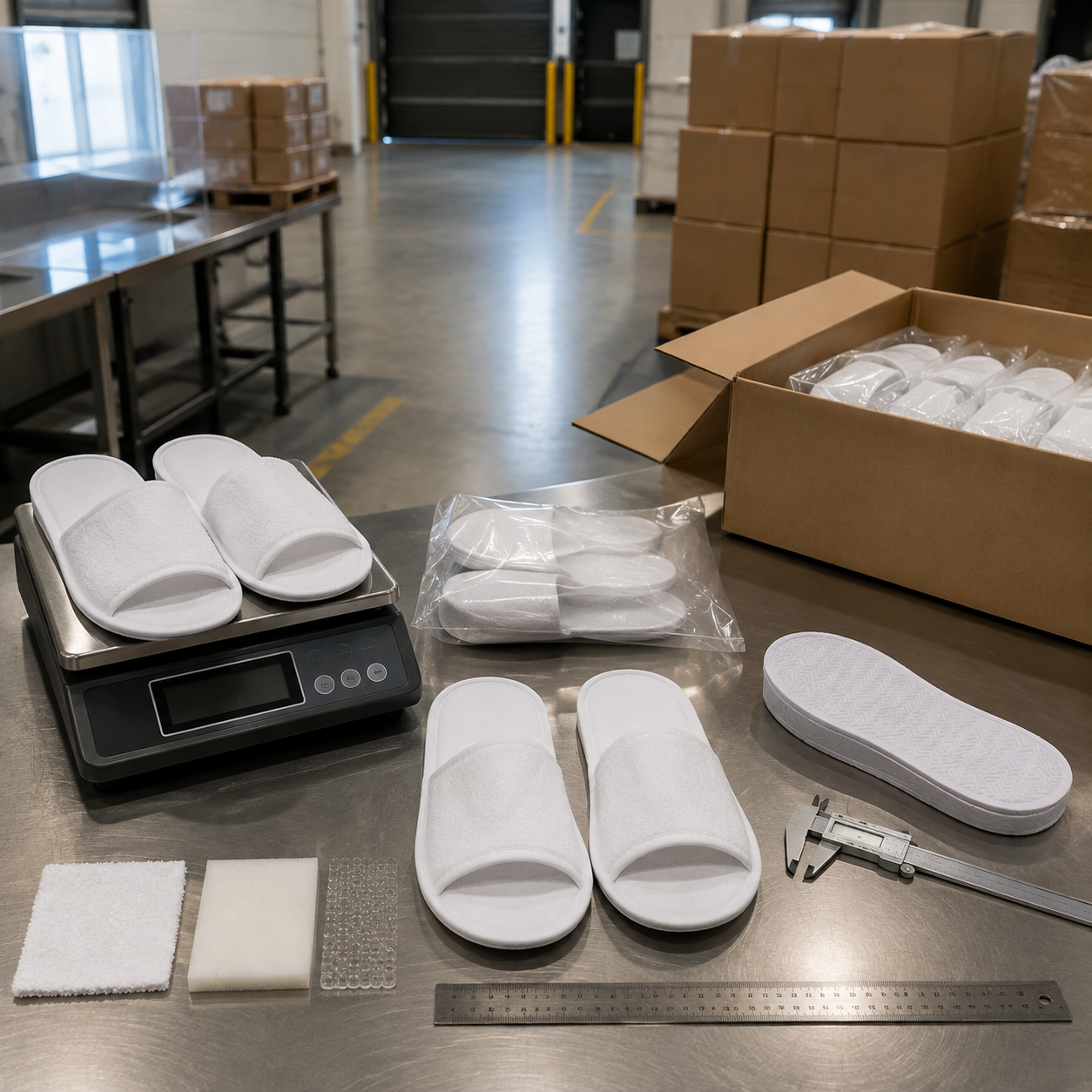
The milestone schedule should reference the same controlled disposable slipper specification through sampling, production, inspection, packing, and freight planning. Suppliers otherwise may be quoting different constructions or provisional shipment data.
| Specification field | Measurable RFQ return |
|---|---|
| Finished length and width | Nominal values, stated units, tolerances, measurement points, tool, sample-selection rule, and disposition for a failed result |
| Sole thickness | Nominal value, stated unit, tolerance, measurement location, compression condition, tool, and disposition rule |
| Pair mass | Nominal value, stated mass unit, tolerance, scale resolution, conditioning assumption, and disposition rule |
| Materials | Upper, lining, sole, binding, and joining-material descriptions, substitution restrictions, and evidence for the offered construction |
| Construction | Open- or closed-toe format, edge finish, joining method, outsole texture, size convention, and color reference |
| Individual packaging | Packaging material, closure method, quantity per pack, artwork revision, and approval status |
| Master carton and pallet | Pairs per carton, arrangement, carton construction, dimensions in stated units, net mass, gross mass, packing variance, and destination handling constraints |
| QC release | Measured characteristics, sample-selection method, defect categories, acceptance or rejection rule, rework authority, and reinspection requirement |
The Mapper wholesale slipper guide identifies terry cloth, EVA soles, and material the publisher describes as non-slip PVC among hotel-slipper material categories. These categories can prompt an offered-material declaration, but they do not establish the composition, dimensions, performance, availability, or compliance status of a quoted disposable slipper. The bidder should substantiate the actual offered construction.
Labeling should be controlled through a matrix covering the product, individual pack, master carton, and pallet where applicable. Record each proposed field, content owner, placement, artwork revision, product scope, supporting basis, reviewer, approval status, and change history. Candidate review fields may include origin, material content, size, responsible-party information, warnings, care content, barcode placement, and carton marks. Their applicability must be determined for the actual product and United States entry; the list does not state that every field is mandatory for every construction.
Do not accept a generic United States compliant statement as evidence. Ask which requirement the supplier intends to address, which product and production scope the evidence covers, who issued the document, and whether it remains current. If a standard is relevant, request its exact title and edition, applicable requirement or test method, tested product identity, report date, result, issuing organization or laboratory, production-site scope, and validity. A standard's requirements are distinct from a supplier's own QC practice. Do not describe a report as certification unless a current document expressly grants certification for the offered product and applicable scope.
Tie Landed Cost to the United States Delivery Endpoint
Compare quotes using the same accepted quantity, currency, quote date, product revision, packaging revision, freight basis, destination event, and responsibility split. Keep firm charges separate from estimates, pass-through items, contingencies, and exclusions.
```text Landed cost per accepted pair = (product + customization + packaging + inspection + origin handling + international freight + insurance + applicable import-related charges + brokerage + domestic delivery + approved contingent charges) / accepted pairs ```
This is a worksheet structure, not a claim that every charge applies to every order. Each line should state:
- Amount or rate basis, currency, and calculation scope.
- Included and excluded service.
- Party responsible for payment and performance.
- Status as firm, estimated, pass-through, contingent, or excluded.
- Quote validity and adjustment trigger.
- Source document and as-of date.
- Classification, duty, tax, or broker assumption requiring buyer review.
When currencies are normalized, record the buyer-approved exchange-rate source, rate, and as-of date. Treat freight as provisional when carton dimensions or weights are provisional. A packaging change that alters shipment data should trigger a revised freight comparison, landed-cost worksheet, and delivery schedule.
The cost and schedule worksheets must use the same handoff points. An expedite or split-shipment option should include a revised milestone schedule, route and capacity evidence, updated charge allocation, and identification of the delayed milestone it is intended to recover.
Use Cited Evidence as RFQ Prompts, Not Shipping Lead Time Benchmarks
The cited commercial pages provide publisher-specific examples and useful RFQ prompts. They do not establish current market benchmarks, another supplier's capacity, or a delivery promise for a United States order.
| Source-supported context | Appropriate RFQ use | Claim boundary |
|---|---|---|
| On the Utop lead-time page displaying June 18, 2026, the publisher's high-volume order example is scoped to 20,000 pairs. | Ask the bidder to state the quoted order quantity in pairs and provide order-linked capacity evidence. | The example does not establish current capacity or another supplier's shipping lead time. |
| On the Utop lead-time page displaying June 18, 2026, a separate material-procurement example is scoped to 20,000 yards of jersey knit or high-gram plush. | Ask for material quantity, unit, reservation status, procurement basis, and supporting evidence. | The material example is separate from the order example and must not be converted into a material-per-pair ratio. |
| On the Utop lead-time page displaying June 18, 2026, the publisher describes its own in-line checks as occurring every 500 units during bulk slipper assembly. | Ask the bidder to define its inspection unit, frequency, selection method, and order-linked records. | The source does not clarify whether a unit is an individual slipper or a pair, so an inspection count should not be inferred. |
| On the Utop lead-time page displaying June 18, 2026, the publisher presents its parallel-line model as changing a 30-day production run into a 10-day production sprint in its stated high-volume context. | Ask for the bidder's duration basis, line allocation, dependencies, and evidence for any claimed overlap. | The source does not identify calendar days versus working days and does not support transferring the duration to another order. |
| On the Union Source page displaying a publication date of June 26, 2025, the publisher states that its own service accepts only orders above US$5,000 in order value. | Ask each bidder for its current commercial threshold, currency, scope, validity, and exception process. | The amount is that publisher's stated service threshold, not a market minimum or another company's policy. |
| The Mapper wholesale slipper guide lists terry cloth, EVA soles, and material described by that publisher as non-slip PVC among hotel-slipper categories. | Use the categories to request an offered-material declaration and supporting evidence. | The categories do not prove the identity or performance of an offered product. |
| The Chantomoo bulk purchasing guide highlights intended use, materials, sizes, colors, packaging, destination, required date, replenishment, and whether shipping, taxes, and duties are included. | Use those fields to normalize product, schedule, and charge responses. | The fields do not verify supplier capacity, charges, delivery commitments, or United States import treatment. |
Recheck the live pages before relying on their commercial details. A displayed publication date provides source context; it is not a quote-validity date or evidence of current availability.
Disposable Slipper Shipping Lead Time RFQ and Award Matrix
| RFQ control | Buyer-defined input | Supplier return | Evidence before award |
|---|---|---|---|
| Quote identity | RFQ revision, requested validity, currency format, and destination | Legal contracting entity, quote revision, validity, assumptions, and exclusions | Matching commercial quote and resolved exception list |
| Product and order scope | Controlled specification, quantity in pairs, variant breakdown, and permitted variance | Exact offered construction, deviations, price basis, and packing scope | Signed specification and dated sample reference |
| Schedule boundary | Required start trigger and United States delivery event | Milestones, duration units, dates, owners, dependencies, and commitment status | Accepted milestone schedule |
| Material and sample status | Required composition, substitution controls, and approval route | Stock or procurement status, reservation, sample type, dispatch status, and rejection effect | Order-linked material confirmation and approval record |
| Labels and packaging | Buyer review fields, artwork ownership, pack configuration, and warehouse constraints | Controlled revisions, open exceptions, carton data, and change effects | Approved artwork, packing specification, and change log |
| Production and QC | Measurement methods, decision rules, release authority, and reporting expectations | Allocation, checkpoints, sample-selection method, defect handling, rework, and reinspection | Allocation confirmation, QC plan, and matching reports |
| Freight basis | Required mode or comparison request and destination handoff | Route, booking owner, capacity status, handoff points, final or provisional shipment data, and validity | Carrier booking, final packing list, and applicable shipment records |
| United States import handoff | Buyer-designated compliance, customs, and broker contacts | Document owner, coordination scope, included services, contingent charges, and exception process | Buyer-reviewed document checklist |
| Final delivery | Named facility, receiving window, appointment process, and handling rules | Appointment owner, unloading scope, delivery window, and acceptance event | Appointment confirmation and delivery record |
| Landed cost | Required worksheet format and destination event | Firm, estimated, pass-through, contingent, and excluded charges with dated source inputs | Reconciled landed-cost worksheet |
| Delay control | Notice contacts, approval authority, and contractual remedy framework | Cause evidence, revised milestones, final-date effect, recovery option, incremental cost, and approval request | Agreed change process and escalation record |
A revised date alone is not a recovery plan. When a milestone slips, the supplier response should identify the cause, affected dependency, revised critical path, effect on the contractual finish event, proposed recovery action, incremental cost, approval required, and supporting evidence.
Before award, attach the accepted schedule, controlled product specification, sample reference, label and packaging revisions, QC plan, responsibility matrix, landed-cost worksheet, exception list, and delay process to the purchase order or governing contract record. Hold award when trigger dates, duration units, material status, release authority, import responsibilities, contingent charges, or destination acceptance remain implicit.
Methodology, Limitations, and Verification
Methodology: The cited pages were evaluated for statements with an identifiable publisher, unit, scope, and displayed date where one was provided. Publisher-specific figures were separated from editorial RFQ controls and were not extrapolated into market benchmarks, another supplier's capacity, a product specification, or an order forecast. Product release, schedule stages, evidence records, and cost fields were aligned to the same requested United States delivery event.
Limitations: The cited commercial pages are not factory audits, current carrier schedules, customs determinations, laboratory reports, legal opinions, or proof of order-specific capacity. Their content, availability, commercial thresholds, and displayed details may change. Mapper's categories do not identify the offered product; Chantomoo's fields do not verify charges; Union Source's stated threshold does not establish another supplier's policy; and Utop's examples do not establish another supplier's duration, inspection plan, or line allocation.
What to verify before award: Confirm the current legal supplier identity, manufacturing site, controlled product and packaging revisions, material declaration, approved sample, proposed labels, production allocation, duration basis, QC plan, release authority, final carton data, carrier booking, document responsibilities, cost inclusions, and destination appointment. Request current supporting test or certification documents only where relevant, and verify that each document matches the offered product, production scope, named requirement, issuer, date, and validity. The buyer's designated United States compliance, customs, legal, and logistics professionals should review final classification, marking, entry, duty, documentation, and contract decisions for the actual transaction.
Author basis: The Vincent Xi author profile identifies Vincent Xi as Editorial Author. This article does not attribute factory visits, product tests, certification assessments, shipment results, customer outcomes, or other first-person experience claims to him.
Discuss Your Requirements
Review our manufacturing capabilities, then share your specifications for a supplier-fit review.