Disposable Slipper Wholesale Supplier Compliance Requirements for United Arab Emirates Buyers
By Vincent Xi, Editorial Author
For a United Arab Emirates RFQ, supplier approval should remain on hold until the quoted legal entity and manufacturing site are tied to a controlled disposable slipper specification, an identified reference sample, claim-specific evidence, contractual bulk-quality rules, approved packaging artwork, confirmed transaction documents, a normalized landed-cost comparison, and assigned delivery responsibilities.
A low unit price, an acceptable-looking sample, or a folder of certificates does not complete that review. The buyer still needs to reconcile the supplier, site, product, sample, report, batch, artwork, and purchase-order identifiers. Unexplained mismatches should stop approval, as should undocumented substitutions, subjective acceptance language, unsupported product claims, or unresolved shipment responsibilities.
These compliance requirements are buyer-set procurement controls unless the UAE importing entity confirms a transaction-specific legal or customs obligation from an appropriate current source. The supplied commercial sources provide limited material, construction, and wholesale-sourcing context. They do not establish UAE law, assess a particular supplier, or prove that a quoted product is compliant.
United Arab Emirates Compliance Requirements for Supplier Approval
Use a release matrix that prevents unresolved evidence from passing silently into production or shipment.
| Approval gate | Record required from the supplier | Buyer verification | Hold condition |
|---|---|---|---|
| Supplier and site identity | Quoted legal entity, invoicing entity, manufacturing-site address, quality contact, dispatch point, and disclosed subcontracted processes | Reconcile names and addresses across the quotation, supporting records, invoice plan, and purchase order | An entity or site mismatch is unexplained, or the production location is not disclosed |
| Product definition | Buyer SKU, supplier model, specification revision, component schedule, construction, dimensions, tolerances, packaging, and artwork status | Use the same identifiers in the quotation, sample record, evidence register, inspection plan, and purchase order | The offer relies on vague grades, undocumented equivalents, or incomplete measurement methods |
| Reference sample | Unique sample identifier, sample status, materials used, known deviations, and linked specification revision | Record whether the sample was handmade, made on normal equipment, or taken from a production trial | The sample is generic, unidentified, or materially different from intended bulk production |
| Claims and supporting documents | Exact claim wording, document owner, issuer, scope, product identity, site where relevant, method, result, date, and current status | Match each document to the quoted SKU, construction, manufacturing relationship, and intended claim | Evidence is incomplete, out of scope, no longer current, or linked to another product, component, entity, or site |
| Bulk-quality control | Lot definition, sample-selection method, defect classes, product-specific defect examples, acceptance rules, reporting, correction, and reinspection terms | Incorporate the agreed controls and remedies into the purchase order | Acceptance remains subjective, or failed results can be released without documented correction and reinspection |
| UAE transaction file | Draft labels, shipping marks, commercial documents, origin evidence when applicable, and proposed classification information | Obtain transaction-specific confirmation from the UAE importing entity and its appointed broker or qualified adviser | Applicable fields, documents, responsibilities, or artwork remain unconfirmed |
| Commercial and shipment release | Normalized quote, approved pack-out, final artwork, batch-linked inspection result, reconciled documents, and responsibility matrix | Match shipment records to the purchase order, SKU, batch, quantity, and agreed delivery boundary | Inspection, artwork, documents, cost exclusions, or delivery responsibilities remain unresolved |
Classify each requested item by its actual basis:
- UAE transaction requirement: Record the confirming authority or qualified party, current source, applicability, and confirmation date in the order file. A supplier template is not confirmation.
- Buyer contractual control: State the requirement in the RFQ and purchase order without describing it as UAE law.
- Voluntary product claim: Require evidence that covers the quoted SKU and intended wording. Remove or narrow the claim when traceability is incomplete.
- Supplier routine: Treat an internal target or customary inspection practice as background unless the buyer adopts it contractually.
No technical standard is named because the supplied evidence does not establish one as applicable to the final construction or UAE transaction. If a supplier proposes a standard, record its exact title, edition, applicable clause or test method, and intended role. Keep the standard's stated requirement separate from the buyer's acceptance rule and the supplier's internal practice. Do not describe a supplier or product as certified unless a current document has been checked for issuer, holder, site, product scope, referenced standard, status, and validity.
Source Context and Evidence Boundaries
The supplied pages support only the uses shown below.
| Source context | Supported use in this article | Unsupported inference to avoid |
|---|---|---|
| Hotel-slipper material and sole guidance | Attributed commercial descriptions of non-woven, terry, waffle, and velour options, plus general considerations involving flexibility, slip control, durability, optional EVA cushioning, and intended climate | UAE legal requirements, tested performance, supplier capability, or compliance of a quoted product |
| Slipper construction and channel context | Construction vocabulary covering injection-moulded, bonded, and stitched approaches, with references to non-woven and terry materials in disposable hotel-slipper contexts | The process used by a quoted supplier, its production capacity, its quality system, or product conformity |
| Sample-to-bulk wholesale sourcing context | The procurement principle of defining materials, size, branding, packaging, sampling, and bulk quality controls instead of relying only on price or sample appearance | Disposable-slipper test evidence, UAE law, an independent supplier assessment, or proof of a supplier outcome |
Practical RFQ Checklist for United Arab Emirates Orders
Attach this checklist to the RFQ and require the supplier to answer every item. An unanswered item should remain open rather than being treated as accepted.
- [ ] Parties and destination: Name the United Arab Emirates importing entity, quoted legal entity, invoicing entity, manufacturing site, dispatch point, quality contact, and any subcontracted process.
- [ ] Product identity: Assign the buyer SKU, supplier model, specification revision, style, color, toe and heel construction, intended use, and unit of measure.
- [ ] Components: Request supplier material codes and available technical records for the upper, lining, padding, binding, thread, adhesive, and sole. Prohibit undocumented equivalents.
- [ ] Construction: Record whether the product is stitched, bonded, moulded, or uses a combined method. Identify seam and bond locations and confirm the intended bulk-production process.
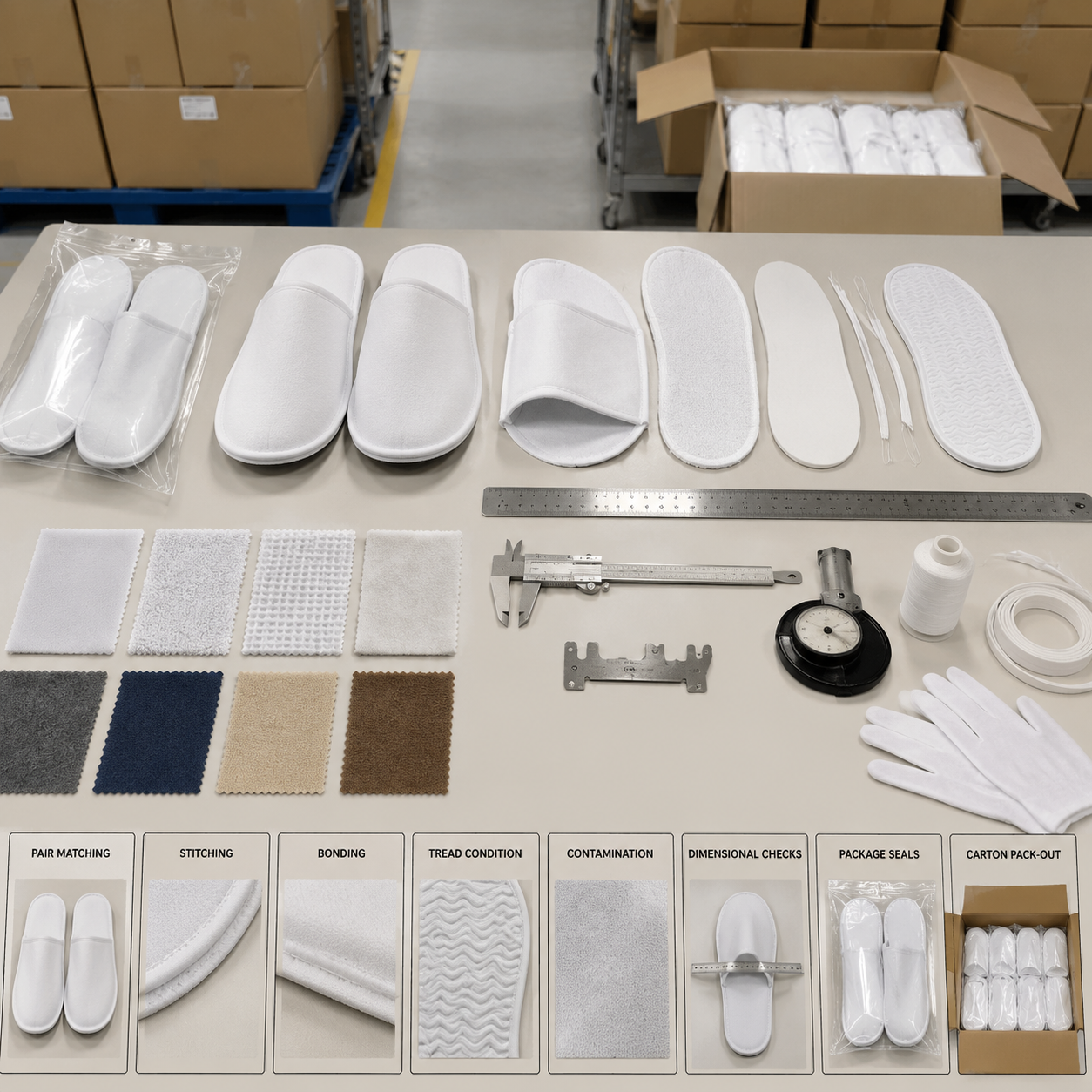
- [ ] Measurable characteristics: Define finished length, forefoot width, sole thickness, pair matching, and product mass when controlled. Give each characteristic a unit, tolerance, measurement point, tool, product condition, and method.
- [ ] Reference sample: Assign a unique sample identifier and record its specification revision, materials, production method, status, known deviations, and approval decision.
- [ ] Packaging and artwork: Specify unit-pack material, seal method, pack count, carton construction, dimensions, weights, loading arrangement, shipping marks, and editable artwork. Require approval before bulk printing or packing.
- [ ] Claims and evidence: List each requested claim exactly and require supporting evidence linked to the quoted SKU, relevant component, manufacturing relationship, method, result, issuer, date, and current status.
- [ ] Bulk QC: Define the production lot, sample-selection method, defect classes, product-specific defect examples, acceptance rules, measuring tools, report format, correction process, reinspection responsibility, and release authority.
- [ ] Traceability and changes: Require batch identification, component-lot linkage, record retention, deviation handling, and advance written approval for any material, source, site, process, dimension, claim, or artwork change.
- [ ] Commercial response: Itemize goods, packaging, samples, artwork or tooling, testing, inspection, origin-side charges, freight, insurance, document fees, payment terms, validity, and exclusions. State the trade term with its named place and edition.
- [ ] UAE transaction documents: Return draft labels, shipping marks, commercial-invoice and packing-list formats, origin evidence when applicable, proposed classification information, and a document-responsibility matrix for importer review.
- [ ] Delivery and release: Show material availability, approval dependencies, production window, inspection timing, corrective-action allowance, document deadlines, booking responsibility, dispatch estimate, required UAE arrival window, and remedies for delay or failed inspection.
- [ ] Final approval: Release production or shipment only after the supplier identity, specification, reference sample, evidence register, artwork, inspection result, documents, landed-cost comparison, and delivery responsibilities have been reconciled.
A numeric specification is incomplete without a repeatable method. For finished length and forefoot width, define the reference points, product condition, measuring tool, tolerance, and reporting unit in millimetres per slipper. For sole thickness, identify each measurement location and any compression applied by the tool. If pair mass is controlled, state whether packaging is included, the scale resolution, the conditioning method, the reporting unit in grams per pair, and the tolerance. Carton records should define pairs per carton, dimensions in millimetres, net and gross mass in kilograms, orientation, and measurement method.
The hotel-slipper source characterizes non-woven fabric as lightweight and budget-oriented for disposable use, terry as absorbent for bathroom use, waffle fabric as breathable, and velour as a premium-feel option (material and sole guidance). These are attributed commercial descriptions, not test results or UAE requirements. The supplier must identify the actual material proposed for the quoted SKU and provide the corresponding technical information.
The construction source distinguishes injection-moulded, bonded, and stitched approaches (construction context). Use that vocabulary to obtain an accurate supplier declaration. The source does not establish which process a quoted manufacturing site uses or whether that process meets the buyer's acceptance rules.
Sample, Claim, and Bulk QC Compliance Requirements
The approved reference sample should be linked to the final SKU, specification revision, component schedule, construction map, artwork revision, and approval record. Its status matters: a development sample may record an appearance choice, but it is not evidence of normal bulk consistency when it was handmade, produced with different materials, or made outside the intended production process.
For each proposed performance, hygiene, composition, or environmental claim, create an evidence-register row containing the exact wording, product identifier, component identifier where relevant, manufacturing-site relationship, sample or batch identity, method and edition where applicable, test conditions, result, issuer, report date, current status, and buyer decision.
| Proposed claim type | Evidence questions | Release control |
|---|---|---|
| Slip-related performance | Which sole, tread, floor substrate, wet or dry condition, conditioning process, method, result, and tested sample are covered? | Do not convert tread appearance or a manual flexibility check into a slip-safety claim |
| Antibacterial or odor-related performance | Which treatment, component, organism or odor protocol, method, test condition, result, and retained effect are covered? | Remove the claim when the proposed wording or quoted construction exceeds the evidence scope |
| Recycled content | Which component, calculation boundary, chain of records, issuer, and batch relationship support the proposed value? | Do not print or publish a value until its evidence chain has been verified for the quoted SKU |
| Biodegradability or a similar environmental claim | Which material, environment, time basis, method, result, and disposal condition does the evidence address? | Use only wording that matches the documented scope; otherwise omit the claim |
| Certification | Who is the holder, which site and activity are in scope, which standard and edition are referenced, and is the document current? | Do not infer product certification from a site, system, component, or unrelated document |
Bulk inspection terms should define the production lot, sample-selection method, defect classifications, product-specific examples, acceptance rules, measuring tools, test conditions, photo requirements, report format, correction process, reinspection responsibility, and final release authority. Relevant defect categories for the buyer to define may include contamination, stains, open stitching, bond separation, exposed padding, distorted shape, pair mismatch, dimensional nonconformity, damaged packaging, and incorrect artwork.
The wholesale sourcing page supports the limited principle of carrying material, size, branding, packaging, sample, and quality-control requirements into bulk production (sample-to-bulk sourcing context). It is not treated as disposable-slipper test evidence or an independent supplier assessment.
Any sampling standard and acceptance setting must be selected and incorporated by the buyer. A supplier's customary inspection method does not automatically become a contractual requirement. Inspection records should identify the purchase order, SKU, production batch, lot definition, inspected quantity, findings, disposition, and responsible approver. Failed results require documented correction and reinspection before shipment release.
UAE Label, Import, Climate, and Delivery Compliance Requirements
Treat normal supplier label and shipping-document templates as drafts. The UAE importing entity and its appointed customs broker or qualified adviser should confirm which product description, classification, label fields, language, origin statement, declaration, and supporting documents apply to the final construction, intended channel, manufacturing origin, and shipment.
Require the supplier to return:
- Editable unit-label, individual-pack, carton-label, and shipping-mark artwork for approval.
- The proposed SKU, product description, material description, pack count, carton data, manufacturing-origin field, and batch field.
- Draft commercial-invoice and packing-list formats reconciled with the quotation and purchase order.
- Origin evidence, transport documents, or declarations when the importing entity confirms they apply.
- A responsibility matrix naming the preparer, reviewer, due point, and recipient for each document.
- Written confirmation that bulk printing and packing will wait for final artwork approval.
The supplied commercial sources do not establish that a particular label field, language, tariff treatment, certificate, or conformity route is mandatory in the UAE. Retain the importer's transaction-specific confirmation and its current supporting source in the order file.
The hotel-slipper material source advises considering the intended climate (material and climate context). It does not provide UAE-specific temperature or humidity limits for a proposed product. The RFQ should state the actual transit, warehouse, and use conditions, then request documented storage ranges for the proposed upper, adhesive, sole, and packaging. Any limits should be traced to supplier technical records and verified for the final construction.
Delivery control should connect sample approval, artwork approval, material availability, production, inspection, corrective action, document preparation, freight booking, dispatch, and the required UAE arrival window. The purchase order should assign responsibility for unavailable materials, failed inspection, delayed documents, missed booking, and proposed substitutions. A visually similar replacement remains an unapproved change when it differs from the locked specification.
Normalize Landed Cost for the UAE Supplier Decision
Request every included and excluded cost associated with goods, individual packaging, export cartons, artwork or tooling, samples, claim-specific testing, inspection, origin-side transport, freight, insurance, document preparation, destination handling, clearance, confirmed duty or tax, local delivery, rejection, rework, and delay. Record the agreed trade term, named place, and edition so each offer uses the same delivery boundary.
The following figures are buyer-created assumptions and arithmetic results for one hypothetical UAE RFQ dated 1 March 2025. That date, every input, and every result are illustrative rather than observed market data. Each value must be replaced or verified using the actual supplier quotation, approved pack-out, and current freight offer.
| Example item | Value and scope | Source, as-of context, and verification |
|---|---|---|
| Order quantity | 24,000 pairs for the complete hypothetical UAE order | Buyer-created assumption as of 1 March 2025; verify in the supplier quotation |
| Export pack-out | 100 pairs per export carton across the complete hypothetical UAE order | Buyer-created assumption as of 1 March 2025; verify against the approved physical pack-out and supplier quotation |
| Carton count | 240 export cartons for the complete hypothetical UAE order, calculated as 24,000 pairs per order divided by 100 pairs per carton | Buyer-created calculation as of 1 March 2025; verify against final carton records |
| Goods-price input | USD 0.72 per pair across the complete hypothetical UAE order of 24,000 pairs | Buyer-created assumption as of 1 March 2025; verify in the supplier quotation |
| Goods subtotal | USD 17,280 for the complete hypothetical UAE order, calculated from 24,000 pairs multiplied by USD 0.72 per pair | Buyer-created calculation as of 1 March 2025; verify in the commercial comparison |
| Freight input | USD 2,400 for the complete hypothetical UAE shipment | Buyer-created assumption as of 1 March 2025; verify in a current freight offer for the agreed delivery boundary |
| Goods-plus-freight result | USD 19,680 for the complete hypothetical UAE shipment, equal to USD 0.82 per pair across 24,000 pairs, using only the example goods and freight inputs | Buyer-created calculation as of 1 March 2025; verify every input and omitted cost before use |
Use this comparison structure:
Normalized landed cost per accepted pair = all included order-level and unit-level costs / quantity of accepted pairs
Use accepted pairs rather than dispatched pairs when rejection or rework reduces the usable quantity. The example excludes insurance, testing, inspection, clearance, destination handling, confirmed duty or tax, local delivery, rejection, rework, and delay. The supplied evidence contains no UAE tariff, tax, clearance, or destination-charge values, so those transaction-specific inputs must come from the importing entity and its appointed broker or qualified adviser.
Methodology, Limitations, and Author Basis
The methodology was to extract only the commercial observations explicitly supported by the linked sources, classify their scope, and convert them into RFQ questions, evidence fields, comparison rules, and buyer-controlled release conditions. The material and sole guidance supports the attributed material-selection and climate-consideration context. The construction context supports the construction vocabulary. The sample-to-bulk sourcing context supports the limited procurement principle of carrying specifications and approvals into bulk-quality controls.
The landed-cost values were derived only through the multiplication and division shown in the example table. They are assumptions for the stated hypothetical RFQ date, not supplier facts, market benchmarks, legal thresholds, forecasts, or recommendations.
The supplied pages are commercial sources. They are not official UAE sources, independent laboratory reports, supplier audits, current certificates, or proof of a quoted product's compliance. The evidence does not establish a definitive UAE product classification, mandatory label content or language, tariff or tax treatment, conformity route, restricted-substance limit, required test method, storage threshold, or customs-document list for the proposed disposable slipper. Verify those matters for the final construction, claims, manufacturing origin, intended channel, shipment route, and importing entity.
No supplier registration file, current certificate, factory audit, independent product test, approved artwork, production record, freight offer, or shipment inspection was supplied. No supplier or product is therefore declared compliant. Document validity, holder, site, product scope, batch relationship, and current status remain transaction-specific verification items.
Author and experience basis: SlipperForge's author profile identifies Vincent Xi as Editorial Author. The approved profile provides no basis for a first-hand factory visit, product test, audit, certificate review, customer outcome, or UAE import-transaction claim, so none is made.
Discuss Your Requirements
Review our manufacturing capabilities, then share your specifications for a supplier-fit review.